
Perhaps my grandmother’s younger brother’s understanding of help should not have surprised me as much as it did.
Long before I understood reciprocity, collective responsibility or Ubuntu as ideas, I had already encountered something similar in my own home.
My first lesson about collective responsibility came long before I had the words to describe it.
I was still in primary school.
My mother occasionally found odd jobs. Whatever she earned was not much, and what she had was already insufficient for the needs of her own children.
But whenever she had something, she did something that puzzled me.
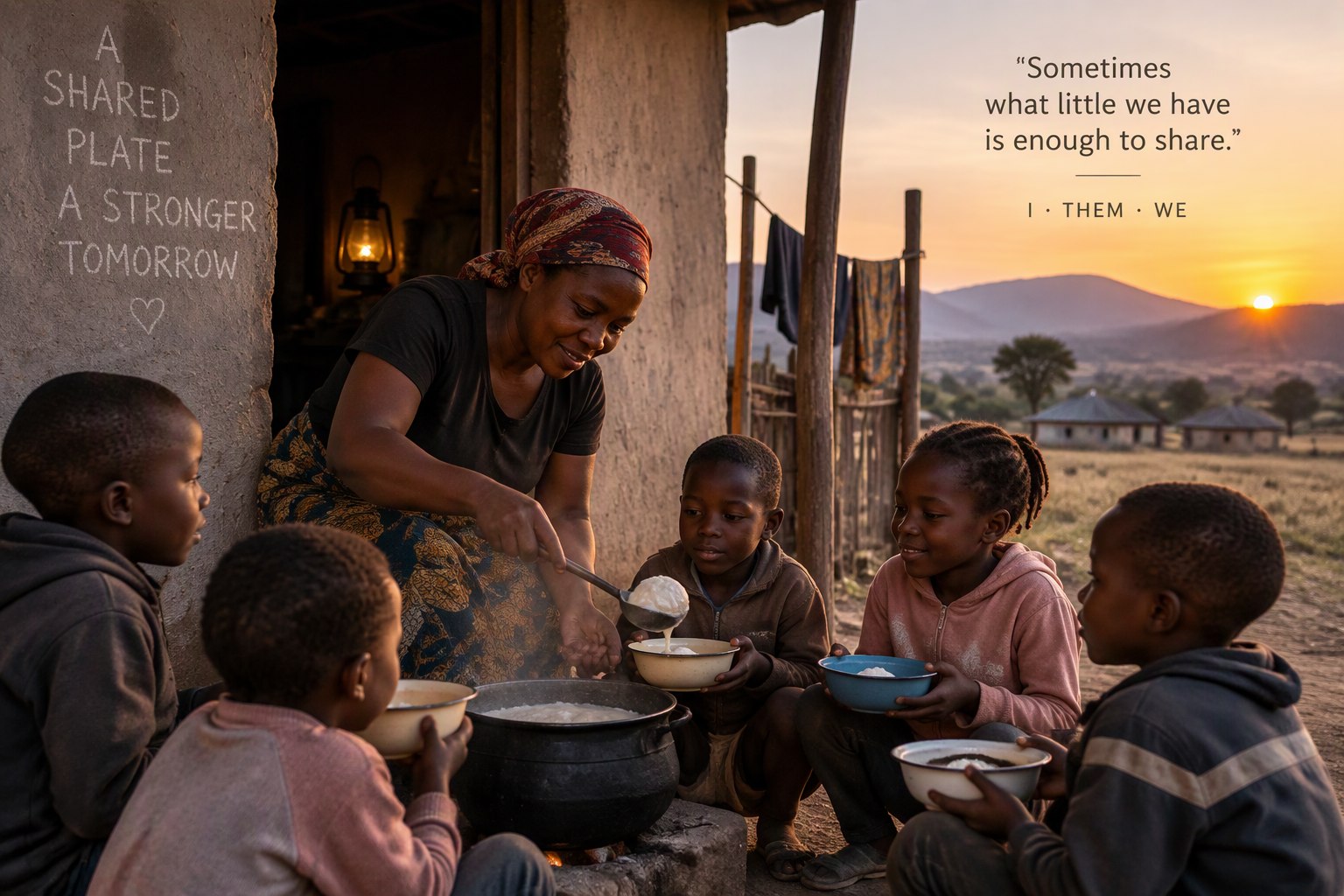
She shared her limited resources not only between me and my sister, but also with the children of her older brother.
One day, I asked her why.
Why, when she had so little, would she divide it further among children who were not hers?
I had seen other people concentrate only on their own children.
My mother became angry.
She told me that if I was developing that kind of mentality, she would rather not do anything for me.
I quickly explained myself.
I was not telling her to stop helping them. I was curious. I wanted to understand why she chose to do it when I could see other people behaving differently.
Her answer was simple.
Those were her brother’s children.
She regarded them as part of her responsibility too.
Whatever little she had was to be shared between me, my sister, and them.
Then came the part that stayed with me.
She effectively told me:
Ignore what other people are doing.
At the time, I thought I was asking about money.
Looking back, I think she was answering a much bigger question about character.
There is the “I”.
I have needs. I have responsibilities. My own survival matters.
Then there is “them”.
Other people also have needs. But it is easy to place those needs outside the boundaries of our responsibility.
Then there is “we”.
The we emerges when the boundary between my problem and their problem becomes less rigid.
My mother did not wait until she had abundance before sharing.
More importantly, she did not make her behaviour dependent on what other people were doing.
That does not mean that a person should help others at the expense of their own survival. Boundaries still matter, especially when generosity can be exploited.
But there was another principle underneath what my mother was teaching me:
Other people should not automatically determine who I become.
If somebody else does not help, I still have to decide what my own values require of me.
If somebody treats me badly, I still have to decide who I am going to be in response.
At primary school, I did not know that this small conversation would follow me into adulthood.
Years later, I would have to confront the same philosophy under very different circumstances.
Join the conversation
Should the willingness to help others depend on whether they would do the same for us?

Leave a Reply