
I grew up in Tshivhulani, a village outside the small town of Sibasa. I attended Tshivhulani Primary School and later Nthetsheleseni Secondary School. However, much of what shaped my understanding of life came from outside the classroom.
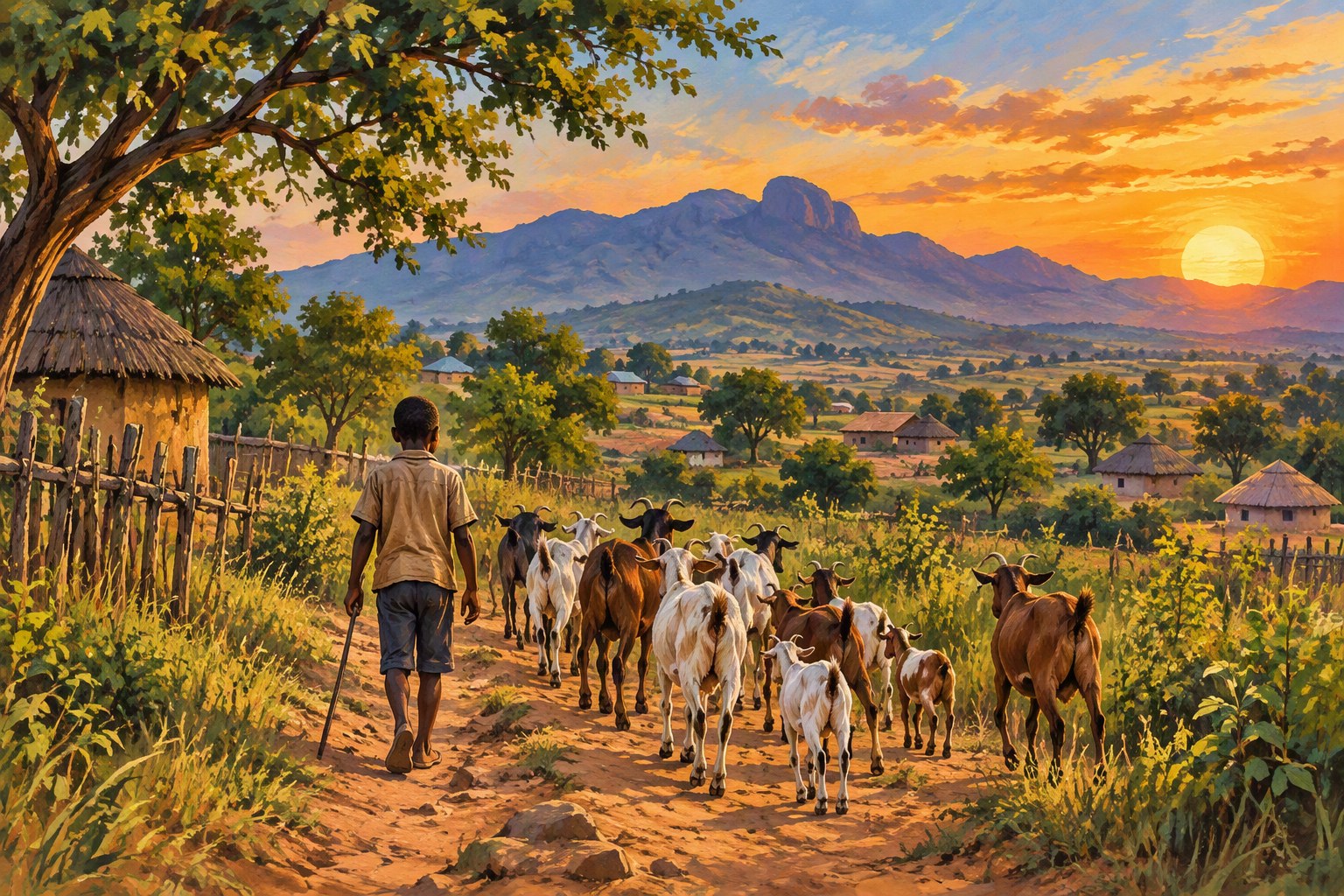
Growing up as a young boy in the village, you looked up to the older boys. After school, they would take the livestock, mainly goats and cattle, out to graze. As a younger boy, you admired them, but you were not yet allowed to follow. Their world seemed adventurous and somehow beyond your age.
Then, almost without noticing it, you became old enough to tag along.
That opened another world. You began to experience the life of a herder: moving through the landscape with livestock, learning where animals could graze and, at the same time, discovering the veld for yourself. There was responsibility, but there was also freedom. You learned to balance looking after the animals with playing, exploring, and foraging for wild fruits and berries.
Eventually, another transition occurred. The older boys outgrew the responsibility, and suddenly you were no longer merely tagging along. The livestock had become your responsibility.
Herding was only one part of village life. There was water to collect from communal taps and boreholes, gardens to tend and subsistence maize farming to participate in. Farming followed the seasons: preparing the land, tilling the soil, planting after the first summer rains, weeding as the crops grew, and harvesting during winter.
Yet childhood was not simply a catalogue of responsibilities.
There was always play.
Street soccer required little more than an open space and something that could serve as a ball. Toys did not necessarily come from shops. Wire and other available materials could become handcrafted cars, giving children the opportunity not merely to play with things, but to make the very things they played with.
And all of this had to coexist with other obligations: doing chores for elders, participating in cultural and social life, attending initiation school and, throughout it all, continuing with formal schooling.
Looking back, I realise that these activities were doing more than keeping a village boy occupied.
They were teaching.
Herding taught responsibility before I had a word for it. Exploring the grazing lands taught me to observe landscapes long before I encountered geography as an academic discipline. Farming made seasons, rainfall, soil and vegetation part of lived experience rather than abstract concepts. Making our own toys encouraged imagination and improvisation. Responsibilities towards elders placed the individual within a wider social world.
Formal schooling was therefore not the beginning of learning. It was another form of learning added to those that already existed.
Perhaps this is where The Philosophy of a Village Boy begins.
It begins with the possibility that a village is not simply a place from which one comes. It can also be a place from which one thinks.


Leave a Reply