
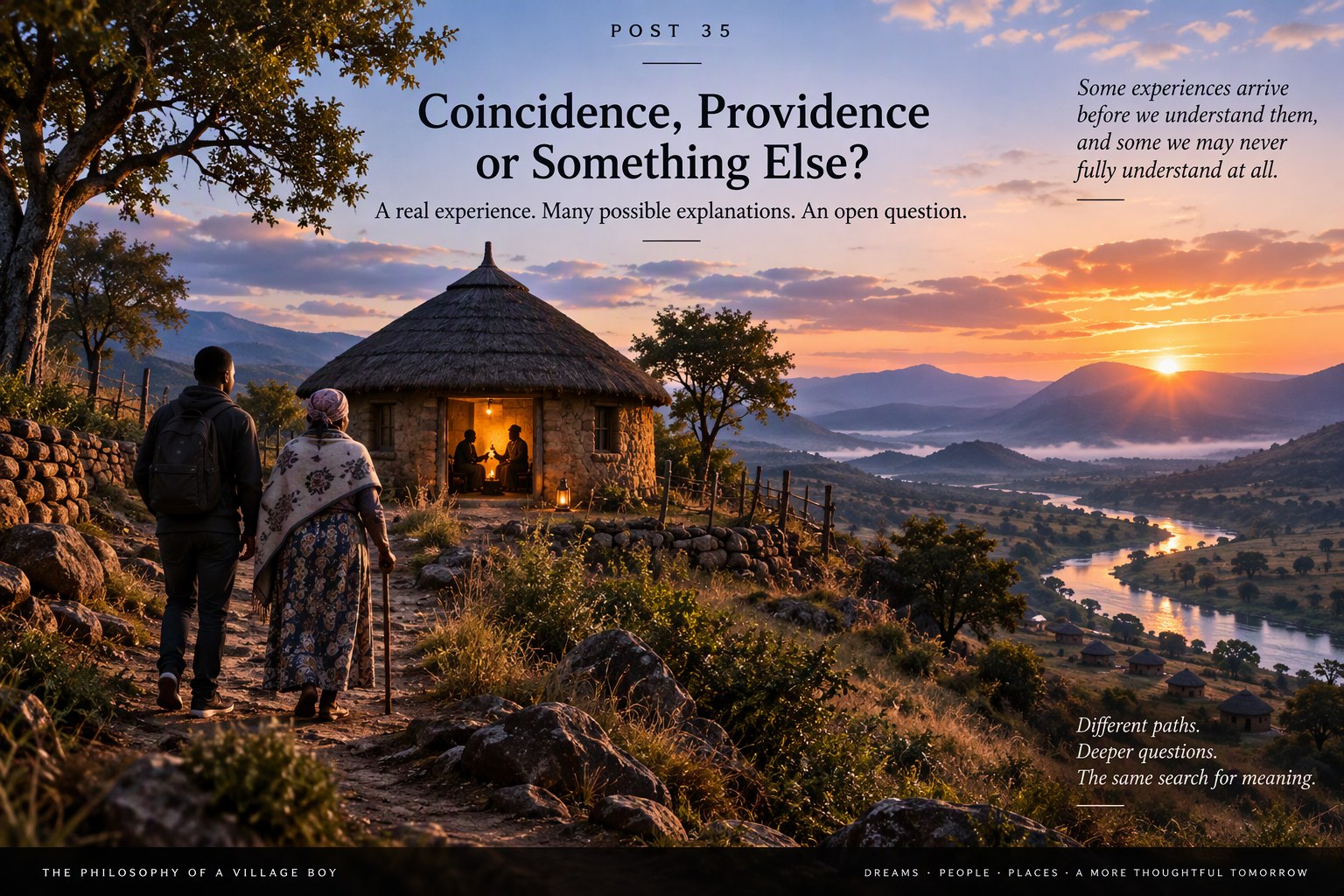
Looking backwards at this period of my life presents me with a problem.
It is not simply a problem about whether dreams can carry messages.
It is a problem about knowledge.
How much can I honestly claim to know about something simply because I experienced it?
The temptation to construct a clear explanation is strong.
The pieces are there.
I was living with uncertainty.
I had a dream involving a great-grandfather I had never met.
My grandmother recognised the description of her father.
The message said that everything would be alright.
Later, I submitted my final PhD thesis for external examination.
My temporary employment reached what I believed was its end.
I gave away my belongings and went home.
I was unexpectedly called back.
Before the new contract was properly finalised, an invitation for a permanent position arrived on my actual birthday.
Permanent employment followed.
Placed together, those events begin to look like a pattern.
But is a pattern the same thing as an explanation?
I don’t think so.
Could It Have Been My Great-Grandfather?
Someone approaching my experience through African spirituality might not find the dream particularly difficult to interpret.
My great-grandfather wanted to reassure his daughter.
I became the messenger.
The traditional healer in the dream was simply the person through whom the message was communicated.
From that perspective, perhaps the strongest part of the story is not even what happened afterwards.
It is the description.
How did I describe a man I had never met?
The spiritual answer would be straightforward:
Because the message came from him.
I understand why someone would reach that conclusion.
I have considered it myself.
But does an explanation fitting the experience mean that the explanation has been proven?
I don’t think I can go that far.
What About God?
A Christian could look at exactly the same events and interpret them differently.
The answer would not necessarily be my great-grandfather.
It could be God.
The right people appeared at different stages of my journey.
Opportunities emerged.
The PhD moved towards completion.
Temporary employment carried me through another uncertain period.
Permanent employment eventually came.
A Christian could look at that sequence and see providence.
Again, I understand the interpretation.
But understanding an interpretation is different from proving it.
What About the Mind?
There is another possibility.
Perhaps I had heard descriptions of my great-grandfather somewhere earlier in my life.
Maybe something was said when I was young.
Maybe I saw something.
Maybe I consciously forgot the source while the information itself remained somewhere in my memory.
The human mind is capable of retaining information without always remembering where that information came from.
Perhaps the uncertainties surrounding the PhD and employment gave the dream its emotional significance.
Then, when circumstances later improved, the dream became even more important to me.
That explanation cannot simply be dismissed either.
Or Was It Chance?
Perhaps none of these events were connected.
I had spent years working towards the PhD, so eventually submitting the thesis was the result of that work.
I had been applying for permanent employment, so eventually receiving an interview invitation was possible.
Temporary contracts sometimes get extended.
An interview invitation had to arrive on some date. It happened to arrive on my birthday.
Perhaps each event had its own explanation.
Then afterwards, I connected them into a story.
That is possible.
But there is something about the word chance that I also find interesting.
Sometimes humans use the word as though naming something as chance has explained what happened.
Has it?
Or does it sometimes simply mean:
I do not know of any causal connection between these events?
Those are not necessarily the same statement.
If I cannot prove ancestral intervention, that does not automatically prove coincidence.
If I cannot prove divine intervention, that does not automatically establish a psychological explanation.
And if science cannot currently establish a supernatural explanation for an experience, that does not mean that science has therefore demonstrated that the experience was meaningless.
Perhaps sometimes the evidence simply does not allow a conclusion.
What Can I Honestly Say?
This is where I return to the facts of my own experience.
I can say that I had the dream.
I can say that I called my grandmother first thing the following morning.
I can say that I described her father.
I can say that she recognised the description.
I can say that neither of us understood the message at the time.
I can say that several important things in my life subsequently changed.
What I cannot establish with the same confidence is why those things happened in that particular sequence.
That is where interpretation begins.
Perhaps my great-grandfather communicated with us.
Perhaps God was working through circumstances I could not see.
Perhaps my subconscious mind produced something extraordinary from information stored somewhere in my memory.
Perhaps coincidence assembled a sequence that only appears meaningful when viewed retrospectively.
Or perhaps there are possibilities that I have not even considered.
I don’t know.
And perhaps “I don’t know” is not a weak answer.
It may be the most honest one.
I cannot say with certainty that my ancestors communicated with me.
But I also cannot honestly dismiss my experience simply because I cannot prove its explanation.
There is a difference between saying:
“I cannot prove this.”
and saying:
“Therefore, this could not have happened.”
The first recognises the limits of my knowledge.
The second goes beyond those limits.
Perhaps this is where I have become comfortable leaving some of these experiences.
Not with certainty.
Not with disbelief.
With an open question.
Because perhaps there are things humans experience long before they understand what those experiences mean.
And perhaps there are some things we may never understand at all.
Join the conversation
When personal experience feels compelling, but its explanation cannot be proven, should we believe it, dismiss it, or simply have the humility to say, “I don’t know”?
Leave a Reply