
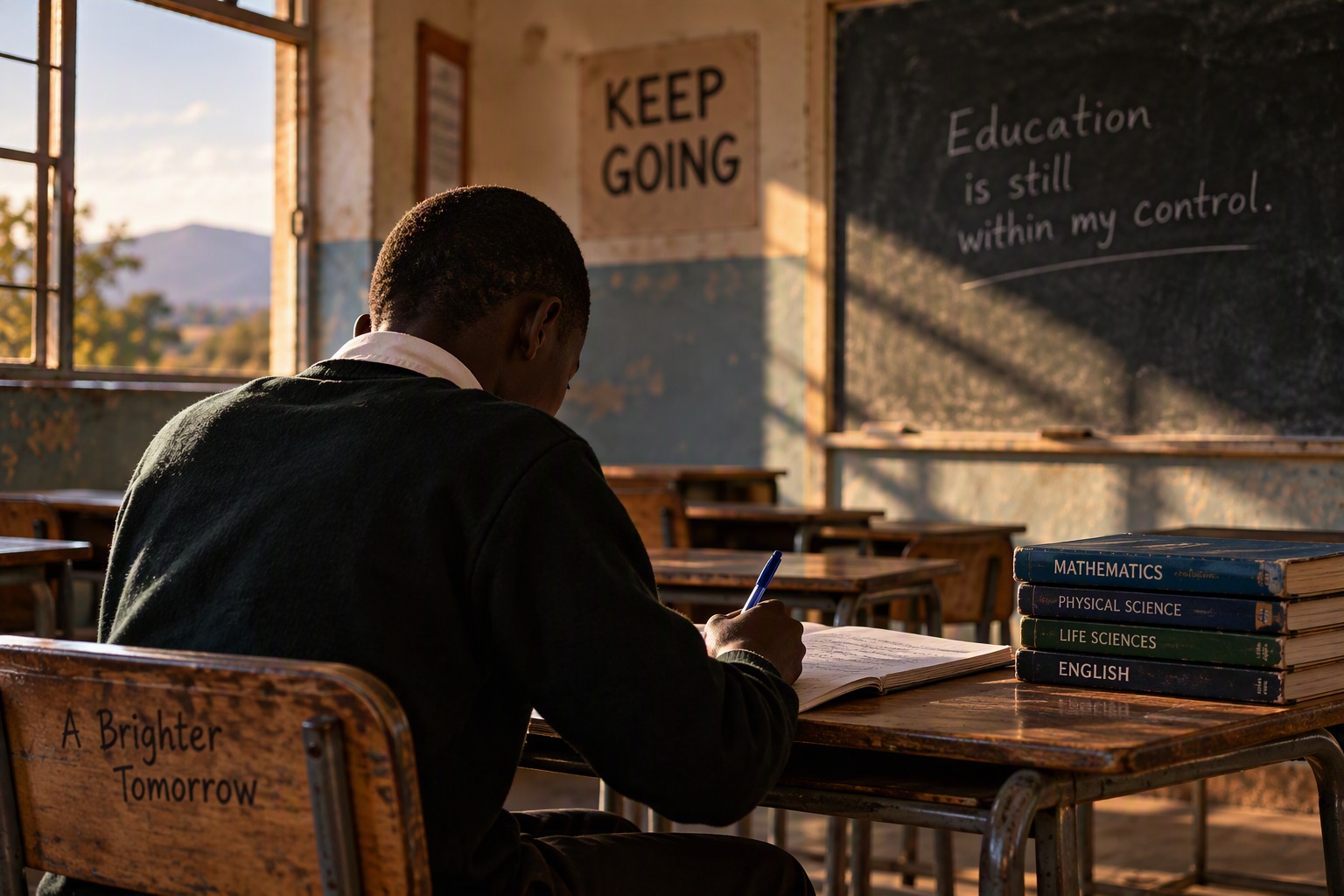
Continuing from Post 5, where my uncle had told me that “the situation is now in your hands,” the situation was about to become even more difficult.
The following year, I was in matric.
Until then, there was at least one thing I had always been able to depend on. My grandmother had taken us to school and paid our school fees from primary school through secondary school. She had also provided us with lunch money.
But during my matric year, my grandmother decided that she was no longer responsible for paying my school fees.
Once again, I accepted the situation.
And it was during this period that I remembered the words of my late grandfather. May his soul rest in peace.
“U Do Vhona Iwe”
Growing up, whenever I felt that I was being excluded or unfairly treated, I would go to my grandfather. I would report the injustice to him and cry.
He would almost always respond with the same words.
In Tshivenda, he would say:
“Fhumula uri hwi iwe, u litshe heya manwe mamange heya, u do vhona iwe.”
Loosely translated into English:
“You just stop crying and stop fussing about these people. You will see.”
Those words comforted me because of the sincerity with which he said them. He spoke almost as though he knew something I did not, as though he knew what the future held and that, somehow, everything would eventually be okay.
I did not necessarily understand what he wanted me to “see.”
But I trusted his words.
So when my grandmother decided not to pay my school fees, I remained composed and focused on my path. I did not use it as an excuse to quit school. I did not quarrel with my uncle or my grandmother.
I accepted that these people did not owe me the future I wanted.
And at that particular moment, there was still one thing I could do.
I could go to school.
So I went to school, even though my school fees had not been paid.
The Unpaid School Fees
Early in the second quarter of my matric year, one of the teachers came to my classroom and called me outside.
He reminded me that I had not paid that year’s school fees.
I acknowledged the fact and assured him that I would get the matter sorted out as a matter of urgency.
But I knew very well that I was unlikely to follow through with that promise.
I did not have a solution.
I returned home later that day and told nobody about the conversation. My grandmother had already made her position clear. There was no reason to disturb her peace by reopening a matter she had already decided.
So once again, I accepted the situation.
And I went back to school.
That was the only part that remained within my control.
As you may probably have guessed by now, like some of the other hopeless situations I had encountered, this one eventually took an unexpected turn.
A few months later, one of the teachers was accused of misappropriating school funds. The matter became an issue involving the School Governing Body and parents.
After that, nobody followed up with me about my outstanding school fees.
The reminders simply disappeared.
I was spared the embarrassment of repeatedly being called aside to explain why the fees had not been paid when I already knew that I had no means of paying them.
I had not solved the problem.
My grandmother had not changed her position. My uncle had not suddenly found the money.
And yet, the immediate problem disappeared without anything I had done to resolve it.
It had never really been within my control.
What Was Actually in My Hands?
Looking back, I do not tell this story to suggest that people should simply ignore their problems and expect those problems to disappear.
That would be the wrong lesson.
What interests me is the pattern.
I could not control what my uncle could afford.
I could not control my grandmother’s decision.
I could not control whether the school demanded its fees.
But I could control whether I continued going to school.
And I did.
Perhaps that is why my grandfather’s words remained with me:
“U do vhona iwe.”
“You will see.”
Perhaps he was telling me not to allow what other people did, or failed to do, to determine what I did next. Perhaps he was simply teaching me patience. Or perhaps there was something more in those words that I still do not fully understand.
Some people might call what happened chance. Others might call it luck. Others might attribute it to God, ancestors, destiny or other supernatural forces.
I cannot prove which explanation is correct.
But looking back, I can now see the irony in my uncle’s words from the previous story:
“The situation is now in your hands.”
Having your life in your hands does not mean having the power to control everything that happens to you.
Sometimes it means something much smaller.
You identify whatever remains within your control, however insignificant it may appear, and you do that.
For me, it was going to school.
I did not know how the school fees would be resolved. I did not know how I would get to university. I did not even know whether university would eventually become possible.
I only knew that the next morning I could wake up and go to school.
So I did.
And perhaps sometimes that is enough.
Do what is within your control, even when you cannot see how circumstances will resolve themselves.
Join the conversation
Have you ever reached a point where an important situation was completely beyond your control, and the only thing left was to keep doing the small part that remained within your hands?
Leave a Reply