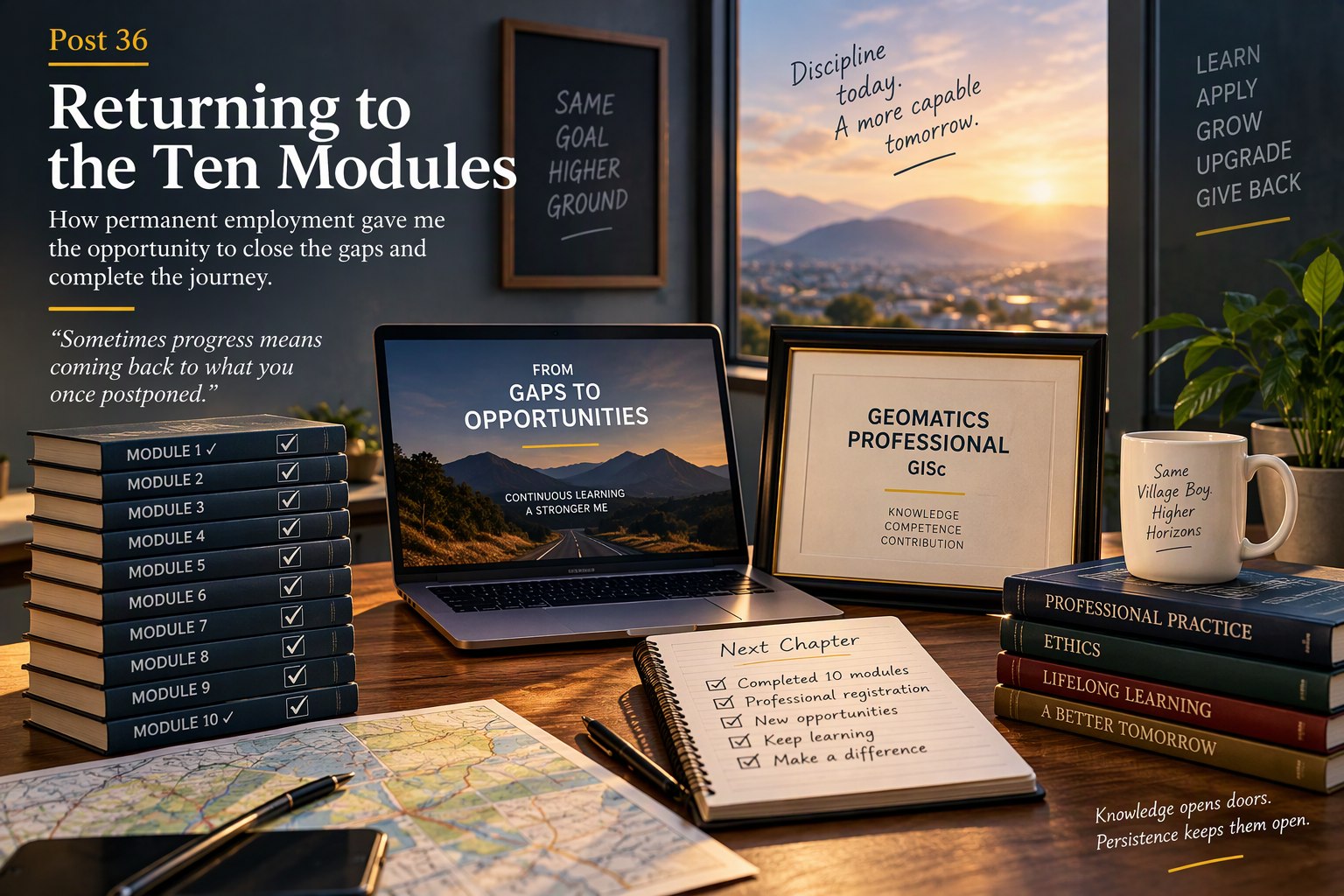
Permanent employment solved one problem, but it also gave me the stability to return to something I had postponed years earlier.
My professional registration.
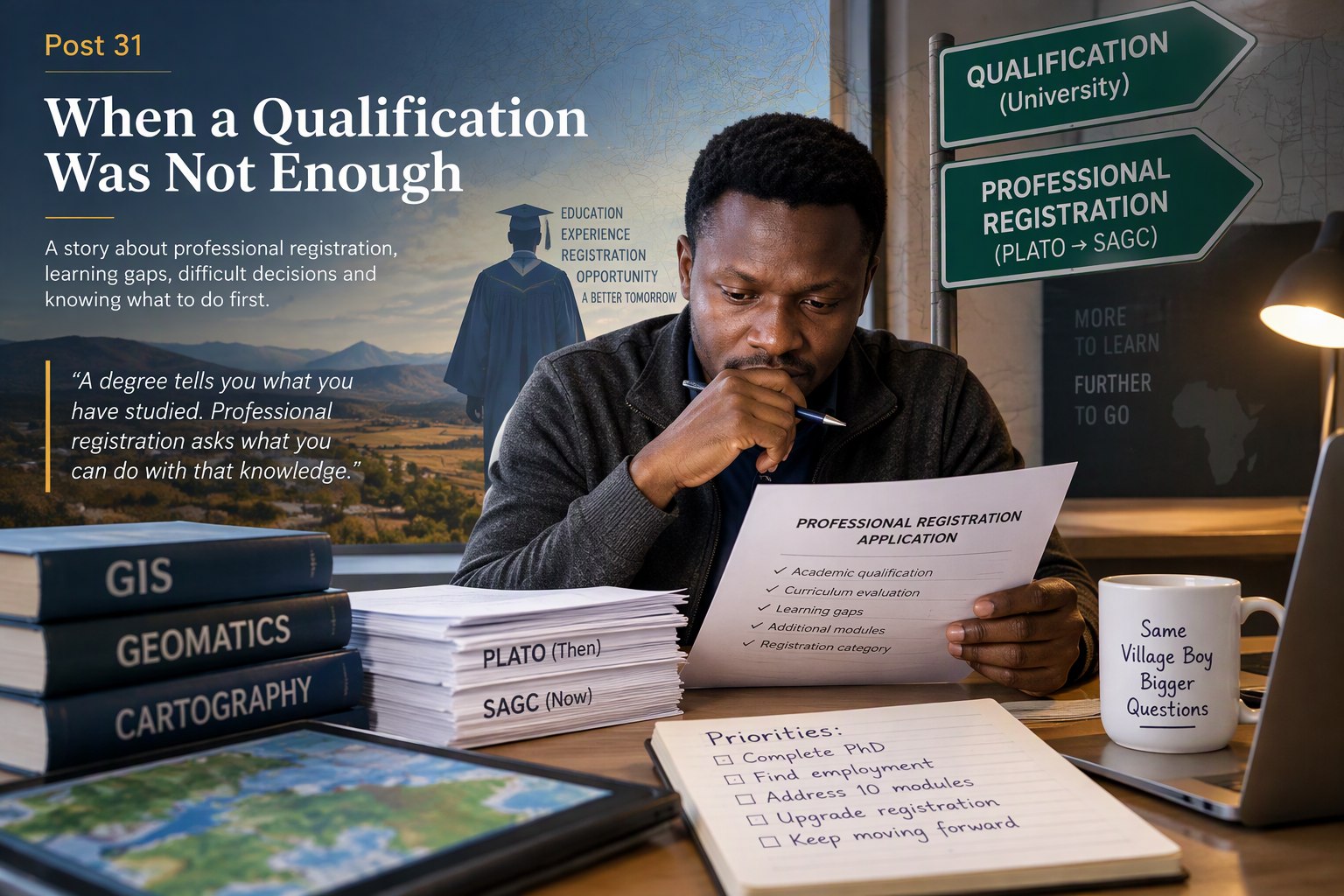
Earlier in my journey, my academic background had been assessed and ten modules had been identified as gaps in my learning.
At the time, I had more immediate priorities.
I needed to complete the PhD.
I needed employment.
I needed an income.
So I had postponed the professional upgrade.
I had not abandoned it.
Now my circumstances were different.
I had permanent employment, and government provided me with a bursary that enabled me to complete the ten modules that had previously been identified as my learning gaps.
So I returned to studying.
There was something important about this stage of the journey.
The gaps had been identified.
I knew what I needed to complete.
And now I had financial support that made it possible for me to do it.
One by one, I completed the modules.
I thought that would settle the matter.
It did not.
By the time I had completed the modules, the South African Geomatics Council (SAGC) wanted my qualification to be evaluated again.
This brought me back to the same problem that had frustrated me earlier in my professional-registration journey.
Consistency.
My qualification had already been assessed.
That assessment had identified the gaps in my learning.
I had then spent time completing the modules that had been identified.
So I had a simple question:
What was the purpose of the original assessment if its outcome could simply be disregarded after I had fulfilled what it required?
I challenged the decision.
Again.
My argument was not that professional standards should be lowered for me.
It was that the outcome of the earlier assessment should be honoured.
If an assessment says:
These are the gaps you must address,
and an applicant subsequently addresses those gaps, surely that earlier assessment has to mean something.
People eventually intervened, and the original assessment was honoured.
In 2022, I finally upgraded my registration to Geomatics Professional: GISc.
It had taken years.
But achieving the professional category taught me something beyond the technical knowledge contained in those ten modules.
What I Learned About Professional Registration
If I were giving advice to someone who wants to enter the GISc profession today, I would start much earlier than the registration application itself.
I would start with the choice of university qualification.
If professional registration forms part of your long-term ambition, investigate whether the qualification you intend to study has been evaluated for professional registration and for which registration category.
Don’t assume that because a qualification contains GIS, Geoinformatics, Geography or Geomatics in its name, it automatically provides the registration pathway you expect.
Find out.
But I would also not tell someone to abandon a university simply because its curriculum has not followed the easiest registration pathway.
Not everybody has the same choices.
Finances, geography, admission requirements and personal circumstances can determine where someone is able to study.
I am evidence that a more difficult route does not necessarily mean that the destination is impossible.
But if you take that route, understand that you may be required to demonstrate in detail what you studied and perhaps address additional learning gaps.
And there is another lesson from my experience.
Do not be afraid to question an assessment that appears inconsistent.
That does not mean every rejection is wrong.
Sometimes an assessment identifies genuine deficiencies in someone’s learning.
When that happens, address them.
That was exactly what I did.
But professional standards should also be accompanied by consistent processes.
Ask questions.
Understand the reasons for the decision.
Keep copies of assessments and correspondence.
If learning gaps are identified, know exactly what they are.
And if you later fulfil what was required but receive a decision that appears inconsistent with what you were previously told, do not be afraid to challenge it.
My professional-registration journey required me to do that more than once.
There is one further caution.
Processes change.
What happened during my registration journey describes what I encountered at that particular time. Anyone going through professional registration today should check the current SAGC requirements rather than assuming that my route remains unchanged.
My experience is not a registration manual.
It is a lesson in what can happen when education, professional standards, institutional processes and individual circumstances meet.
Looking back, those ten modules represented something much bigger than ten courses.
Initially, they represented what I did not know.
Then they became something I could work towards.
Professional registration taught me to recognise the gaps in my own learning.
But the process also taught me something equally important:
There are times when I must accept that I still have something to learn, and there are times when I must have the courage to question the people assessing what I have learned.
Knowing the difference matters.
Join the conversation
If you have pursued professional registration in GISc or another profession, have you ever had to address identified learning gaps or challenge an assessment that you believed was inconsistent?