One of the major challenges towards the end of my PhD came from delays in completing the study.
My thesis had effectively been completed, but I was still waiting for my supervisor’s comments. He had several students under his supervision and other responsibilities.
As the delays continued, most of the funding from my scholarship eventually came to an end.
The monthly stipend stopped.
I had to return home unemployed.
Fortunately, most of the work on the thesis had already been done. Whatever remained could largely be completed remotely, just as I had done during my Master’s. I would only need to return to the university when my physical presence was necessary, particularly to discuss comments, print, and eventually submit the final thesis.
But working from home introduced another problem.
A Home Without Electricity
By then, my grandmother and I had moved into the modest home I had been building using some of my savings from the PhD scholarship.
We had a place to call home again.
But the house was in a new settlement expansion, and the area had not yet been connected to the electricity grid.
I still needed to work through my supervisor’s comments whenever they came.
For that, I needed my laptop.
And the laptop needed electricity.
Sometimes I crossed the road to my grandmother’s younger brother’s house so that I could work.
There was also another unlikely option.
Nearby stood a structure that had been intended for a chicken business. Construction had been abandoned before the facility was completed and before it had ever been used for that purpose.
But the unfinished structure had something I needed.
Electricity.
Cultivation Returns to the Story
That place also brought an earlier part of our story back into the picture.
In Post 8: Do Your Part, Even If It Is Only a Drop in the Ocean, I wrote about the decline of subsistence farming in rural areas and what it meant to my grandmother.
Growing up, I watched her cultivate several masimu, or farming plots, every season. I remember her small circular storage hut being filled with maize after harvest. In many years, that harvest would sustain the household until the following season.
Then, a few years after I enrolled at university, the subsistence farmers were told to stop cultivating those plots.
The land was no longer going to be available for cultivation. It would be demarcated into residential stands.
Eventually, a large settlement arose where those masimu had once been.
There was little my grandmother could do about it.
Years later, after relocating to the village where she had been born, cultivation somehow returned to her life.
Her cousin was cultivating vacant land around the unfinished chicken facility. There was a portion that he was not using, and my grandmother asked whether she could cultivate it.
Her cousin approached the owner.
Permission was granted.
My grandmother began cultivating maize again.
It was not her land.
She had not regained the masimu that had been lost.
And there was no guarantee that this arrangement would last.
But after years without the farming plots she had once cultivated, she once again had access to a piece of land.
And unexpectedly, I also benefited from the same arrangement.
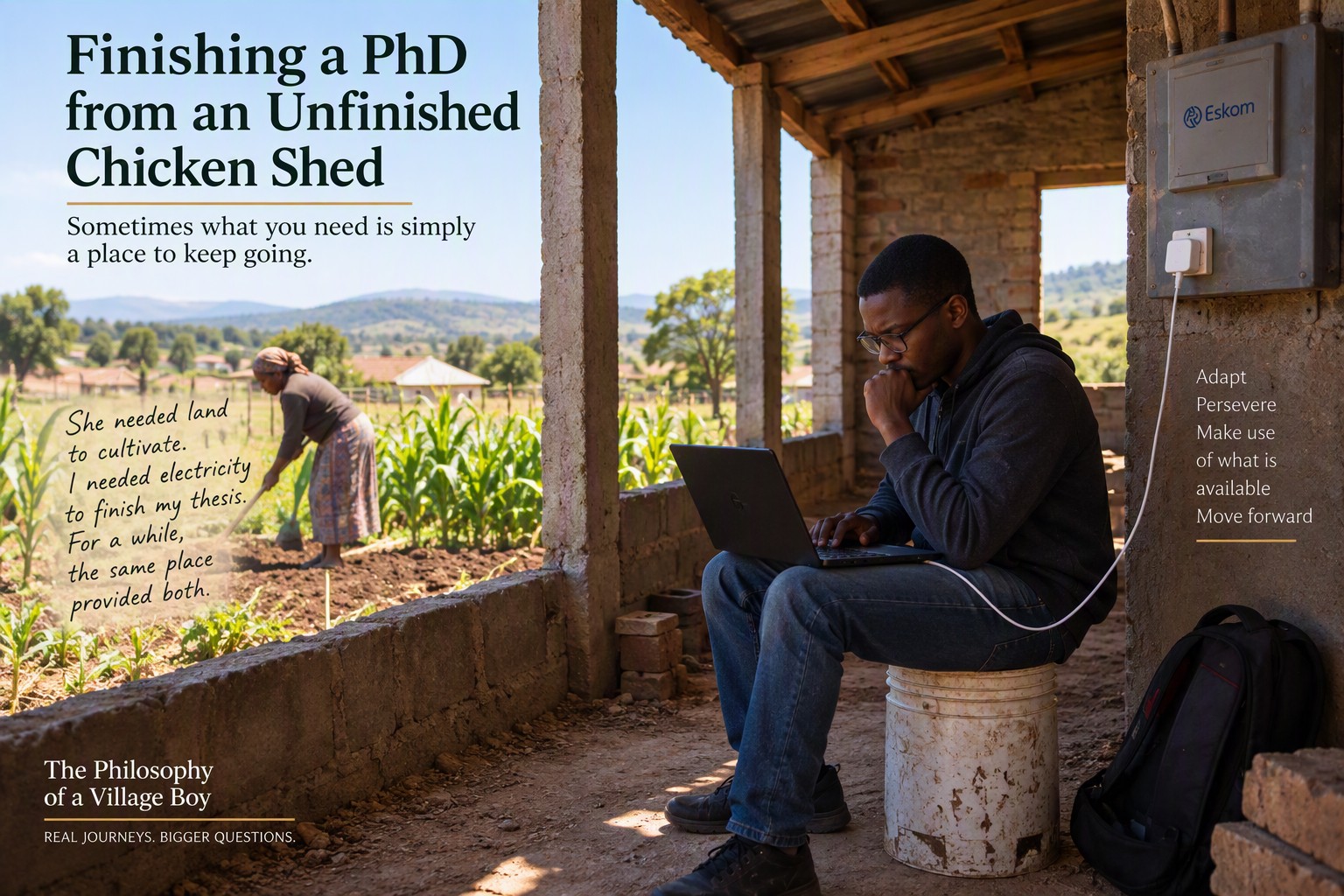
While my grandmother cultivated outside, I could sit inside the unfinished chicken facility, plug in my laptop, and continue working through my supervisor’s comments.
After all the university offices, academic discussions, research, conferences, and international travel that had formed part of my PhD journey, some of the final work on my thesis was being done from an unfinished chicken facility in a village.
There was nothing glamorous about it.
It did not need to be glamorous.
It had electricity.
That was what I needed.
Another Temporary Solution
Eventually, I completed the thesis and submitted it.
Not long afterwards, our new home was connected to the electricity grid.
The cultivation arrangement also eventually came to an end.
The owner returned to the original plan, completed the chicken facility, and started the business for which it had originally been intended.
My grandmother and her cousin could therefore no longer cultivate there.
Once again, my grandmother’s access to agricultural land had been temporary.
There is something interesting about how the different needs came together at that particular place.
Years earlier, she had lost access to the masimu she cultivated when agricultural land was converted into residential stands.
Much later, in another village, somebody else’s unused land temporarily allowed her to cultivate again.
That same temporary arrangement indirectly gave me something I needed to complete my PhD.
She needed land to cultivate.
I needed electricity to finish my thesis.
For a while, the same place provided both.
Neither arrangement was permanent.
Perhaps it did not need to be.
Throughout the journey I have described in these posts, many solutions did not necessarily remove the larger problem permanently. Sometimes they simply provided what was needed to move through a particular moment.
An internship did not guarantee permanent employment.
A scholarship did not remove every financial challenge.
Temporary access to land did not solve the wider problem of disappearing masimu.
And electricity from an unfinished chicken facility did not solve the lack of electricity at our new home.
But each provided something that was needed at the time.
Perhaps this takes me back to the philosophy behind Post 8:
Do your part. Work with what is within your control and make use of the opportunities available to you, even if what you can do seems like only a drop in the ocean.
Join the conversation
Have you ever found that a temporary or unlikely solution was enough to help you through an important stage of your journey?
Leave a Reply