The Philosophy of a Village Boy

The Philosophy of a Village Boy explores knowledge, science, African spirituality, indigenous thought, identity, and the territory between experience and evidence.

Category: Rural Landscapes & Identity

Exploring the relationships between land, place, culture and identity, with reflections on rural landscapes, village life, indigenous knowledge, customary practices, memory and belonging.

  • Post 32: Returning to the Place I Had Left

    Post 32: Returning to the Place I Had Left

    While I was at home trying to complete my PhD, I continued applying for jobs.

    One of those applications took me back to a familiar organisation.

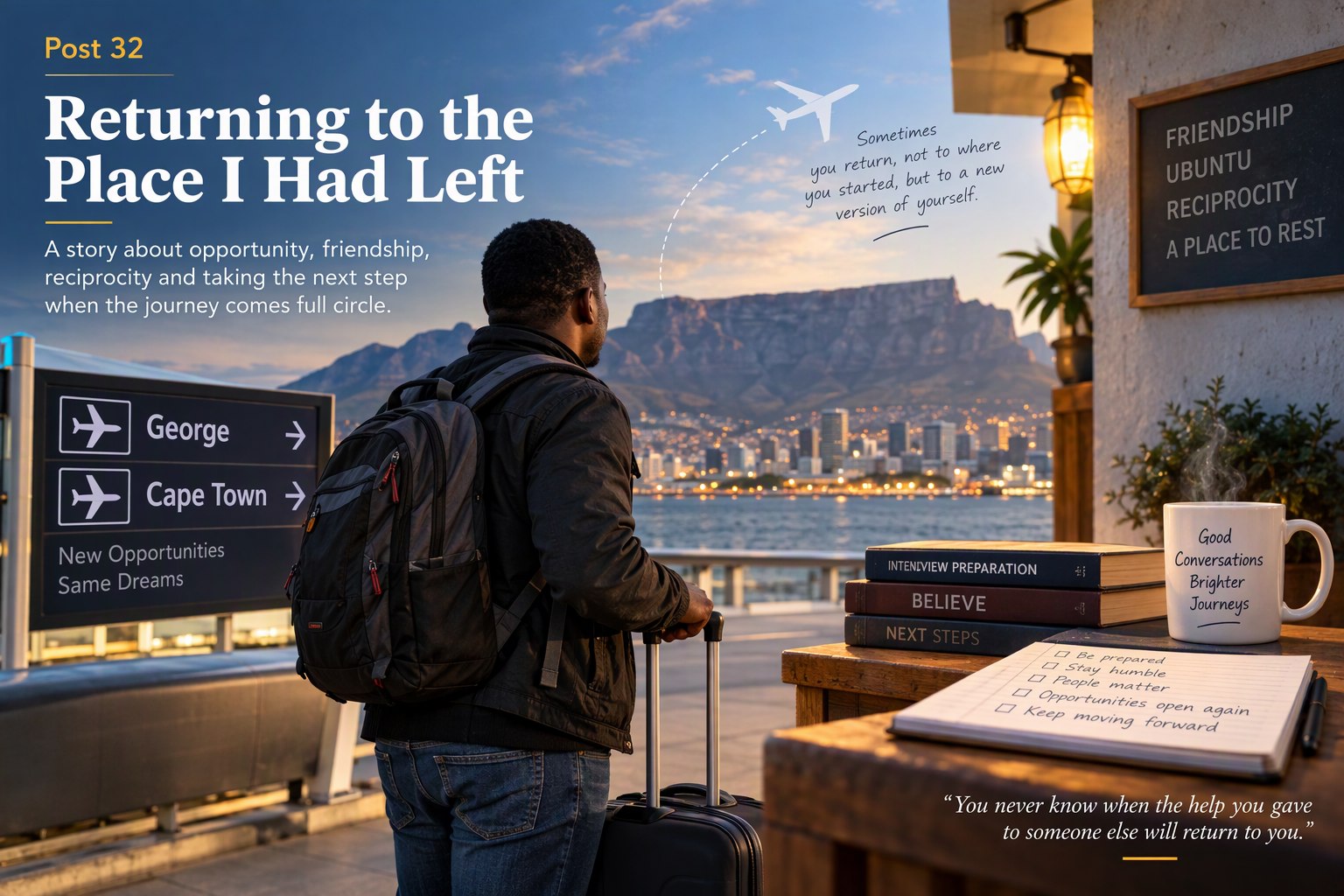
    I was called for an interview in Cape Town by the same conservation agency I had left earlier when I went to pursue my PhD.

    There was something almost circular about it.

    I had left the agency because the PhD opportunity had opened. Now the scholarship had run out, I was trying to finish the PhD from home, and the same agency was giving me another opportunity.

    But first, I had to get to Cape Town.

    My lady friend from KwaZulu-Natal, whom I had assisted during an earlier part of my journey, was now in Cape Town furthering her studies.

    I told her about the interview and asked her to help me find accommodation for the night before the interview.

    She refused.

    Not because she did not want to help me.

    She refused because she did not want me to spend money unnecessarily.

    She insisted that she and her housemates would accommodate me at their residence. She reminded me that I had assisted her before and that I should now allow her to assist me.

    I accepted.

    The ladies changed their arrangements for that night and provided me with my own space.

    It was a little uncomfortable, but I could have said no.

    What mattered was their generosity.

    They also provided supper and helped orientate me around Cape Town, a city that was unfamiliar to me.

    The following morning, I went for the interview.

    Some of the panel members seemed excited that I wanted to return to the agency that I had previously left to complete my studies.

    Then I travelled back home.

    Before the end of that week, I received the breakthrough.

    I had been offered the job.

    It was a one-year contract.

    I took it.

    My former GIS manager, the person who had helped me with professional registration and recommended me for the PhD scholarship, had already left the agency some time before.

    So, although I was returning to a familiar organisation, things had changed.

    I had changed too.

    I returned carrying a PhD that still had to be completed, the experience of losing the financial security of a scholarship and a clearer understanding of how quickly circumstances could change.

    The contract solved one problem.

    But it did not solve everything.

    It was still temporary employment.

    So I continued applying for permanent positions.

    Looking back, however, I also remember something else about that trip to Cape Town.

    At an earlier point in my journey, I had been in a position to assist someone else.

    Now circumstances had shifted.

    I needed help.

    She remembered.

    I had only asked her to help me find accommodation.

    Instead, she effectively said:

    You helped me before. Allow me to help you now.

    Perhaps reciprocity does not always arrive according to a schedule.

    Sometimes what you give to another person returns years later, in another city, under completely different circumstances.

    And sometimes it does not return from the person you helped at all.

    But on this occasion, it did.

    Join the conversation

    Have you ever received help from someone you once helped, at exactly the point when you needed someone yourself?
  • Post 30: Finishing a PhD from an Unfinished Chicken Shed

    Post 30: Finishing a PhD from an Unfinished Chicken Shed

    One of the major challenges towards the end of my PhD came from delays in completing the study.

    My thesis had effectively been completed, but I was still waiting for my supervisor’s comments. He had several students under his supervision and other responsibilities.

    As the delays continued, most of the funding from my scholarship eventually came to an end.

    The monthly stipend stopped.

    I had to return home unemployed.

    Fortunately, most of the work on the thesis had already been done. Whatever remained could largely be completed remotely, just as I had done during my Master’s. I would only need to return to the university when my physical presence was necessary, particularly to discuss comments, print, and eventually submit the final thesis.

    But working from home introduced another problem.

    A Home Without Electricity

    By then, my grandmother and I had moved into the modest home I had been building using some of my savings from the PhD scholarship.

    We had a place to call home again.

    But the house was in a new settlement expansion, and the area had not yet been connected to the electricity grid.

    I still needed to work through my supervisor’s comments whenever they came.

    For that, I needed my laptop.

    And the laptop needed electricity.

    Sometimes I crossed the road to my grandmother’s younger brother’s house so that I could work.

    There was also another unlikely option.

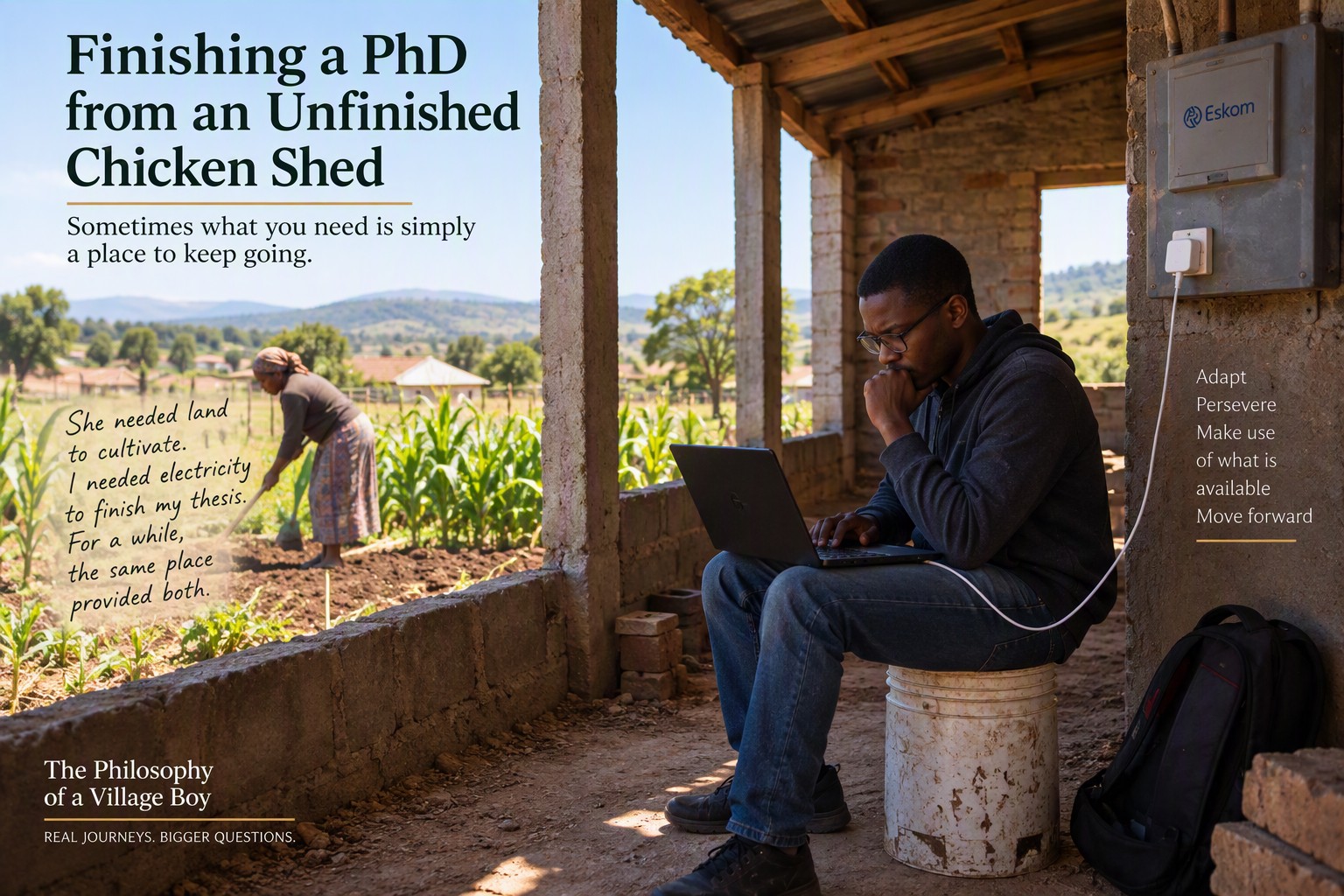
    Nearby stood a structure that had been intended for a chicken business. Construction had been abandoned before the facility was completed and before it had ever been used for that purpose.

    But the unfinished structure had something I needed.

    Electricity.

    Cultivation Returns to the Story

    That place also brought an earlier part of our story back into the picture.

    In Post 8: Do Your Part, Even If It Is Only a Drop in the Ocean, I wrote about the decline of subsistence farming in rural areas and what it meant to my grandmother.

    Growing up, I watched her cultivate several masimu, or farming plots, every season. I remember her small circular storage hut being filled with maize after harvest. In many years, that harvest would sustain the household until the following season.

    Then, a few years after I enrolled at university, the subsistence farmers were told to stop cultivating those plots.

    The land was no longer going to be available for cultivation. It would be demarcated into residential stands.

    Eventually, a large settlement arose where those masimu had once been.

    There was little my grandmother could do about it.

    Years later, after relocating to the village where she had been born, cultivation somehow returned to her life.

    Her cousin was cultivating vacant land around the unfinished chicken facility. There was a portion that he was not using, and my grandmother asked whether she could cultivate it.

    Her cousin approached the owner.

    Permission was granted.

    My grandmother began cultivating maize again.

    It was not her land.

    She had not regained the masimu that had been lost.

    And there was no guarantee that this arrangement would last.

    But after years without the farming plots she had once cultivated, she once again had access to a piece of land.

    And unexpectedly, I also benefited from the same arrangement.

    While my grandmother cultivated outside, I could sit inside the unfinished chicken facility, plug in my laptop, and continue working through my supervisor’s comments.

    After all the university offices, academic discussions, research, conferences, and international travel that had formed part of my PhD journey, some of the final work on my thesis was being done from an unfinished chicken facility in a village.

    There was nothing glamorous about it.

    It did not need to be glamorous.

    It had electricity.

    That was what I needed.

    Another Temporary Solution

    Eventually, I completed the thesis and submitted it.

    Not long afterwards, our new home was connected to the electricity grid.

    The cultivation arrangement also eventually came to an end.

    The owner returned to the original plan, completed the chicken facility, and started the business for which it had originally been intended.

    My grandmother and her cousin could therefore no longer cultivate there.

    Once again, my grandmother’s access to agricultural land had been temporary.

    There is something interesting about how the different needs came together at that particular place.

    Years earlier, she had lost access to the masimu she cultivated when agricultural land was converted into residential stands.

    Much later, in another village, somebody else’s unused land temporarily allowed her to cultivate again.

    That same temporary arrangement indirectly gave me something I needed to complete my PhD.

    She needed land to cultivate.

    I needed electricity to finish my thesis.

    For a while, the same place provided both.

    Neither arrangement was permanent.

    Perhaps it did not need to be.

    Throughout the journey I have described in these posts, many solutions did not necessarily remove the larger problem permanently. Sometimes they simply provided what was needed to move through a particular moment.

    An internship did not guarantee permanent employment.

    A scholarship did not remove every financial challenge.

    Temporary access to land did not solve the wider problem of disappearing masimu.

    And electricity from an unfinished chicken facility did not solve the lack of electricity at our new home.

    But each provided something that was needed at the time.

    Perhaps this takes me back to the philosophy behind Post 8:

    Do your part. Work with what is within your control and make use of the opportunities available to you, even if what you can do seems like only a drop in the ocean.

    Join the conversation

    Have you ever found that a temporary or unlikely solution was enough to help you through an important stage of your journey?

  • Post 28: Building My Grandmother a Place to Call Home

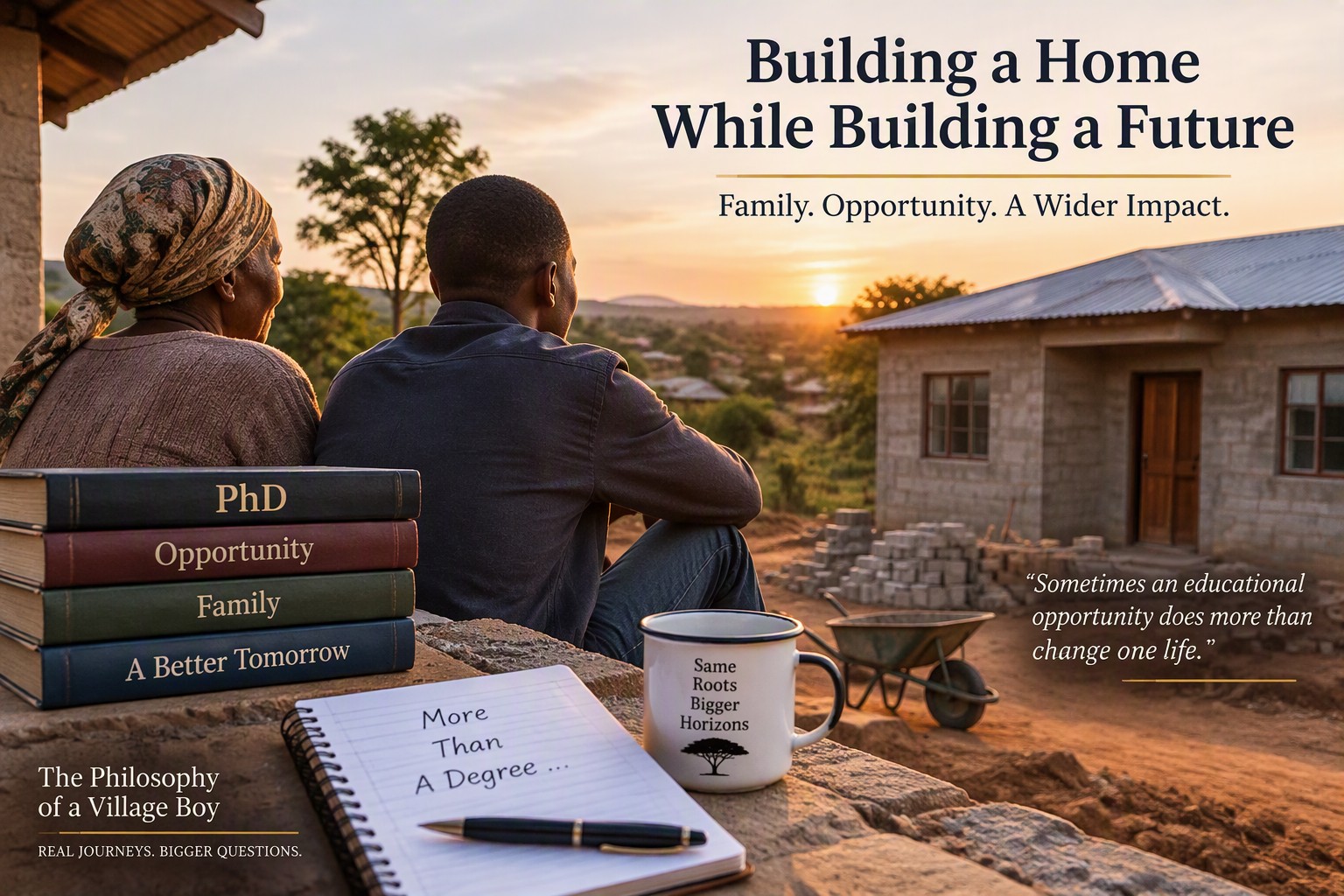
    Post 28: Building My Grandmother a Place to Call Home

    While my PhD was opening new doors for me, another part of my life was changing at home.

    My grandmother had lost all her children.

    I had also left, first for George and later to pursue my studies. She increasingly found herself alone.

    Eventually, she made a difficult but practical decision.

    She sold the family house and relocated to the village where she had been born.

    Her two younger brothers and younger sister were there, together with their families. At least she would have people around her who could keep a close eye on her.

    For me, that brought some relief.

    Initially, she stayed with her younger sister.

    It was a working solution, but she still needed a place she could call her own.

    A Scholarship Serving Another Purpose

    My PhD scholarship had given me something I had rarely enjoyed during the earlier stages of my education: enough financial room to save something.

    Some of those savings now had another purpose.

    I started building a modest home for my grandmother.

    There was an irony in this period of my life.

    Academically, I was progressing towards the highest university qualification.

    Personally, I was effectively homeless.

    When I returned home, there was no longer the family house I had previously returned to. I stayed with extended family, particularly at the home of one of the sons of my grandmother’s youngest sister.

    But I knew that situation was temporary.

    Slowly but surely, the new place began taking shape.

    Whatever I could put aside from the scholarship contributed towards creating somewhere my grandmother could eventually call her own.

    The scholarship had been awarded to enable me to pursue a PhD.

    But its effect was beginning to extend beyond the university.

    It paid my tuition and registration.

    It provided the stipend that supported me while I studied.

    And part of what I managed to save was now helping to build a home.

    There is perhaps something about educational opportunities that is difficult to see if we only look at the qualification eventually awarded to one person.

    The scholarship belonged to me on paper, but its consequences did not stop with me.

    An opportunity to pursue a PhD was indirectly helping my grandmother rebuild a place for herself after leaving the family home.

    Slowly, the construction continued.

    But my financial resources were not unlimited.

    And before the house was completed, someone else would need financial help.

    Her circumstances would confront me with a different question:

    What happens when the little that we have is needed in two places at the same time?

    Join the conversation

    When an opportunity improves one person’s circumstances, where do you think its benefits to that individual end and responsibilities towards family begin?

  • Post 18: The Interview I Could Not Afford to Attend

    Post 18: The Interview I Could Not Afford to Attend

    The municipality gave me a lifeline, but not yet financial freedom.

    The stipend was not enough to solve the problem that had prevented me from applying for internships and entry-level positions in the first place.

    Then, towards the end of the year or early the following year, I received another phone call.

    It was the lecturer who had previously encouraged me to register for a Master’s degree at the university he was moving to.

    I was surprised that he had remembered me.

    I had told him that I would take a year to save money and register the following year.

    Now that year had arrived.

    But I had saved nothing.

    “You, Lidzhegu,” he asked, calling me by my surname, “are you saying you don’t want to do Master’s?”

    I paused.

    I recalled that I had made a promise.

    So I responded and said I wanted to register.

    He gave me the necessary information and instructions.

    Once again, there was a familiar problem.

    Registration money.

    At around the same time, my friend from Tshikhudini and I had applied for GIS internships advertised in another province.

    We were both invited for interviews.

    My friend said:

    “Let’s go,”

    I said I wasn’t going.

    My reasoning was simple.

    Our stipend was not enough to pay for transport, accommodation before the interview, and all the expenses that would follow if I actually got the job.

    We were also using part of our stipends for driving lessons. We were working towards obtaining our driver’s licences, which we eventually did.

    My friend understood all of this.

    He had the same problem.

    But he was going anyway.

    I stayed behind.

    On the day of the interview, I tried calling him before the interview to wish him luck. His phone was unreachable.

    I tried again afterwards.

    Still unreachable.

    I only discovered what had happened when I saw him on the next working day.

    He told me that he had not had enough money for accommodation the night before the interview. He had slept at a police station, on a bench around the reception or service area.

    When he woke up, his belongings were gone, including his phone.

    Fortunately, he still managed to get to the interview and, most importantly, make his way home.

    Now he needed another phone.

    He wanted to buy one and insure it. One way of doing that was to take the phone on a retail store account, but he did not have a store account and did not want one.

    I had a store account.

    He had cash.

    And I needed cash for my Master’s registration.

    The amount he had available for the phone was enough to cover my registration.

    So we came up with a simple arrangement. He gave me the cash. We bought the phone using my store account and took out the insurance. He would pay the insurance while I paid off the account.

    It solved both our immediate problems.

    What still fascinates me when I look back is how this opportunity came about. My friend had travelled to an interview that I had decided I could not afford to attend. Things went badly for him, yet the problem that followed unexpectedly created a solution to a completely different problem in my life.

    His misfortune had become my lifeline.

    I had the registration money.

    Now I could finally register for my Master’s.

    Join the conversation

    Have you ever experienced a situation where an unexpected problem created an opportunity that neither person involved could have planned?

  • Post 17: When the Municipality Finally Called

    Post 17: When the Municipality Finally Called

    After submitting our handwritten CVs, nothing happened immediately.

    Our names were far down the municipality’s volunteer list. We had seen that ourselves.

    But whenever my friend and I happened to be in town, we developed a habit.

    We went to the municipality.

    We would ask whether there had been any progress.

    Then we would leave and continue with our lives.

    We did not know it at the time, but those small visits were apparently making an impression.

    Meanwhile, graduation had not transformed my everyday reality.

    My cousin, who was the same age as me and had gone to university at roughly the same time, was also now a graduate. Let’s call him my second cousin.

    We did whatever work became available.

    One family friend built stone walls. My cousin and I helped by collecting stones and maintaining a constant supply while he worked.

    Sometimes another family friend, also a builder, asked us to dig foundation trenches before he started laying foundations.

    At another point, we worked with a subcontracting company painting RDP houses in villages around the district.

    We were graduates.

    But if there was work available, we worked.

    A few months after submitting the handwritten CVs, I was helping the first family friend plaster a house.

    My job included mixing mortar (cement, sand and water) and keeping him supplied while he plastered. Afterwards, we would work on smoothing the plaster.

    It was hard physical work.

    But for a village boy, blisters from this kind of work were not completely foreign. In some ways, they were part of village life and identity.

    Then my phone rang.

    Someone from the municipality wanted to know whether I was still interested in voluntary work.

    “Very much,” I responded.

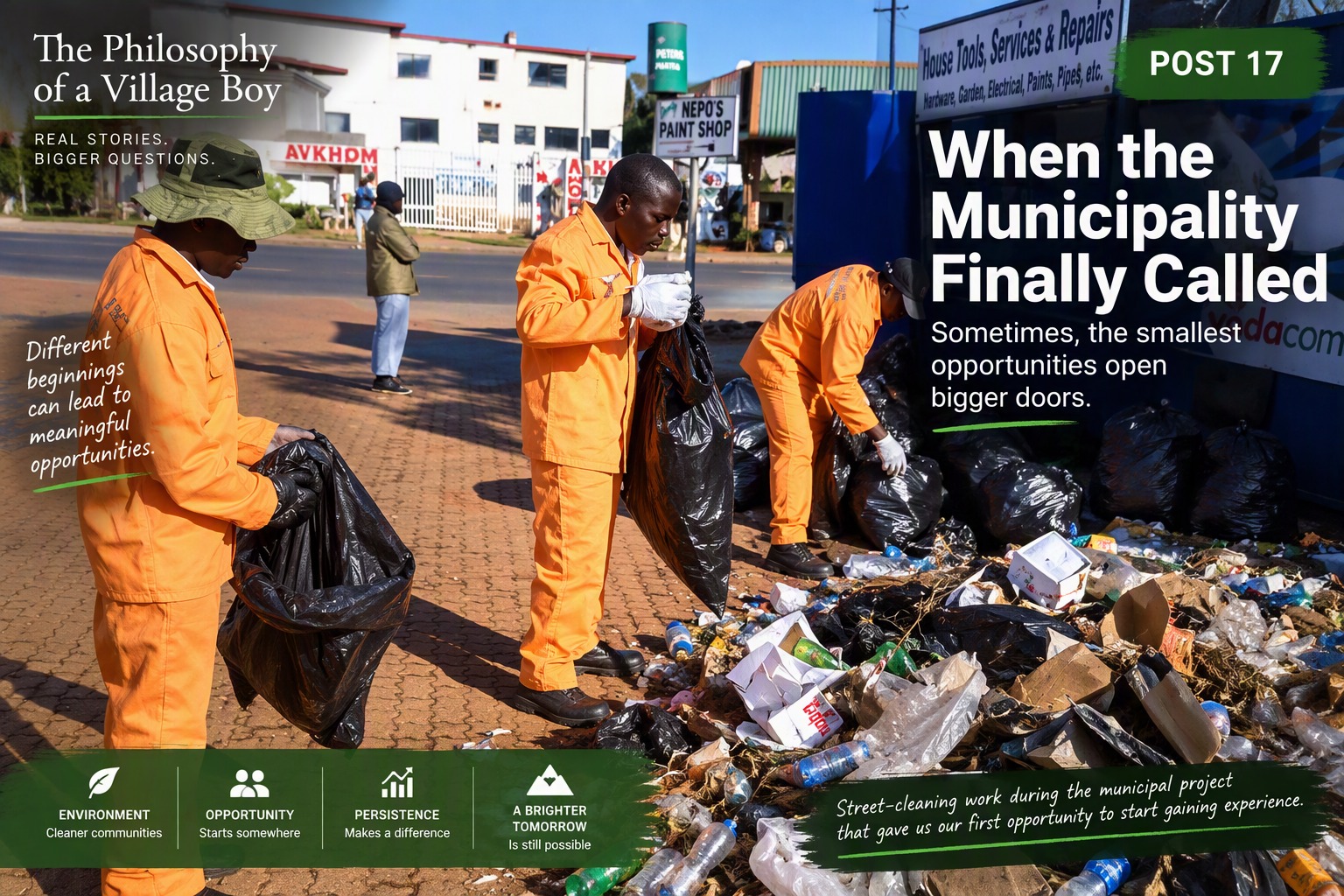
    There was an opening in a street-cleaning and greening project. The municipality wanted environmental graduates who could assist with environmental education and awareness campaigns.

    I was told to report the following morning to sign the contract.

    After the call, I told the family friend I was working with.

    He congratulated me and said he would find somebody else to help him finish the plastering job.

    Then I called my friend from Tshikhudini.

    He too had received the same call, he said.

    We met at the municipal offices the following day and signed our contracts.

    Only later did another part of the story become clear.

    We were told that although we had originally been down the volunteer list, our repeated visits to the municipality to check on progress had demonstrated that we were serious. We had consequently been moved up the list.

    That made me think.

    When we walked into that office with handwritten CVs, being at the bottom of the list looked like something beyond our control.

    We couldn’t control how many names were ahead of ours.

    But perhaps we could control whether our names remained merely names on a piece of paper.

    Every time we happened to be in town, we showed up.

    We asked.

    We followed up.

    We made ourselves visible.

    Perhaps persistence did not guarantee an opportunity.

    But in this case, apparently, somebody noticed it.

    The work itself was modest. It was volunteer work accompanied by a stipend that was just enough for some upkeep.

    Initially, we even had to do litter picking in town.

    We didn’t complain.

    We had gone from handwritten CVs at the bottom of a volunteer list to having an opportunity to start building experience.

    It wasn’t yet the breakthrough I needed.

    But it was a lifeline.

    And perhaps there is a subtle distinction there that I did not fully appreciate at the time:

    Some things are beyond our control, but that does not necessarily mean that humans do not influence them.

    Join the conversation

    How many opportunities have people abandoned because they assumed that after submitting an application, everything else was beyond their control?

  • Post 16: The Handwritten CV

    Post 16: The Handwritten CV

    On my last day at university, I submitted the final corrected version of my mini-thesis.

    I was done.

    Before leaving, I met another friend. He was also a village boy, from Tshikhudini. Let me call him my second friend.

    While I had been doing Honours, he had been finishing some outstanding undergraduate modules. Now he was starting his own Honours degree.

    He still had another class to attend that day.

    I told him:

    “I’m done here. This is my last day. I’m leaving.”

    His response surprised me.

    If I was leaving, he said, he was also quitting.

    “We are leaving together.”

    I reminded him of the obvious difference.

    “Man, I completed my Honours.”

    His response was difficult to argue with.

    “So what? You are unemployed, and so am I.”

    He had watched me struggle financially during Honours. His financial circumstances were not very different from mine, and he did not want to experience the same thing.

    He was quitting.

    I said fine, but there had to be a plan.

    We could not simply return home and add ourselves to the growing number of unemployed graduates.

    We needed to do something.

    “Like what?”

    I suggested that we submit our CVs to the local municipality and ask for any voluntary work related to environmental sciences. Even if it involved waste management, we could start somewhere.

    His attitude immediately changed.

    “You see, now you are talking. Let’s do this.”

    There was one small problem.

    I didn’t have my CV with me.

    Neither did he.

    Today, perhaps the obvious response would be to go somewhere, type the CVs properly, print them and return later.

    We didn’t.

    We went back to the Honours office.

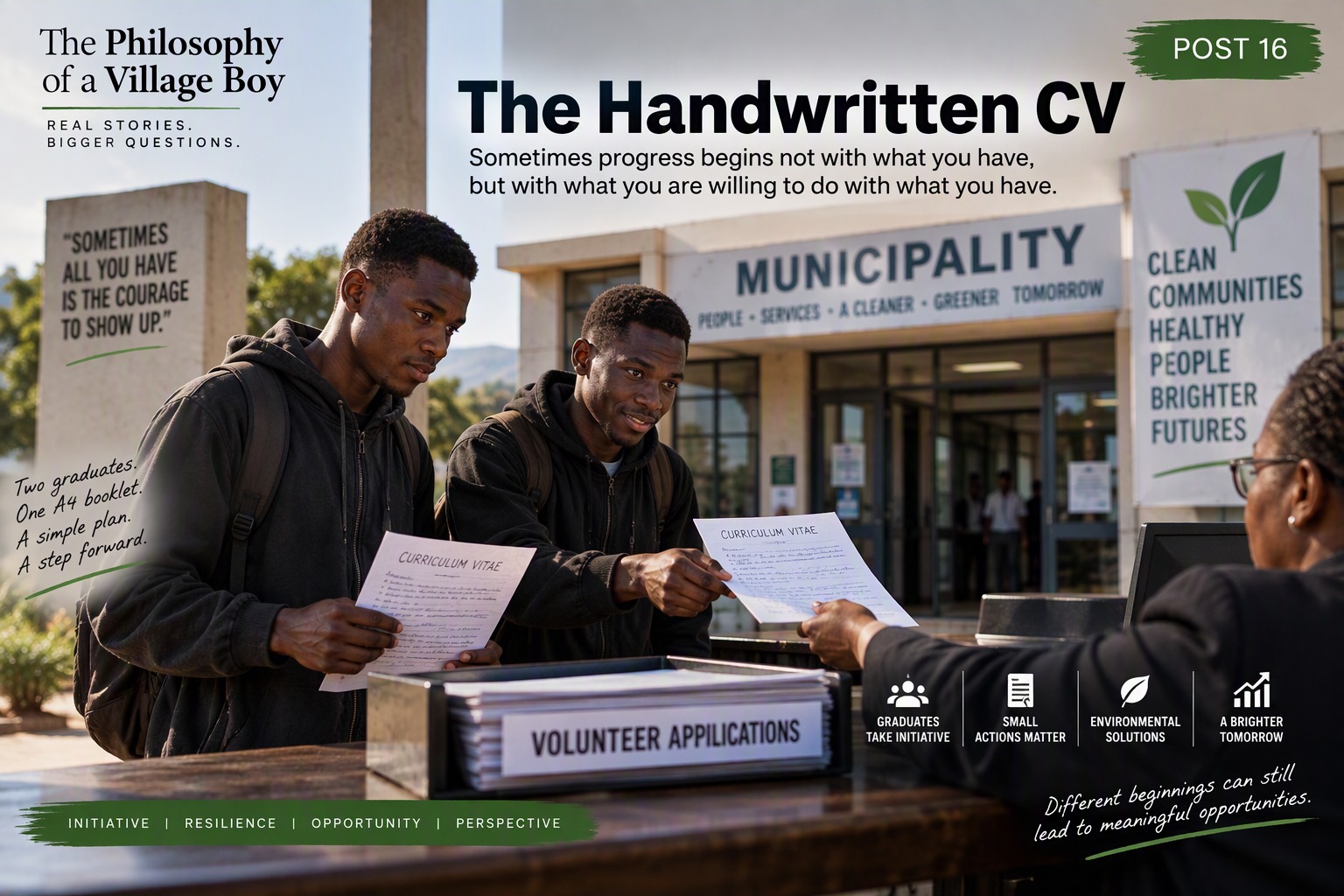
    My friend had much better handwriting than I. He took pages from an A4 booklet and handwrote both our CVs.

    Two university graduates then walked into a municipality looking for professional experience, carrying handwritten CVs.

    We submitted them.

    When we looked at the volunteer list, our names were near the bottom.

    Then we went our separate ways.

    Looking back, there wasn’t much reason to assume that anything would come from submitting.

    But submitting those CVs was one thing we could control.

    What happened afterwards was not within our control.

    Or at least that is what I thought at the time.

    Join the conversation

    Would you submit a handwritten CV if that was the only CV you could submit that day, or would you wait until you could present yourself more professionally?

  • Post 15: Do We Just Let His Efforts Go to Waste?

    Post 15: Do We Just Let His Efforts Go to Waste?

    My Honours graduation was approaching, but there was one problem.

    The university had withheld my results because of the unpaid debt.

    My grandmother became worried.

    She asked me:

    “What are we going to do now?”

    I didn’t have an answer.

    “I really don’t know.”

    A couple of weeks later, she returned from visiting her siblings in the village where she was born.

    When she arrived, she told me:

    “Makhulu vhari ni foune.”

    Loosely translated into English: “Your grandfather says you must call him.”

    She was referring to her younger brother, the sibling immediately after her. My grandmother was the eldest child.

    I didn’t ask many questions. I called him.

    After exchanging pleasantries, he went directly to the point.

    “How much money is needed?”

    I told him.

    His response was equally direct.

    The following day, I was to meet his son in town. He would give me the full amount.

    I was relieved.

    After thanking him and ending the call, I turned to my grandmother. She had heard the entire conversation.

    I wanted to know what had happened.

    How had she persuaded him to help?

    She explained what she had told him.

    “This child had finished his studies. He had done everything within his ability. He had worked hard. Now the university was withholding his results because of a debt that I clearly could not afford to pay.” Those were her words to her younger brother

    Then she had essentially asked him:

    What do we do? Do we simply let his efforts go to waste?

    That was how my grandmother persuaded her younger brother to settle my university debt.

    I could now graduate.

    But the experience also strengthened a decision I had already been considering.

    I did not want to put my family through situations like this again.

    So I vowed not to apply for internships or entry-level jobs.

    Looking back, there is something strange about that decision.

    My response to finally overcoming the financial obstacle preventing me from graduating was to avoid opportunities that might create another financial obstacle.

    Was I protecting my family?

    Was I protecting myself?

    Or had the struggle taught me to see opportunity itself as a potential financial risk?

    Whatever the answer, graduating did not mean that I had escaped the problem.

    Join the conversation

    When someone’s education is made possible by repeated sacrifices from family members, does that support create freedom, or can it also create a fear of asking those people to sacrifice again?

  • Post 13: The Hidden Cost of Getting Your First Job

    Post 13: The Hidden Cost of Getting Your First Job

    When I previously wrote about the financial burden of taking on a new job, I only touched briefly on something I think deserves deeper reflection.

    We often assume that going to university or college, obtaining a qualification and graduating will solve the problem. For many young people, particularly those from poor and rural families, perhaps that is not the end of the struggle. It may be only the beginning of another.

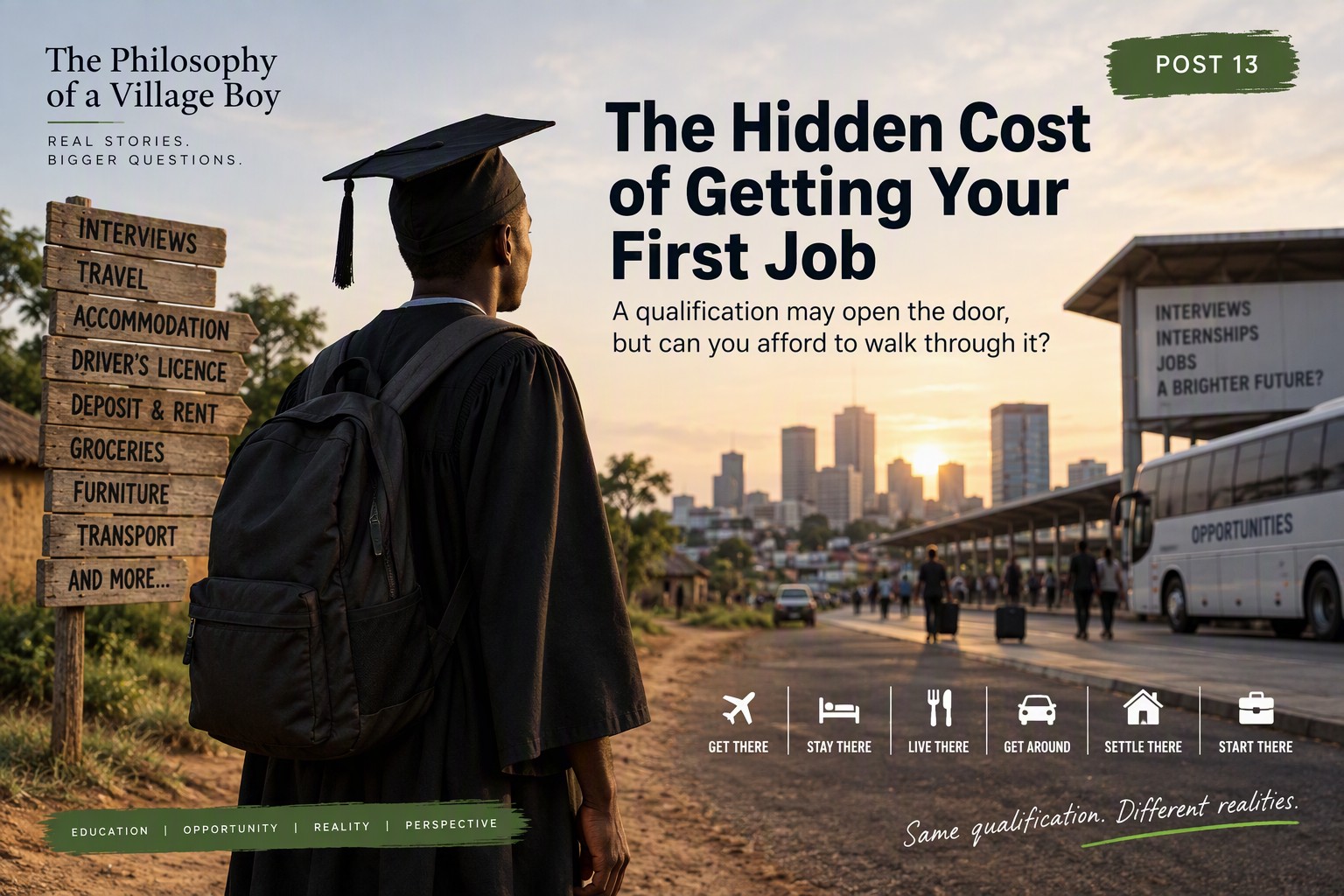
    Entry-level positions require experience. Internships are supposed to help graduates acquire that experience. But even getting an internship requires resources.

    You have to search and apply for opportunities. If you are invited for an interview in another town or province, you have to travel there. Depending on the distance, you may need accommodation. You need food and local transport. And increasingly, even some internships expect applicants to have a driver’s licence.

    For someone whose family struggled just to get them through university, where is this additional money supposed to come from?

    And suppose you overcome all of that and actually get the job.

    You may still need money for your first month’s rent and a deposit. You need groceries. You may need furniture. You need transport to and from work. All of these expenses arrive before the first salary.

    So what does it really mean to say that someone is “qualified” for a job?

    On paper, the answer may be straightforward. They possess the required qualifications.

    In reality, there seems to be another qualification that is rarely listed in the advertisement: you must be able to afford becoming employed.

    I understood this problem too well.

    After completing my undergraduate studies, I made what may sound like a strange decision. I was not going to apply for internships or entry-level positions.

    It was not because I did not want to work.

    I simply knew that my family could not afford everything that might follow from an application being successful.

    But deciding not to apply did not solve anything. I still needed a strategy.

    I had none.

    I could not suddenly produce the money required to enter the job market. That part was beyond my control.

    So I returned to a question that had already become important in my life:

    What is within my control?

    One answer seemed obvious.

    I could continue studying.

    Perhaps doing Honours would give me another year to improve my qualifications while allowing other things to resolve themselves as they sometimes did.

    There was only one problem.

    My family could not afford postgraduate studies either.

    So I had solved one problem by creating another.

    Join the conversation

    How many unemployed graduates are actually unable to enter the job market, not because they lack qualifications or ambition, but because they cannot afford the cost of becoming employed?

  • Post 8: Do Your Part, Even If It Is Only a Drop in the Ocean

    Post 8: Do Your Part, Even If It Is Only a Drop in the Ocean

    As previously mentioned in Post 2, geographical research problems can sometimes be identified simply by observing one’s immediate surroundings. Having been born and raised in a rural area, when I look at rural landscapes from a researcher’s perspective, I see many issues that could potentially be addressed through research and policy interventions.

    Sometimes, I manage to do the little that is within my control: conduct research and publish the findings in peer-reviewed journals. What happens beyond that is often outside my control. I cannot necessarily influence policy or ensure that recommendations from my research are implemented.

    Again, the approach is the same one that has appeared throughout the previous posts: identify the problem, identify what is within your control, and focus on that.

    When Masimu Disappear

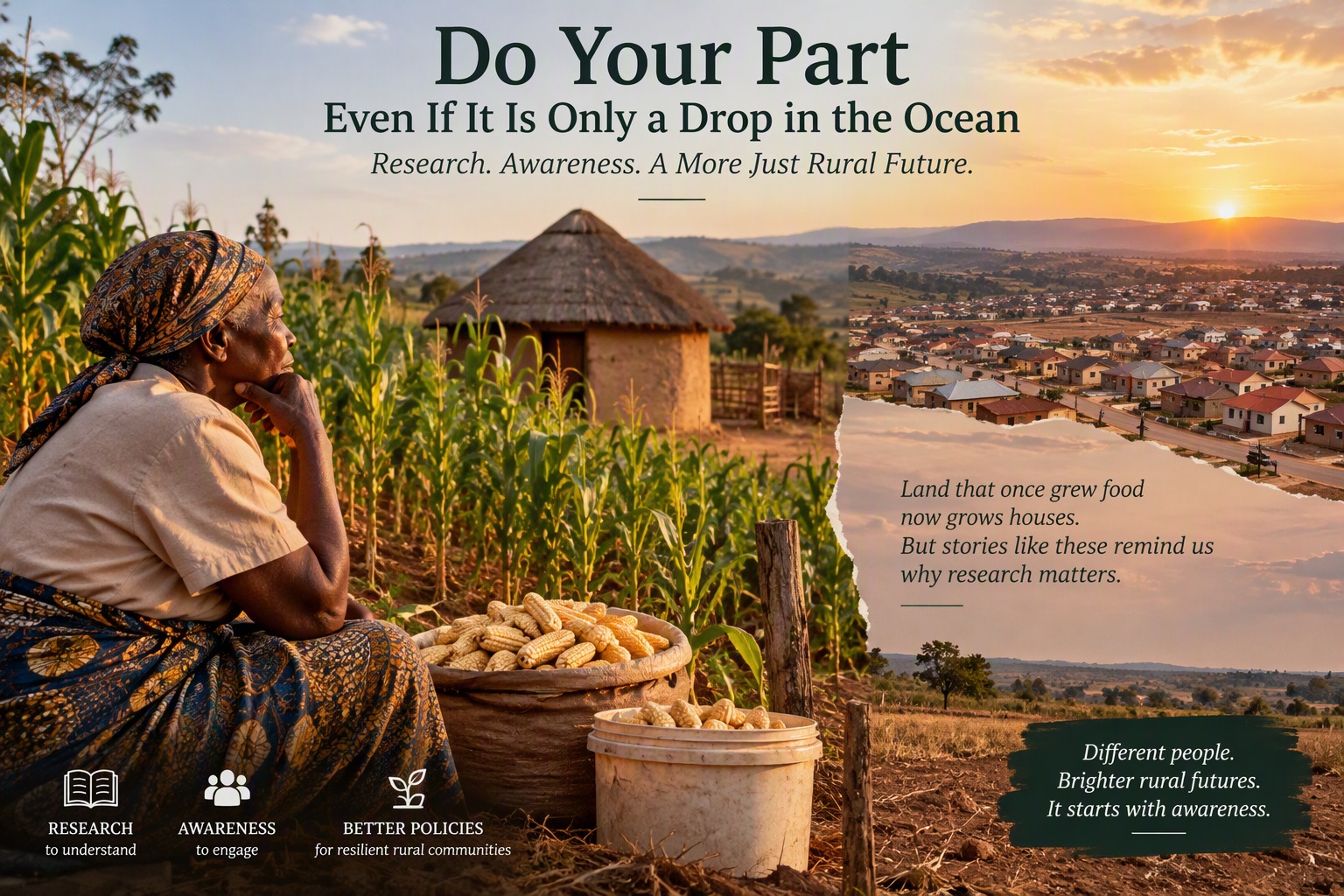
    One issue that concerns me greatly is the decline of subsistence farming in rural landscapes as land previously used for farming is converted to other uses, particularly residential development.

    Growing up, my grandmother had a number of masimu, or farming plots, which she cultivated every season. I remember her small, circular storage hut being filled with maize after harvest. In many years, that harvest would sustain the household until the following season.

    A few years after I enrolled at university, however, the subsistence farmers in our area were told to stop cultivating their plots. The land was no longer going to be available for farming. It was going to be demarcated into residential stands.

    Today, a large settlement occupies the land where those fields once stood.

    There was very little that the individual subsistence farmers could do about it.

    My grandmother did not suddenly lose her desire to farm because she had lost the land. She kept some of her maize seeds in buckets, hoping that one day she would find another piece of land where she could plant them.

    She never did.

    Even after relocating back to the village where she was born, she never found land on which she could continue farming. She passed away still having never had that opportunity.

    Later, I began thinking that perhaps my grandmother’s experience was not unique. There might be many other people whose farming land had disappeared beneath expanding rural settlements. I had also observed similar conversion of farming plots around Nobody Ga-Mothiba, outside Mankweng.

    That led me back to the question I have repeatedly raised in these posts:

    What can I actually do about it?

    I cannot allocate land. I cannot prevent a traditional authority or municipality from converting agricultural land to residential use. I cannot personally change South Africa’s rural land-tenure system.

    But I can research the problem.

    Together with Tabaro Kabanda, I subsequently published Declining land for subsistence and small-scale farming in South Africa: A case study of Thulamela local municipality in Land Use Policy.

    The study used Landsat imagery from 2005, 2013, and 2020 and found a general decline in agricultural land alongside an increase in built-up areas. Agricultural fallow land declined from 26% to 8%, representing a 69% reduction in its extent.

    Importantly, the research did not treat what was happening merely as a land-cover change. It linked the decline of agricultural land and its conversion to built-up areas to weaknesses in land-use management in rural areas characterised by customary land-tenure rights. It also identified a particular problem with land-use schemes: vacant and unsurveyed land can be broadly classified as agricultural land, making it difficult to distinguish and protect productive land actually being used by subsistence and small-scale farmers.

    The paper therefore recommended that suitable agricultural land, including land already being used for subsistence and small-scale farming, should be clearly categorised as an arable-use zone in municipal land-use schemes. It further recommended measures to strengthen the tenure rights of subsistence farmers.

    Did publishing the paper solve the problem?

    No.

    The settlement that replaced the masimu is still there. My grandmother never got her farming land back. And I cannot determine whether the recommendations in the paper will ever influence land-use policy.

    But that is precisely the point.

    Solving the entire problem was never within my control. Researching it was.

    Sometimes doing your part does not mean that you will see the problem resolved. It means contributing what you are capable of contributing.

    My research may ultimately amount to no more than a drop of water in an ocean. But an ocean is made of drops.

    So I did my part.

    And perhaps that is enough.

    Join the conversation

    Have you ever recognised a problem that was too large for you to solve, but still decided to contribute the little that was within your control?

  • Post 2: A Journey Shaped by Circumstance

    Post 2: A Journey Shaped by Circumstance

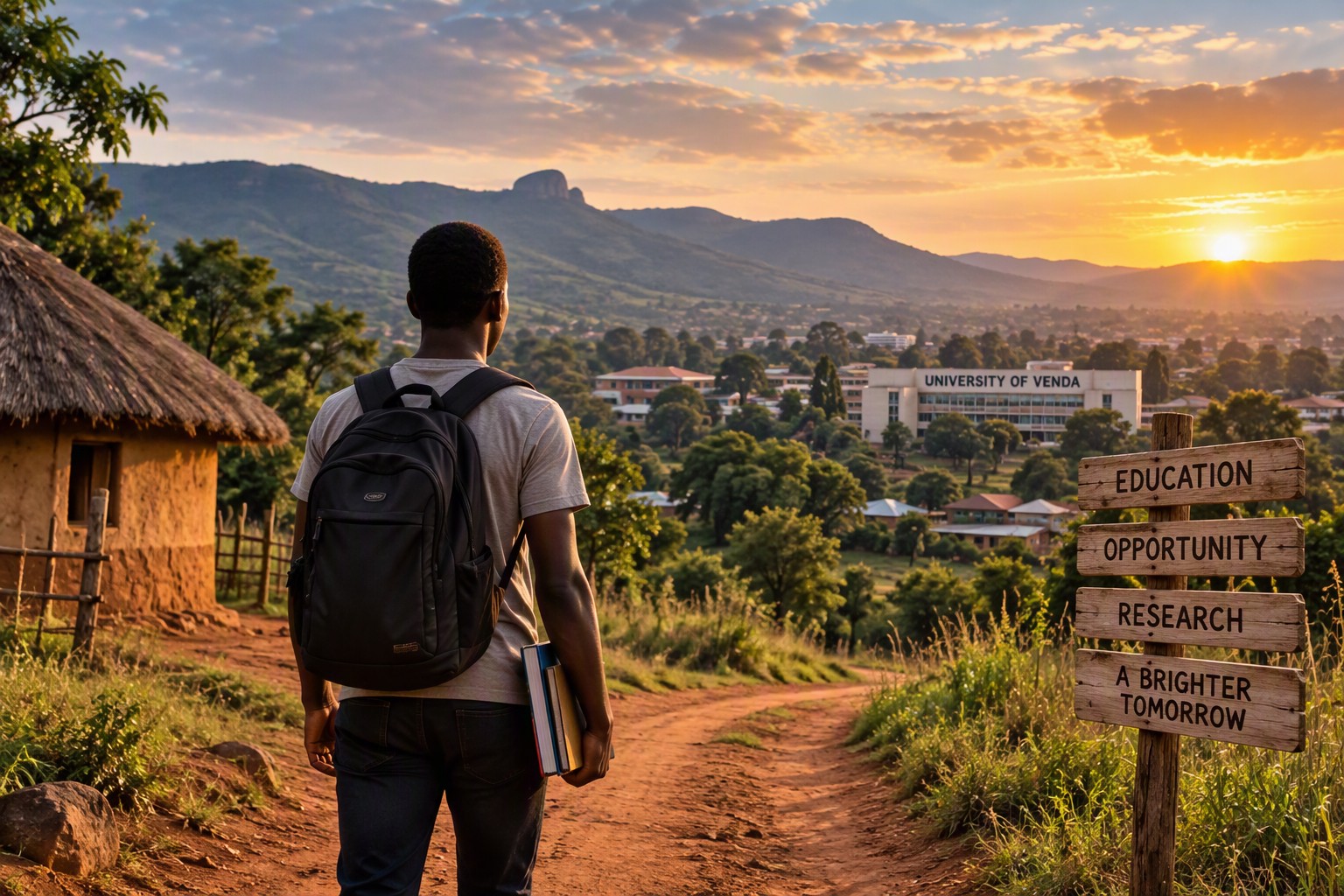
    After matriculating from a village secondary school with merit, including a distinction in Biology and TshiVenda, and a B+ in Geography, I embarked on an academic journey that began with enrolling at a local university, the University of Venda, for a degree in Environmental Sciences.

    Coming from a humble financial background, I knew that entering the workforce immediately after completing my undergraduate degree would be a challenge. Entering the job market requires financial resources that are easy to overlook: travelling to interviews, relocating after an appointment, securing accommodation, and surviving financially until the first salary arrives.

    Coming from a village made this challenge even greater. There were few, if any, opportunities for graduates within the immediate surroundings. Finding employment meant being prepared to relocate to towns, cities, or even other provinces where opportunities were available.

    The financial burden associated with taking up a first job, which often comes in the form of an internship or an entry-level position, can be substantial. Relocation requires money for the first month’s rent, a deposit, basic furniture, groceries, transport, and other necessities. I knew that my family’s financial circumstances did not afford me the luxury of entering the job market without these resources.

    Before completing my undergraduate degree, I therefore made a decision: instead of immediately entering the job market, I would continue with postgraduate studies.

    As luck would have it, the rural landscape still had a great deal to teach me.

    Or was it luck?

    Was it fate, circumstance, or the influence of forces beyond what humans can readily explain? In the absence of scientific evidence to prove or disprove such possibilities, we can only speculate. Whatever the reason, the decision to continue studying would profoundly influence the direction of my academic journey.

    After enrolling for an Honours degree in Environmental Sciences, specialising in Geography, at the University of Venda, I quickly discovered that I had a keen interest in Geographic Information Systems (GIS), Remote Sensing, research, scientific enquiry and academic writing.

    It was during this period that I was formally introduced to research methods, geographical thought and research methodologies. One lesson in particular stayed with me: a research problem does not always have to be found somewhere far away. Sometimes, you simply have to look carefully at what is happening around you.

    I learned that a researcher could observe their immediate environment, identify environmental or socio-economic challenges, and investigate those challenges from a geographical perspective. Research questions could emerge from the landscape itself, from the experiences of communities, and from patterns that were visible in everyday life.

    I also learned another route to identifying research problems: engaging with existing academic literature. By reading previous studies, examining their recommendations and identifying gaps in existing knowledge, a researcher could find questions that had not yet been adequately answered.

    Throughout my academic journey, I would eventually employ both approaches.

    I would look at the literature.

    But I would also look outside.

    And, once again, the village would give me something to investigate.

  • Post 1: When the Village Becomes Your Classroom

    Post 1: When the Village Becomes Your Classroom

    I grew up in Tshivhulani, a village outside the small town of Sibasa. I attended Tshivhulani Primary School and later Nthetsheleseni Secondary School. However, much of what shaped my understanding of life came from outside the classroom.

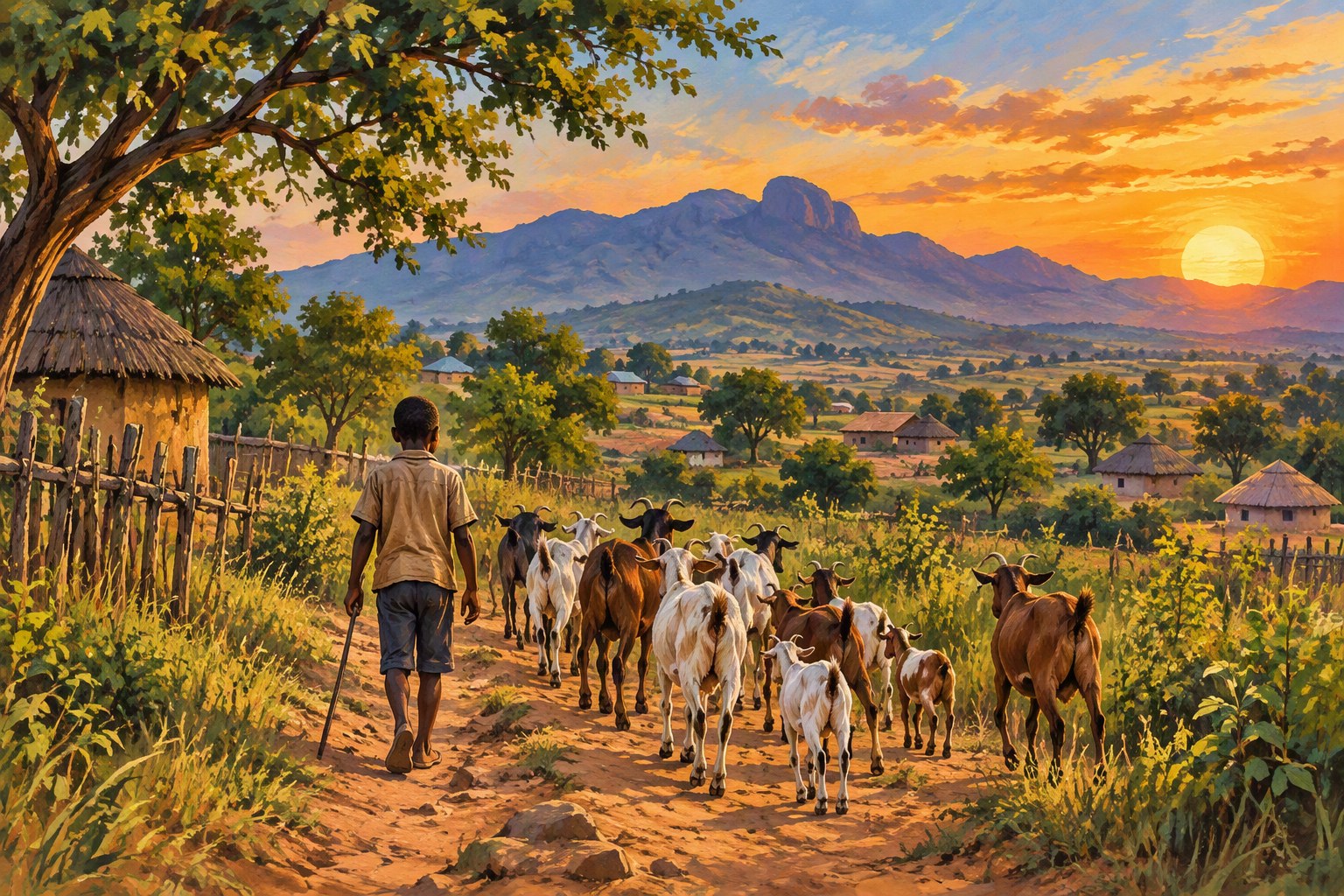
    Growing up as a young boy in the village, you looked up to the older boys. After school, they would take the livestock, mainly goats and cattle, out to graze. As a younger boy, you admired them, but you were not yet allowed to follow. Their world seemed adventurous and somehow beyond your age.

    Then, almost without noticing it, you became old enough to tag along.

    That opened another world. You began to experience the life of a herder: moving through the landscape with livestock, learning where animals could graze and, at the same time, discovering the veld for yourself. There was responsibility, but there was also freedom. You learned to balance looking after the animals with playing, exploring, and foraging for wild fruits and berries.

    Eventually, another transition occurred. The older boys outgrew the responsibility, and suddenly you were no longer merely tagging along. The livestock had become your responsibility.

    Herding was only one part of village life. There was water to collect from communal taps and boreholes, gardens to tend and subsistence maize farming to participate in. Farming followed the seasons: preparing the land, tilling the soil, planting after the first summer rains, weeding as the crops grew, and harvesting during winter.

    Yet childhood was not simply a catalogue of responsibilities.

    There was always play.

    Street soccer required little more than an open space and something that could serve as a ball. Toys did not necessarily come from shops. Wire and other available materials could become handcrafted cars, giving children the opportunity not merely to play with things, but to make the very things they played with.

    And all of this had to coexist with other obligations: doing chores for elders, participating in cultural and social life, attending initiation school and, throughout it all, continuing with formal schooling.

    Looking back, I realise that these activities were doing more than keeping a village boy occupied.

    They were teaching.

    Herding taught responsibility before I had a word for it. Exploring the grazing lands taught me to observe landscapes long before I encountered geography as an academic discipline. Farming made seasons, rainfall, soil and vegetation part of lived experience rather than abstract concepts. Making our own toys encouraged imagination and improvisation. Responsibilities towards elders placed the individual within a wider social world.

    Formal schooling was therefore not the beginning of learning. It was another form of learning added to those that already existed.

    Perhaps this is where The Philosophy of a Village Boy begins.

    It begins with the possibility that a village is not simply a place from which one comes. It can also be a place from which one thinks.