
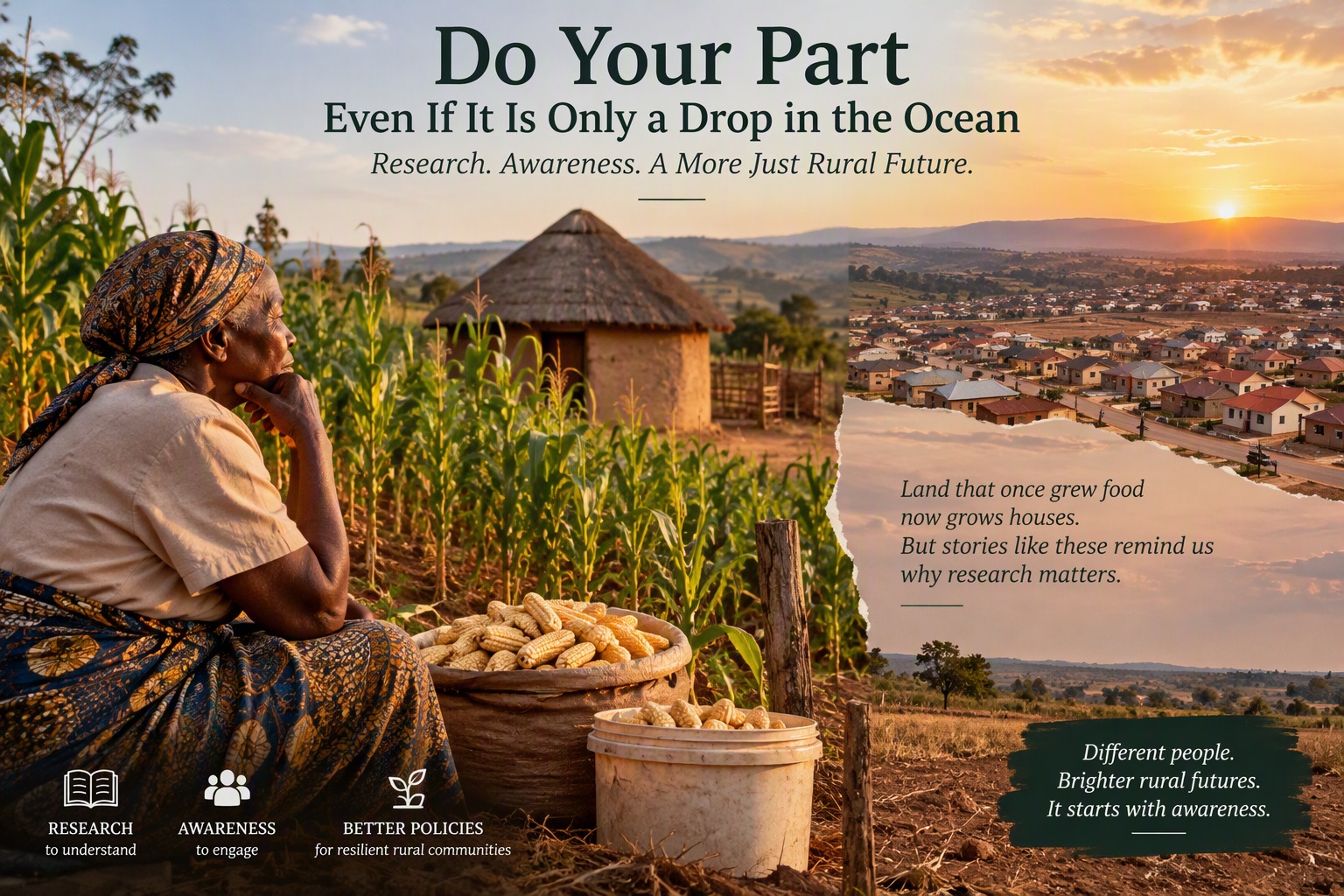
As previously mentioned in Post 2, geographical research problems can sometimes be identified simply by observing one’s immediate surroundings. Having been born and raised in a rural area, when I look at rural landscapes from a researcher’s perspective, I see many issues that could potentially be addressed through research and policy interventions.
Sometimes, I manage to do the little that is within my control: conduct research and publish the findings in peer-reviewed journals. What happens beyond that is often outside my control. I cannot necessarily influence policy or ensure that recommendations from my research are implemented.
Again, the approach is the same one that has appeared throughout the previous posts: identify the problem, identify what is within your control, and focus on that.
When Masimu Disappear
One issue that concerns me greatly is the decline of subsistence farming in rural landscapes as land previously used for farming is converted to other uses, particularly residential development.
Growing up, my grandmother had a number of masimu, or farming plots, which she cultivated every season. I remember her small, circular storage hut being filled with maize after harvest. In many years, that harvest would sustain the household until the following season.
A few years after I enrolled at university, however, the subsistence farmers in our area were told to stop cultivating their plots. The land was no longer going to be available for farming. It was going to be demarcated into residential stands.
Today, a large settlement occupies the land where those fields once stood.
There was very little that the individual subsistence farmers could do about it.
My grandmother did not suddenly lose her desire to farm because she had lost the land. She kept some of her maize seeds in buckets, hoping that one day she would find another piece of land where she could plant them.
She never did.
Even after relocating back to the village where she was born, she never found land on which she could continue farming. She passed away still having never had that opportunity.
Later, I began thinking that perhaps my grandmother’s experience was not unique. There might be many other people whose farming land had disappeared beneath expanding rural settlements. I had also observed similar conversion of farming plots around Nobody Ga-Mothiba, outside Mankweng.
That led me back to the question I have repeatedly raised in these posts:
What can I actually do about it?
I cannot allocate land. I cannot prevent a traditional authority or municipality from converting agricultural land to residential use. I cannot personally change South Africa’s rural land-tenure system.
But I can research the problem.
Together with Tabaro Kabanda, I subsequently published Declining land for subsistence and small-scale farming in South Africa: A case study of Thulamela local municipality in Land Use Policy.
The study used Landsat imagery from 2005, 2013, and 2020 and found a general decline in agricultural land alongside an increase in built-up areas. Agricultural fallow land declined from 26% to 8%, representing a 69% reduction in its extent.
Importantly, the research did not treat what was happening merely as a land-cover change. It linked the decline of agricultural land and its conversion to built-up areas to weaknesses in land-use management in rural areas characterised by customary land-tenure rights. It also identified a particular problem with land-use schemes: vacant and unsurveyed land can be broadly classified as agricultural land, making it difficult to distinguish and protect productive land actually being used by subsistence and small-scale farmers.
The paper therefore recommended that suitable agricultural land, including land already being used for subsistence and small-scale farming, should be clearly categorised as an arable-use zone in municipal land-use schemes. It further recommended measures to strengthen the tenure rights of subsistence farmers.
Did publishing the paper solve the problem?
No.
The settlement that replaced the masimu is still there. My grandmother never got her farming land back. And I cannot determine whether the recommendations in the paper will ever influence land-use policy.
But that is precisely the point.
Solving the entire problem was never within my control. Researching it was.
Sometimes doing your part does not mean that you will see the problem resolved. It means contributing what you are capable of contributing.
My research may ultimately amount to no more than a drop of water in an ocean. But an ocean is made of drops.
So I did my part.
And perhaps that is enough.
Join the conversation
Have you ever recognised a problem that was too large for you to solve, but still decided to contribute the little that was within your control?
Leave a Reply