
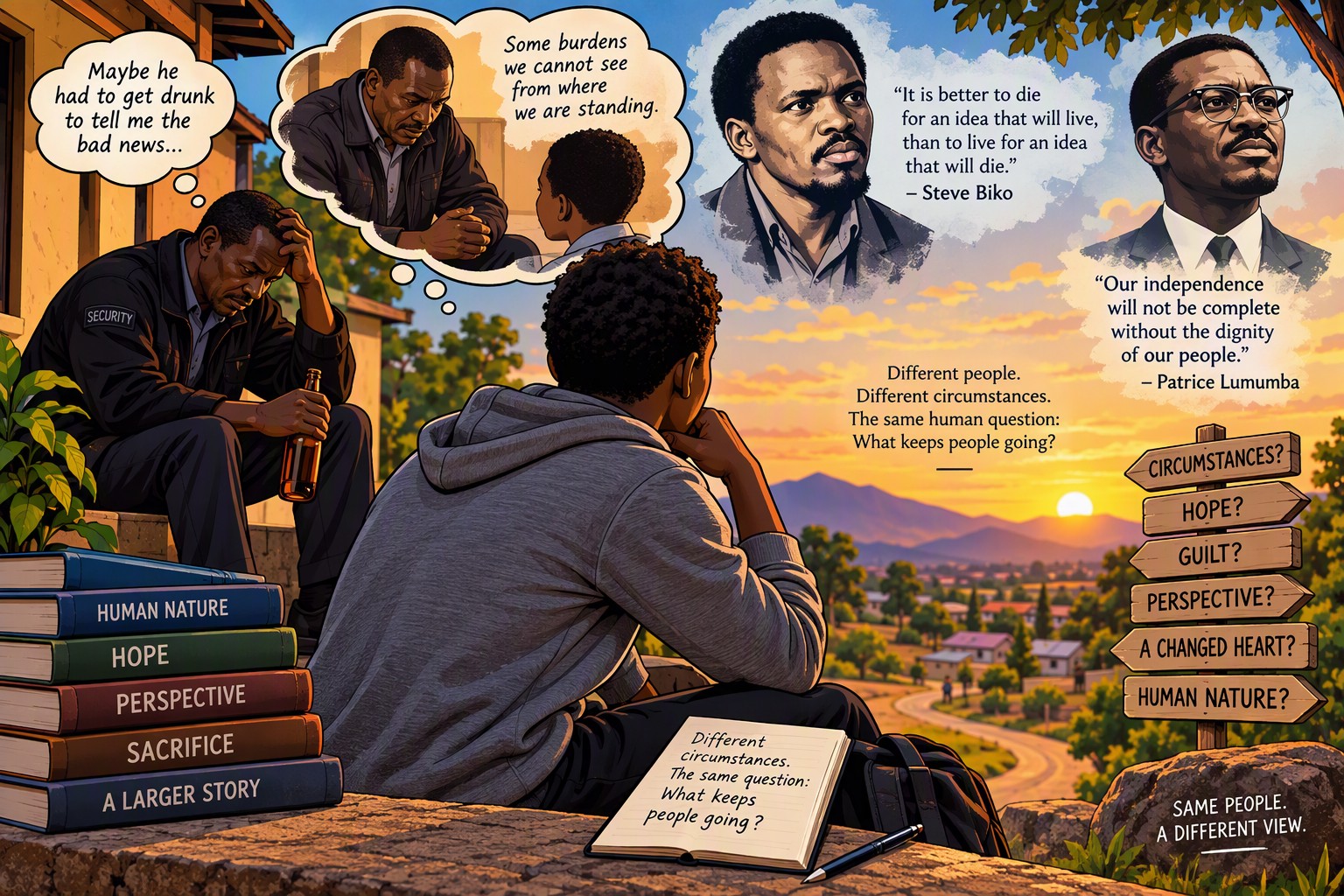
Looking back at the last few posts, one question keeps coming back to me.
What actually changed?
During my matric year, I had reached rock bottom in terms of family support. My school fees were unpaid, resources were almost nonexistent, and much of what I needed simply could not be provided.
Yet shortly afterwards, when I went to university, the picture changed.
My second uncle paid my first-year registration fees. My grandmother started using part of her pension to help with registration and my daily transport from the village to university and back home. My mother took odd jobs and assisted whenever she could.
Suddenly, everyone was chipping in.
So, was this really a change of heart?
I am beginning to think that perhaps“change of heart” is too simple an explanation.
Could it be that the care had always been there, but the means were not?
Could my family also have been overwhelmed by circumstances during those earlier years?
Or did something change when I matriculated, received a scholarship, and actually enrolled at university?
Perhaps what changed was hope.
What Was Happening on the Other Side?
There is something about my second uncle’s story that I keep returning to.
He was the security guard who paid my first-year university registration fees. He was also the uncle who would later confide in a family friend that it was not that he did not want to help me. He simply could not afford to do as much as he wanted.
That account becomes even more interesting when I connect it with something my cousin has maintained about an earlier incident.
My cousin’s view was that my uncle had to get drunk before he could come and deliver discouraging news to me.
Could that situation have been eating him inside more deeply than I understood at the time?
Could alcohol have been his way of summoning the courage to tell me something that he knew would hurt me?
I cannot know.
But when I put that account alongside what he later reportedly told the family friend, another picture begins to emerge.
Perhaps while I was struggling with the pain of not receiving the help I needed, he was struggling with the pain of not being able to provide it.
Could both of us have been suffering from the same situation, only from opposite sides?
I could see my unpaid school fees.
I could see that I did not have the resources I needed.
But could I see what it was doing to the people who could not provide those things?
I don’t think I could.
Perhaps that is the limitation of judging human behaviour only from where we are standing.
Could Hope Have Changed Everything?
There is another possibility that fascinates me.
Once I matriculated, received the scholarship and actually entered university, perhaps something that had previously looked uncertain suddenly became possible.
Maybe my progress restored hope.
And hope is a strange thing in the human condition.
Throughout history, people have endured extraordinary suffering because they believed that the future they were working towards was possible.
Steve Biko is widely credited with the words:
“It is better to die for an idea that will live, than to live for an idea that will die.”
Whatever one’s interpretation of Biko’s broader political philosophy, there is something profound in that statement about human beings and hope.
Patrice Lumumba expressed something similar under very different circumstances. In his final letter, he maintained his belief in the eventual triumph of Congo’s cause despite facing the possibility that he might not live to witness it. He wrote of his confidence in the destiny of his country and of a future that remained worth struggling for.
Their circumstances were obviously vastly different from my family’s circumstances, and I am not comparing my struggle with theirs.
What interests me is the human mechanism underneath.
What does hope do to people’s willingness to sacrifice?
Perhaps people can endure enormous hardship when they believe that something meaningful lies on the other side.
Could that have happened within my own family on a much smaller and more ordinary scale?
During matric, perhaps they saw an endless problem that they did not have the resources to solve.
But once I was at university, perhaps they saw a destination.
A degree.
A future.
A possibility.
And once tuition was covered by the scholarship, nobody had to solve the entire problem either. My second uncle could pay the first registration. My grandmother could help with later registration and daily transport. My mother could contribute whenever she found work.
Maybe the burden had become divisible.
Maybe hope had become believable.
And perhaps my perseverance had something to do with it too.
By continuing despite everything, matriculating, obtaining the scholarship, and actually reaching university, had I demonstrated that whatever little assistance they could provide might make a difference?
But that introduces another uncomfortable question.
Do people sometimes become more willing to support us once they can see evidence that we might succeed?
And if they do, is that really a change of heart?
Or is that simply another part of the human condition?
I don’t know.
Perhaps nothing fundamental changed in their hearts.
Perhaps circumstances changed.
Perhaps hope changed.
Perhaps what seemed possible changed.
Or perhaps all these things were happening simultaneously.
I can only speculate.
But the more I revisit these events, the more difficult it becomes for me to maintain the simple conclusion that people did not care.
There is an important difference between someone being unwilling to help you and someone desperately wanting to help you but being unable to do so.
The difficulty is that when you are the person who needs the help, the two can look the same.
Sometimes it takes years, and information you did not have at the time, before you begin to see the difference.
Join the conversation
Have you ever looked back at someone’s failure to help you and realised that you may not have understood what was happening on their side?


Leave a Reply