The Philosophy of a Village Boy

The Philosophy of a Village Boy explores knowledge, science, African spirituality, indigenous thought, identity, and the territory between experience and evidence.

Category: Philosophy, Spirituality & Meaning

Reflections on existence, consciousness, spirituality and meaning, bringing philosophical inquiry into conversation with African thought, lived experience, ancestral knowledge and questions about what it means to know and be human.

  • Post 35: Coincidence, Providence or Something Else?

    Post 35: Coincidence, Providence or Something Else?

    Looking backwards at this period of my life presents me with a problem.

    It is not simply a problem about whether dreams can carry messages.

    It is a problem about knowledge.

    How much can I honestly claim to know about something simply because I experienced it?

    The temptation to construct a clear explanation is strong.

    The pieces are there.

    I was living with uncertainty.

    I had a dream involving a great-grandfather I had never met.

    My grandmother recognised the description of her father.

    The message said that everything would be alright.

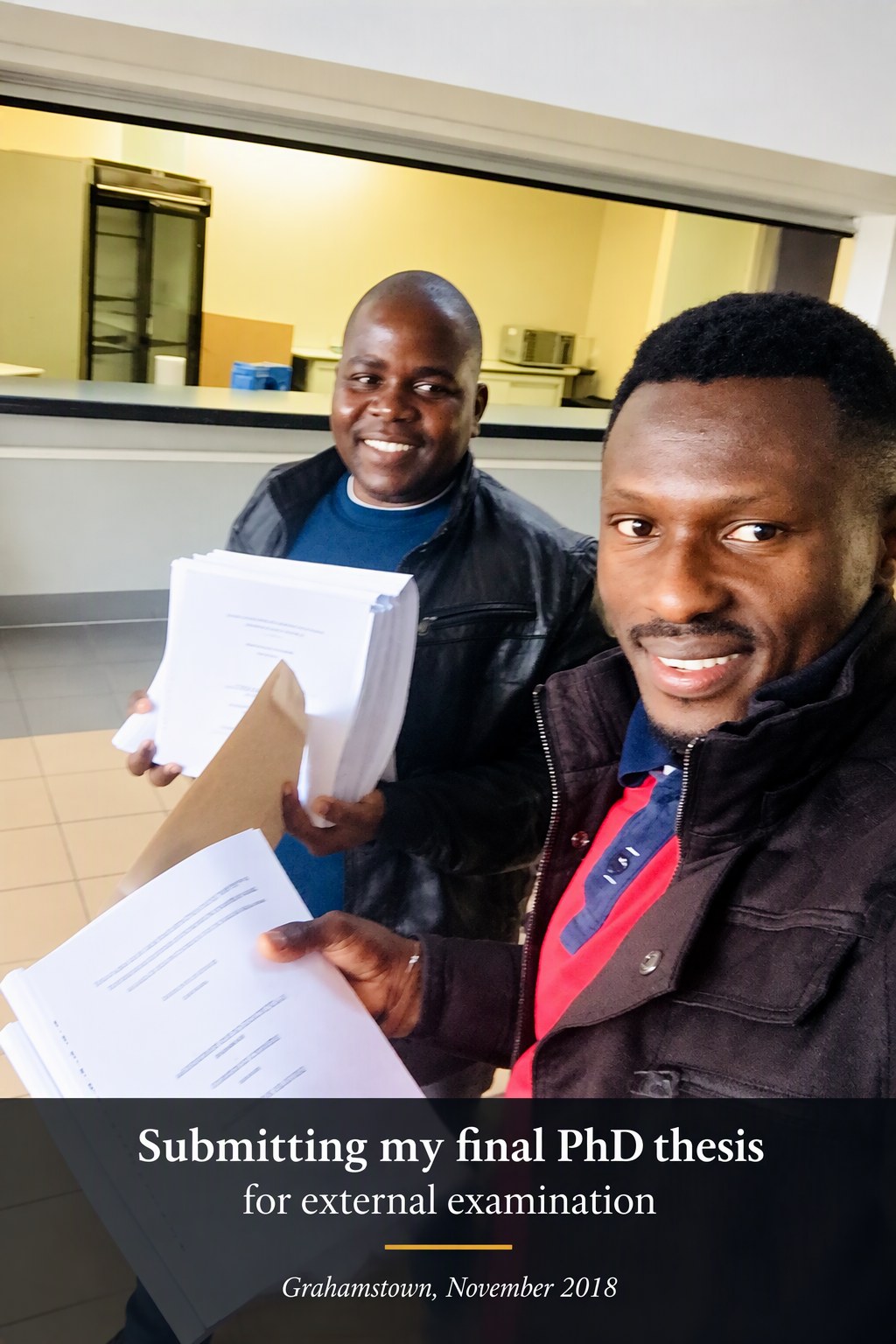
    Later, I submitted my final PhD thesis for external examination.

    My temporary employment reached what I believed was its end.

    I gave away my belongings and went home.

    I was unexpectedly called back.

    Before the new contract was properly finalised, an invitation for a permanent position arrived on my actual birthday.

    Permanent employment followed.

    Placed together, those events begin to look like a pattern.

    But is a pattern the same thing as an explanation?

    I don’t think so.

    Could It Have Been My Great-Grandfather?

    Someone approaching my experience through African spirituality might not find the dream particularly difficult to interpret.

    My great-grandfather wanted to reassure his daughter.

    I became the messenger.

    The traditional healer in the dream was simply the person through whom the message was communicated.

    From that perspective, perhaps the strongest part of the story is not even what happened afterwards.

    It is the description.

    How did I describe a man I had never met?

    The spiritual answer would be straightforward:

    Because the message came from him.

    I understand why someone would reach that conclusion.

    I have considered it myself.

    But does an explanation fitting the experience mean that the explanation has been proven?

    I don’t think I can go that far.

    What About God?

    A Christian could look at exactly the same events and interpret them differently.

    The answer would not necessarily be my great-grandfather.

    It could be God.

    The right people appeared at different stages of my journey.

    Opportunities emerged.

    The PhD moved towards completion.

    Temporary employment carried me through another uncertain period.

    Permanent employment eventually came.

    A Christian could look at that sequence and see providence.

    Again, I understand the interpretation.

    But understanding an interpretation is different from proving it.

    What About the Mind?

    There is another possibility.

    Perhaps I had heard descriptions of my great-grandfather somewhere earlier in my life.

    Maybe something was said when I was young.

    Maybe I saw something.

    Maybe I consciously forgot the source while the information itself remained somewhere in my memory.

    The human mind is capable of retaining information without always remembering where that information came from.

    Perhaps the uncertainties surrounding the PhD and employment gave the dream its emotional significance.

    Then, when circumstances later improved, the dream became even more important to me.

    That explanation cannot simply be dismissed either.

    Or Was It Chance?

    Perhaps none of these events were connected.

    I had spent years working towards the PhD, so eventually submitting the thesis was the result of that work.

    I had been applying for permanent employment, so eventually receiving an interview invitation was possible.

    Temporary contracts sometimes get extended.

    An interview invitation had to arrive on some date. It happened to arrive on my birthday.

    Perhaps each event had its own explanation.

    Then afterwards, I connected them into a story.

    That is possible.

    But there is something about the word chance that I also find interesting.

    Sometimes humans use the word as though naming something as chance has explained what happened.

    Has it?

    Or does it sometimes simply mean:

    I do not know of any causal connection between these events?

    Those are not necessarily the same statement.

    If I cannot prove ancestral intervention, that does not automatically prove coincidence.

    If I cannot prove divine intervention, that does not automatically establish a psychological explanation.

    And if science cannot currently establish a supernatural explanation for an experience, that does not mean that science has therefore demonstrated that the experience was meaningless.

    Perhaps sometimes the evidence simply does not allow a conclusion.

    What Can I Honestly Say?

    This is where I return to the facts of my own experience.

    I can say that I had the dream.

    I can say that I called my grandmother first thing the following morning.

    I can say that I described her father.

    I can say that she recognised the description.

    I can say that neither of us understood the message at the time.

    I can say that several important things in my life subsequently changed.

    What I cannot establish with the same confidence is why those things happened in that particular sequence.

    That is where interpretation begins.

    Perhaps my great-grandfather communicated with us.

    Perhaps God was working through circumstances I could not see.

    Perhaps my subconscious mind produced something extraordinary from information stored somewhere in my memory.

    Perhaps coincidence assembled a sequence that only appears meaningful when viewed retrospectively.

    Or perhaps there are possibilities that I have not even considered.

    I don’t know.

    And perhaps โ€œI don’t knowโ€ is not a weak answer.

    It may be the most honest one.

    I cannot say with certainty that my ancestors communicated with me.

    But I also cannot honestly dismiss my experience simply because I cannot prove its explanation.

    There is a difference between saying:

    โ€œI cannot prove this.โ€

    and saying:

    โ€œTherefore, this could not have happened.โ€

    The first recognises the limits of my knowledge.

    The second goes beyond those limits.

    Perhaps this is where I have become comfortable leaving some of these experiences.

    Not with certainty.

    Not with disbelief.

    With an open question.

    Because perhaps there are things humans experience long before they understand what those experiences mean.

    And perhaps there are some things we may never understand at all.

    Join the conversation

    When personal experience feels compelling, but its explanation cannot be proven, should we believe it, dismiss it, or simply have the humility to say, โ€œI don’t knowโ€?

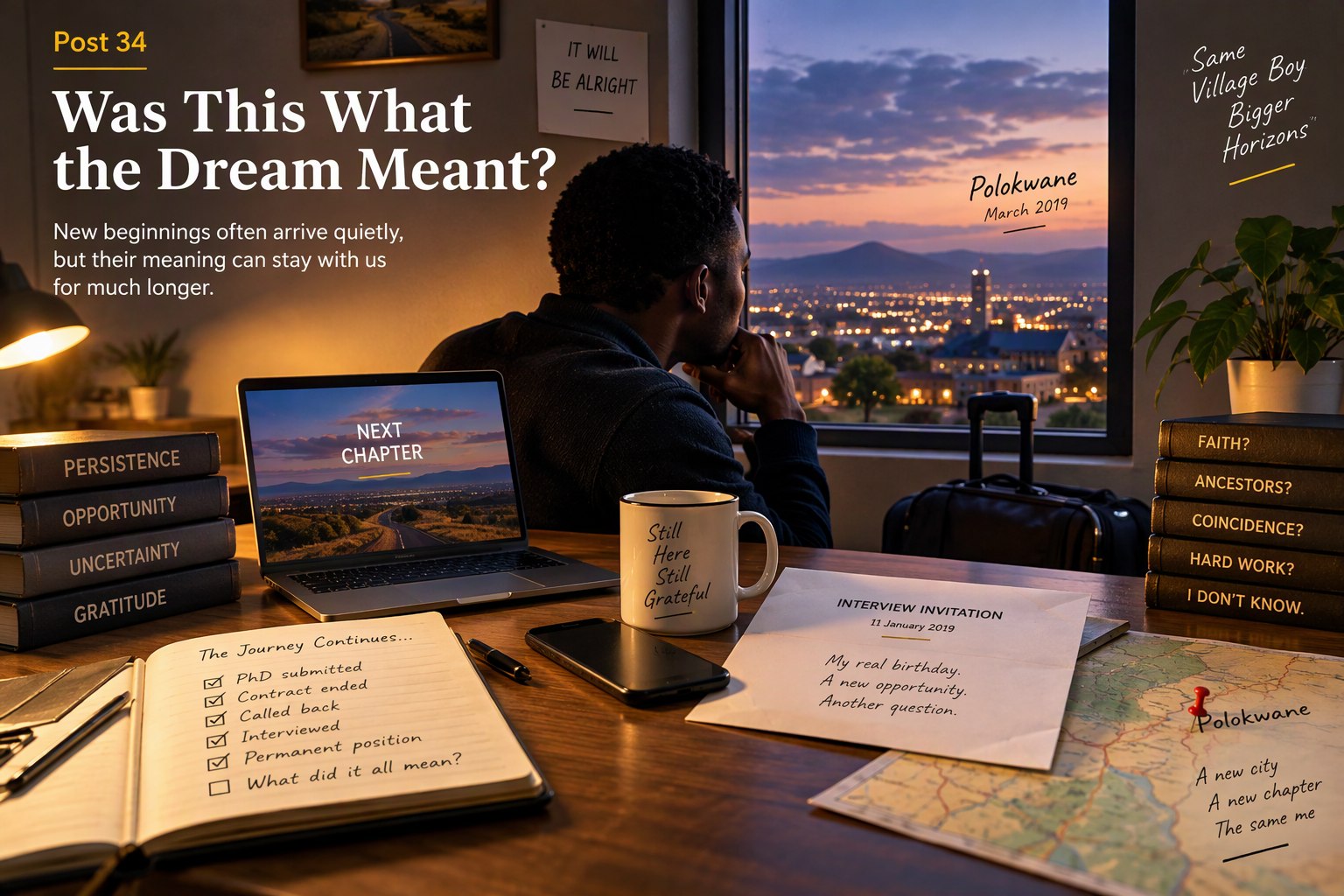
  • Post 34: Was This What the Dream Meant?

    Post 34: Was This What the Dream Meant?

    I attended the interview in January 2019.

    Then I waited.

    By that stage, waiting had become familiar to me.

    I had waited for opportunities. I had waited for funding. I had waited for different stages of the PhD journey to unfold. Now I was waiting again.

    Then the breakthrough came.

    I was offered the permanent position.

    In March 2019, I left George and started my first permanent job in Polokwane.

    After years of studying, internships, temporary work, financial uncertainty and applications, I finally had permanent employment.

    Naturally, my mind returned to the dream.

    โ€œYour father says you must not worry. Everything will be alright.โ€

    Was this what the message had meant?

    Looking backwards, it would be very easy for me to say yes.

    But can I honestly know that?

    The dream never said:

    You are going to get permanent employment.

    It never mentioned Polokwane.

    It never mentioned March 2019.

    In fact, the message was not even addressed directly to me.

    The traditional healer in the dream had told my grandmother:

    โ€œYour father says you must not worry.โ€

    Perhaps I was only the messenger.

    Perhaps what subsequently happened in my own life had nothing to do with the message at all.

    That possibility has to remain open.

    But there is something about the experience that I still struggle to explain.

    The permanent employment came afterwards.

    The description of my great-grandfather came before.

    I had never met him. He had died before I was born.

    Yet after the dream, before any of these later events occurred, I called my grandmother from George and asked her about her father.

    Was he tall?

    Was he slender?

    Was he a clean man who dressed well?

    Did he have that particular green jacket?

    She recognised the description.

    That telephone conversation happened before I knew what would happen with my employment.

    It happened before I submitted my final PhD thesis for external examination.

    It happened before I left George believing that my contract had ended.

    It happened before I was unexpectedly called back.

    And it happened before the invitation for a permanent position arrived on my actual birthday.

    That distinction matters to me.

    If something good had happened first and I later remembered a vague dream and attached meaning to it, retrospective interpretation would provide a fairly straightforward explanation.

    But the dream was important enough for me to call my grandmother when I had it.

    The message existed before the outcome.

    The question existed before the outcome.

    Neither my grandmother nor I knew what was supposed to become alright.

    Then, over the following months, several things that had been uncertain began to resolve.

    The final PhD thesis was submitted for external examination.

    The employment contract that I thought had ended was unexpectedly extended.

    Before that extension was even properly formalised, another opportunity opened.

    Then permanent employment followed.

    So was this what the dream meant?

    I still cannot say.

    Perhaps I had heard something about my great-grandfather earlier in life and forgotten where I had heard it.

    Perhaps information stored somewhere in my memory later appeared in the dream.

    Perhaps the dream and the events that followed were completely unrelated.

    Perhaps I am connecting them because I now know how the story ended.

    Those possibilities cannot simply be dismissed.

    But neither can I honestly say that I know that one of them must be the explanation.

    And perhaps this is where I have to separate two questions.

    What happened?

    That I can describe.

    Why did it happen that way?

    That is much harder.

    I cannot prove that my great-grandfather communicated through my dream.

    But neither can I prove that he did not.

    The permanent job did not settle that question.

    If anything, it gave me another reason to keep asking it.

    Months earlier, during a period of uncertainty, there had been a simple message:

    โ€œEverything will be alright.โ€

    Months later, several of the things that had been uncertain were beginning to become alright.

    Whether those two facts are connected is something I still cannot claim to know.

    Join the conversation

    When something meaningful happens before an outcome, how do we distinguish coincidence from a connection we simply do not understand?

  • Post 33: Everything Will Be Alright

    Post 33: Everything Will Be Alright

    In 2018, I was back in George, working on a one-year contract while completing my PhD.

    Although I was employed, there was still uncertainty about what would happen next. The contract was supposed to end in December, while the PhD journey was also approaching its final stages.

    It was during this period that I had a dream that has remained with me ever since.

    In the dream, my grandmother wanted me to accompany her to consult a traditional healer.

    At first, I refused.

    She said she would go alone.

    I felt guilty about allowing her to go by herself, so I decided to accompany her.

    When we arrived at the traditional healer’s place, we sat outside because he was still attending to another client.

    When he finished, he came out of the consultation hut just as my grandmother was about to enter.

    Instead of allowing her inside, he closed the door and greeted her outside.

    He was laughing.

    Then he asked my grandmother whether she was the daughter of a particular man.

    He started describing him.

    A tall, slender gentleman.

    A clean man who was always well dressed.

    He also described a particular green jacket that the man used to wear.

    My grandmother said yes.

    The man he was describing was her father.

    My great-grandfather.

    Then the traditional healer delivered a very simple message:

    โ€œYour father says you must not worry. Everything will be alright.โ€

    That was the dream.

    When I woke up the following morning, I was still in George.

    My grandmother was at home, far away from me.

    I called her first thing in the morning.

    Before telling her the entire dream, I started asking her questions.

    Was her father tall?

    Was he slender?

    Was he a clean man who dressed well?

    Did he have a particular green jacket that he used to wear?

    My grandmother was shocked.

    She wanted to know how I knew these things about her father.

    I had never met him. He had died before I was born.

    That was when I told her about the dream.

    I explained how we had gone together to consult a traditional healer and how the healer had described her father before giving her the message:

    โ€œYou must not worry. Everything will be alright.โ€

    But there was a problem.

    Neither my grandmother nor I knew what was supposed to be alright.

    The message did not say that I would get a job.

    It did not say anything about the PhD.

    It did not mention money.

    It did not give us a date.

    It simply said:

    Everything will be alright.

    So we were left with the message and a question:

    What was going to be alright?

    Life continued.

    In November 2018, I travelled from George to Grahamstown to submit my final PhD thesis for external examination.

    After everything that had happened during the PhD journey, the thesis was finally out of my hands.

    One uncertainty was moving towards resolution.

    Another remained.

    My one-year employment contract was supposed to expire in December.

    When I left George for the December holidays, I therefore left believing that my time there had come to an end.

    I acted accordingly.

    I gave away my belongings.

    My bed.

    My plates.

    My pots.

    As far as I knew, I was leaving George.

    I went home.

    Then, while I was at home, something unexpected happened.

    I was informed that I should return to work in January because the contract was going to be extended.

    So I returned to George.

    But there was still no new contract.

    We were told to continue working while the new contracts were being prepared.

    There was something almost strange about returning.

    Only weeks earlier, I had given away my belongings because I genuinely believed that this chapter had ended. Now I was back, working again, without even having the new contract in my hands.

    Then another opportunity appeared.

    On 11 January 2019, I received an invitation to attend an interview for a permanent GIS position.

    There was also a funny coincidence in the date.

    11 January is my real birthday, although it is not the date of birth recorded on my identity document.

    Did that mean anything?

    I did not know.

    Perhaps it was simply a coincidence.

    But I noticed it.

    I accepted the invitation and later attended the interview in January.

    By then, the dream had already happened.

    My grandmother had already heard me describe a father I had never met.

    She had already recognised him from the description.

    And she had already heard the message:

    โ€œYour father says you must not worry. Everything will be alright.โ€

    When that message came, neither of us knew what it meant.

    Since then, I had submitted my final PhD thesis for external examination.

    My temporary contract had reached what I believed was its end.

    I had given away my belongings and gone home.

    I had unexpectedly been called back to George.

    I had returned without a new contract having been signed.

    And now, before that situation had even fully settled, an invitation to interview for a permanent position had arrived on my actual birthday.

    At this point, I still did not know how the story would end.

    That matters to me.

    It is easy to look backwards at events after we already know the outcome and arrange them into a meaningful pattern.

    But at that moment, there was no outcome to work backwards from.

    When I called my grandmother after the dream, neither she nor I knew that I would submit my thesis in November, leave George in December believing that my job had ended, be unexpectedly called back, or receive an invitation for a permanent position on my birthday.

    We knew none of that.

    We had only the dream.

    We had the description of a man I had never met.

    And we had a message whose meaning neither of us understood:

    โ€œEverything will be alright.โ€

    Perhaps it was reassurance.

    Perhaps it was coincidence.

    Perhaps it was something else.

    At that point in the story, however, there was simply no way of knowing.

    There was only one unanswered question:

    What exactly was going to be alright?

    Join the conversation

    Have you ever experienced something that seemed meaningful before you had any idea what, if anything, it meant?

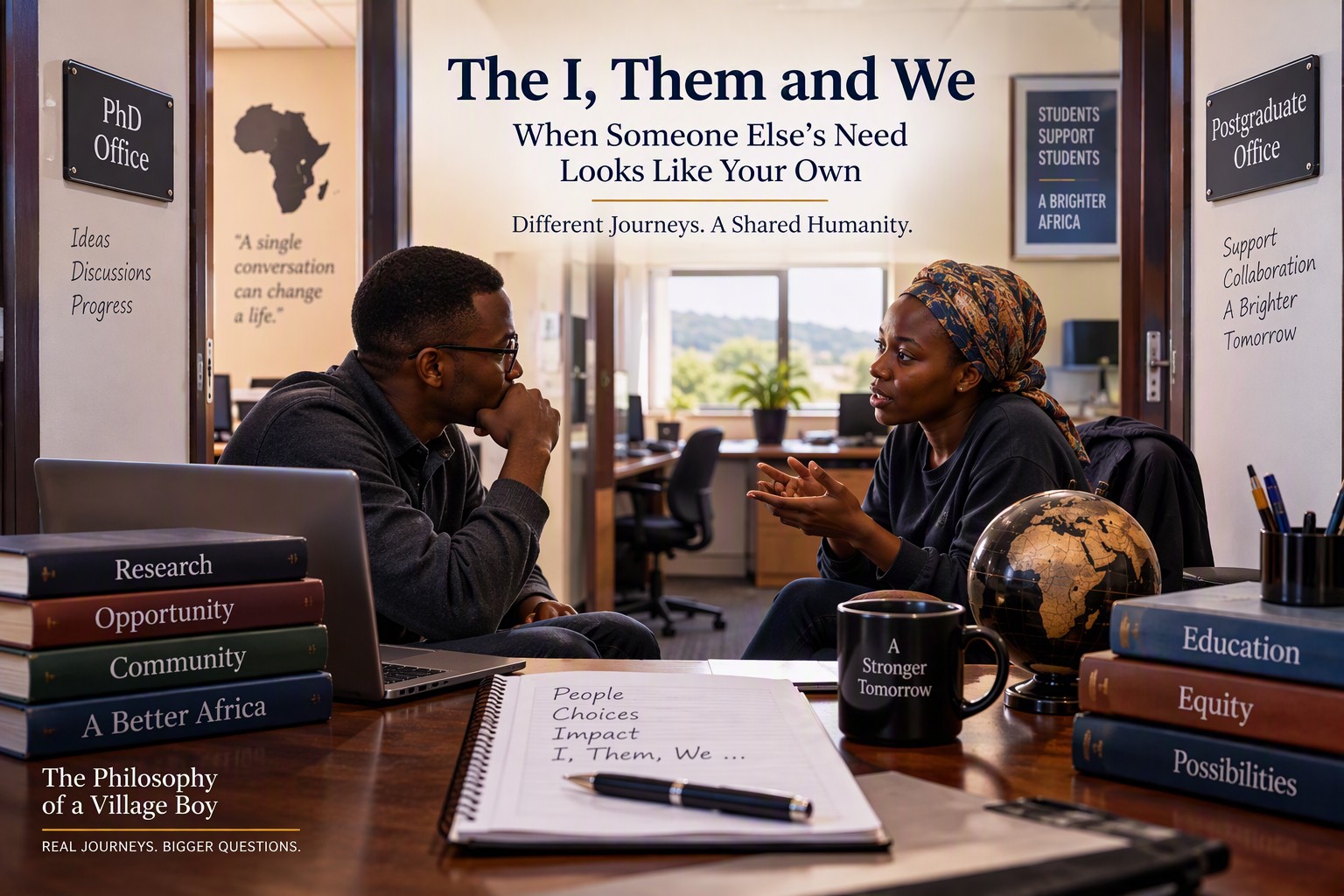
  • Post 29: The I, Them, and We

    Post 29: The I, Them, and We

    Postgraduate students worked from offices allocated to us at the university.

    Fellow students and interns worked from the postgraduate office next to ours. Although a wall physically separated the two rooms, that barrier meant very little socially. The offices faced each other, and the relationships among the students meant that we interacted regularly. In practice, we were part of the same university community.

    One in particular was a Zulu village girl from KwaZulu-Natal whose family circumstances were not very different from my own.

    A member of her extended family had played an important role in her journey. This person had supported her financially, helped put her through school, and she was staying with this family member while doing her internship.

    Then, during the December holidays, something changed.

    There was a fallout between them.

    Suddenly, the support and living arrangement she had depended on were no longer available.

    She was now on her own.

    The First-Month Problem

    She needed to return to Grahamstown, now called Makhanda, in the Eastern Cape, where she was doing her internship.

    But returning was no longer simply a question of transport.

    She had to find her own accommodation. She needed money for transport, rent, groceries, and the other expenses that came with establishing herself independently.

    Her internship would pay her, but that did not solve the immediate problem.

    She needed enough money to survive for that first month while waiting for her internship payment.

    There is something peculiar about situations like this.

    From the outside, a person can appear to have an opportunity. She had an internship. She would receive an income. There was a path forward.

    But between having an opportunity and being able to take advantage of it stood a much smaller, more immediate problem:

    How do you get there?

    How do you pay for transport?

    How do you secure accommodation?

    What do you eat while waiting for the first payment?

    She was at home and could not see how she would return to Grahamstown and continue with her internship.

    When she explained the problem to me, she didn’t know I had experienced something remarkably similar earlier in my own journey.

    I knew what it meant to have an opportunity waiting for you but not have the immediate financial resources required to reach it.

    Then she asked me for help.

    She proposed that I lend her the money and that she would repay me through monthly instalments once her internship payments started coming through.

    Under different circumstances, perhaps the decision would have been easy.

    But I had my own pressing needs.

    My Needs or Hers?

    The family house had been sold.

    My grandmother had relocated, and I was using some of my savings from the PhD scholarship to build a modest home that we could eventually call our own.

    At that stage, I was effectively homeless myself.

    Every amount of money had a purpose.

    Redirecting some of it elsewhere would delay construction of the house.

    Both needs were real.

    This was therefore not simply a question of whether I was willing to help someone.

    It was a question of competing objectives.

    There was something I needed.

    There was something she needed.

    And I had limited resources with which to address both.

    Whose need should come first?

    There was the I: my own legitimate needs.

    There was them: the needs of another person.

    And beyond the two sits a much larger consideration: we, the collective.

    Humans constantly have to make choices between these competing interests.

    Sometimes our own needs must come first.

    Sometimes another person’s need appears more urgent.

    And sometimes the interests of the larger collective may require individuals to sacrifice something of their own.

    But how do we decide?

    She Was Another Version of Me

    In this particular situation, something made the decision easier.

    I recognised her problem.

    I had lived a version of it.

    I knew what it was like when the difference between continuing with an opportunity and losing it could come down to something as ordinary as transport, accommodation, groceries, or having enough money to survive until another source of income became available.

    I looked at what I needed.

    Then I looked at what she needed.

    If I redirected some of my money, construction of the house would slow down.

    But it would continue.

    If she could not return to Grahamstown, the consequences for her internship could be much greater.

    Her immediate need seemed greater than mine.

    And when I looked at her circumstances, I could see something of my own earlier journey.

    She was, in some ways, another version of me.

    So I lent her the money.

    Construction slowed down.

    She returned to Grahamstown, secured her own accommodation and continued with her internship.

    And, as she had promised, she repaid the money through monthly instalments.

    Our Journeys Continued

    Her internship was not the end of her journey.

    After completing it, she moved to Cape Town to further her studies.

    Our relationship also did not end with that loan.

    Over the years, there were other occasions when I assisted her as she continued along her academic and professional journey.

    But there is something important that must not disappear from this story:

    She also assisted me.

    The assistance between us did not move permanently in one direction.

    At one point, I happened to be in a position to respond to a problem she was facing. At other points in our lives, circumstances were different, and she was able to assist me.

    That complicates the distinction between I and them.

    Perhaps those positions are not as fixed as they sometimes appear.

    Today I may be the person with something to give.

    Tomorrow I may be the person who needs someone else.

    And perhaps neither of us knows, at the moment of helping, how those positions may eventually change.

    Years Later

    Much later, when we spoke about those years again, she reminded me of some of the assistance I had given her.

    Interestingly, I could not remember every individual act she mentioned.

    But I remembered why I helped.

    I told her:

    I saw myself in her.

    She agreed.

    Perhaps that tells me more about my original decision than trying to reconstruct every individual act of assistance.

    I was not looking at her circumstances entirely from the outside.

    Her struggle was familiar because I had lived a version of it myself.

    But that realisation creates another question.

    Would I have made the same decision if I could not see myself in her?

    The I, Them and We

    This is where that relatively simple financial decision becomes philosophically interesting to me.

    Humans constantly negotiate between I, them, and we.

    The individual has legitimate needs.

    So does the person standing in front of us.

    Beyond both are families, communities, societies, and humanity collectively.

    But resources are limited.

    Choosing one objective can mean postponing another.

    In this particular situation, I chose โ€œthemโ€ over โ€œIโ€, at least temporarily. I delayed something I needed because another person’s immediate need seemed greater.

    But I do not think that means โ€œthemโ€ should always come before โ€œIโ€.

    There must surely be circumstances in which choosing โ€œIโ€ is both reasonable and necessary.

    The more difficult question is how we make that distinction.

    And knowing how our relationship developed later makes the categories even less certain.

    Who exactly is โ€œthemโ€?

    The person who needs my help today may be the person who helps me tomorrow.

    Perhaps โ€œIโ€ and โ€œthemโ€ sometimes describe temporary positions rather than permanent identities.

    That possibility brings me closer to โ€œwe.โ€

    Not because everyone will help everyone else.

    Not because every act of assistance will eventually be returned.

    And certainly not because helping another person should be treated as an investment from which repayment is expected.

    When I lent her the money, I did not know what future circumstances would bring.

    I was responding to the situation in front of me.

    But looking backwards, I can see something that I could not have known then: human beings move between these positions.

    Sometimes we have.

    Sometimes we need.

    Sometimes we give.

    Sometimes we receive.

    And perhaps this is one reason the boundary between our individual interests and the interests of others deserves closer examination.

    My experience also raises another question that I find even more uncomfortable:

    How much of our willingness to help other people depends on our ability to recognise something of ourselves in them?

    Would I have moved the resources in the same way if her circumstances had been completely foreign to me?

    I do not know.

    Perhaps that is precisely why the question is worth asking.

    In her situation, I knew what it was like to have an opportunity in front of you but struggle to reach it because of something as basic as money.

    I had been there before.

    This time, however, I was standing on the other side of the problem.

    And years later, I would discover that neither of us would remain permanently on one side.

    Join the conversation

    When your own legitimate needs compete with another person’s immediate need, what should determine whether you choose โ€œI,โ€ โ€œthem,โ€ or the wider โ€œweโ€? And does knowing that any of us may one day move from the position of giver to receiver change how we should think about helping one another?

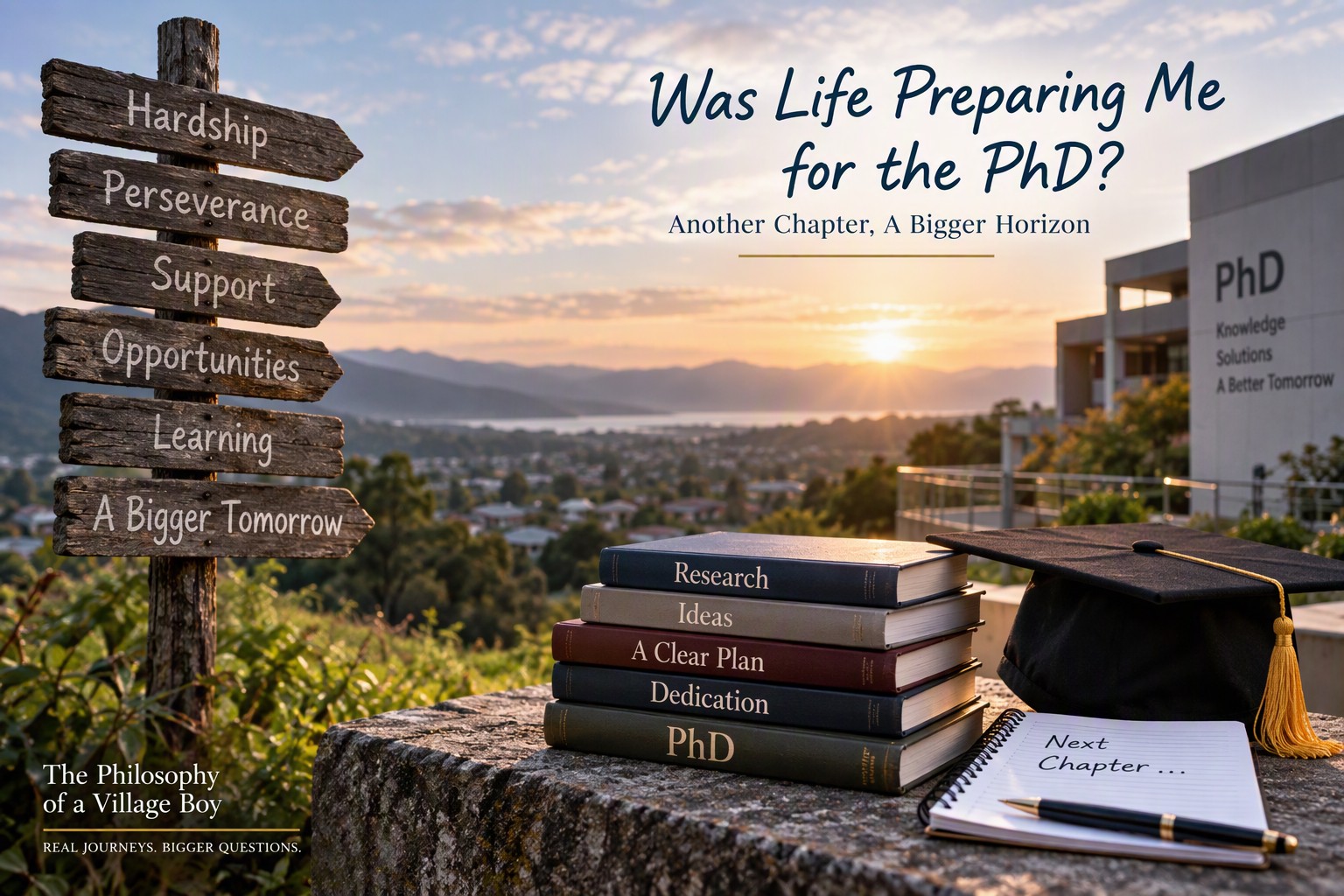
  • Post 26: Was Life Preparing Me for the PhD?

    Post 26: Was Life Preparing Me for the PhD?

    The journey had already been shaped by hardship, perseverance, hard work, dedication, humility and planning.

    There had also been interventions from people who saw potential in me and decided to help. Then there were unforeseen events that created much-needed twists and relief.

    And, as I reflected in Post 25, there were events for which different people could offer very different explanations. Science may speak of probability, circumstances, cause and effect. Religion or spirituality may offer explanations involving God, ancestors or some greater purpose. Neither necessarily provides a conclusive explanation for the entire sequence of events.

    All of this had now brought me to another chapter of my life.

    I was going to pursue a PhD.

    Another Kind of Challenge

    A PhD requires a clear plan, clear and realistic objectives, dedication and sustained hard work.

    These were not entirely new demands.

    Throughout my journey, I had already been required to develop many of these qualities, sometimes without even recognising that I was doing so.

    When financial difficulties threatened my studies, I had learned to identify the immediate problem and focus on what was within my control. When I needed employment, I developed a plan and continued applying. When professional registration became important, I deliberately pursued it.

    Now the objective was different, but the approach was familiar.

    Looking backwards, it almost seems as though life had been preparing me for what came next.

    But was it?

    Was life really preparing me for a PhD, or does it only look like preparation because I now know where the journey eventually led?

    That is difficult to answer.

    What I do know is that by the time the PhD opportunity arrived, I had already developed many of the qualities I would need to pursue it.

    The Scholarship Changed the Equation

    There was also one major difference between this stage and some of my earlier experiences at university.

    This time, I had funding.

    The PhD opportunity came with a scholarship that covered registration and tuition fees. It also provided a monthly stipend that catered for my living expenses and more.

    For someone whose educational journey had repeatedly been complicated by financial difficulties, that mattered.

    For once, the immediate struggle was not simply about finding enough money to remain at university.

    But having funding did not mean that the journey would suddenly become straightforward.

    The PhD would bring challenges of its own.

    It would also bring friendships, professional networks, international travel and experiences that I could not have imagined when I first started university.

    My world was about to become considerably bigger.

    Join the conversation

    When you look back at your own journey, have there been experiences that only later appeared to have been preparing you for something you could not see at the time?


  • Post 25: When Explaining the Parts Does Not Explain the Whole

    Post 25: When Explaining the Parts Does Not Explain the Whole

    Reflection on Posts 21โ€“24

    Posts 21 to 24 describe a period of my journey that took me from an internship in Polokwane to a short-term GIS position in George, and eventually to a PhD at Rhodes University.

    Each event can be explained individually.

    But does explaining each event necessarily explain the whole?

    What I Used to Tell People

    I used to say that if I told people the story of my life and then told them that God exists, or that my ancestors had been behind me all the way, they would believe me.

    I was not saying that my life proves that God exists, or that my ancestors were directing my journey.

    My point was about interpretation.

    Tell the story to someone who already believes in God and conclude that God was guiding the journey, and that person may agree.

    Tell the same story to someone who believes in ancestral guidance and conclude that the ancestors were behind it, and that person may also agree.

    Someone approaching the same story from a naturalistic perspective may instead see human decisions, circumstances, social networks, probability, and chance.

    The events remain the same.

    The explanation changes.

    So how do we determine which explanation, if any, is justified?

    What Can Science Explain?

    Science can explain much of my journey without requiring supernatural intervention.

    Financial relief during my Master’s changed what was possible. Education gave me qualifications. Applying for jobs exposed me to opportunities. The internship gave me professional experience. Going to George changed my professional environment. My work allowed another professional to assess my capabilities. Mentorship exposed me to opportunities I did not know about.

    My actions clearly mattered.

    But perhaps actions do not necessarily determine outcomes. Perhaps they alter the probability of certain outcomes becoming possible.

    That distinction matters.

    I could control whether I applied for a scholarship. I could not control whether a scholarship existed.

    I could decide to go to George. I could not control who would later be appointed there.

    I could demonstrate my abilities through my work. I could not control whether someone would see enough potential in that work to advocate for me.

    My agency operated within circumstances I did not control.

    What Were the Chances?

    It is tempting to look at the sequence and ask: what were the chances?

    There was the financial relief during my Master’s, the GIS internship, my decision to leave an extended internship for a short-term contract in George, the later appointment of the GIS manager, our professional interaction, the unsuccessful first scholarship application, the second opportunity, and the motivational letter written without my knowledge.

    But I cannot simply assign probabilities to these events and multiply them.

    They were not independent. One event changed the circumstances in which the next occurred. My education influenced my employment prospects. My internship changed my experience. My experience affected subsequent opportunities. Going to George changed the professional environment in which my career continued.

    And then there is hindsight.

    Am I connecting these events simply because I now know where they led? Perhaps. But even if hindsight explains why I find the sequence significant, does it explain why the sequence happened?

    I cannot calculate a meaningful numerical probability for the life I have lived. There are too many dependent events and unknown alternatives.

    What I can say is that the outcome depended on a chain of events, some influenced by my decisions and others entirely outside my control.

    That is the part I am trying to understand.

    Where Does the Mental Schema Fit?

    I have previously considered whether the mental schema explains some of these experiences.

    Perhaps knowing what we want makes us more alert to opportunities connected to our objectives.

    I wanted a career in GIS. I wanted professional registration. I had also wanted to complete a PhD.

    That may explain why I recognised and pursued certain opportunities once they appeared.

    But can it explain why they appeared?

    When I decided to leave Polokwane for George, the GIS manager who would later influence my PhD journey was not there.

    There was no opportunity for me to recognise.

    My preparedness may explain what happened after our paths crossed.

    It does not explain why they crossed.

    Is Chance an Explanation?

    Perhaps the answer is simply chance.

    I had reasons for going to George. The GIS manager had a separate professional journey that eventually led there. Rhodes University’s Institute for Water Research had its own reasons for offering the scholarships.

    Separate causal chains eventually intersected.

    There is nothing scientifically impossible about that.

    But when I call the intersection chance, what have I actually explained?

    If I mean that I could not predict the convergence, that is true.

    If I mean that I have no evidence that the events were deliberately coordinated, that is also reasonable.

    But if chance becomes the explanation for everything that remains after the individual events have been explained, I am less convinced.

    Have I explained the unexplained part, or merely given it a name?

    The Same Standard Must Apply to God and the Ancestors

    The question has to work in both directions.

    If I am unwilling to accept chance simply because I have reached the limit of an explanation, I cannot insert God, the ancestors, or the universe into the same gap and pretend that the problem has been solved.

    Not being able to explain something does not make a supernatural explanation true.

    This brings me back to what I used to tell people.

    A Christian believer may look at the journey and see providence.

    Someone who believes in ancestral guidance may see the ancestors.

    A naturalist may see human agency, circumstances, social networks, and the intersection of independent causal processes.

    My story may be compatible with all these interpretations without being capable, by itself, of proving any of them.

    When Explaining the Parts Does Not Explain the Whole

    I can explain many of the individual events.

    I can explain why I applied for the internship.

    I can explain why I left.

    I can explain why I went to George.

    I can explain how mentorship, professional networks, and scholarship opportunities subsequently influenced my journey.

    But I am still left with the convergence.

    Perhaps nothing further needs explaining. Perhaps lives emerge from countless intersecting events, and humans construct meaning from them afterwards.

    Perhaps ordinary causes and deeper meaning are not necessarily mutually exclusive.

    I do not know.

    And perhaps that is the most honest place for me to stop.

    I am not prepared to use my life as proof that God exists or that my ancestors have been directing my journey.

    But I am equally uncomfortable with using the word chance as though naming the unexplained part means that it has been explained.

    Science can explain many of the mechanisms that brought me here. What remains difficult is determining what, if anything, the convergence of those mechanisms means.

    Perhaps the question emerging from Posts 21 to 24 is therefore not whether God, the ancestors, chance, or a mental schema brought me to this point.

    It is this:

    When we can explain the individual parts of a journey, have we necessarily explained why those parts came together to produce the life that was actually lived?

    Join the conversation

    When ordinary events converge into an extraordinary turning point, how do you distinguish coincidence from meaning?

  • Post 24: A Thank You That Took More Than Ten Years

    Post 24: A Thank You That Took More Than Ten Years

    There was one unfinished part of the story.

    Gratitude.

    I knew the role my former GIS manager had played in changing the trajectory of my career.

    I had never forgotten it.

    But knowing that you are grateful and actually expressing that gratitude are two different things.

    For years, I could not find the right words.

    More than ten years after beginning my PhD, I finally did.

    I sent her a message.

    I told her that my silence over the years had never been a reflection of ingratitude. I had simply struggled to find words capable of expressing what her mentorship and intervention had meant to me.

    She had helped me professionally.

    She had encouraged me to look beyond short-term employment.

    She had sent me the first PhD scholarship opportunity even though that application was unsuccessful.

    She had sent another one.

    And behind the scenes, without my knowledge at the time, she had supported my application through a strong motivational letter.

    That second opportunity eventually took me to Rhodes University and into my PhD.

    There was something I could finally say clearly:

    I could not honestly tell the story of my career development without acknowledging the role she had played in it.

    More than ten years later, I finally thanked her.

    Why Do We Wait So Long?

    Looking back, I sometimes wonder why it took me so long.

    Perhaps people assume that those who helped them already know how important their contribution was.

    But do they?

    A lecturer can say something in a classroom and forget it.

    A supervisor can recommend someone and continue with their work.

    A mentor can forward an opportunity without knowing what that opportunity will eventually become.

    The person making the intervention may eventually forget the moment.

    The person whose life was changed by it may remember it forever.

    That is one of the strange asymmetries of mentorship.

    Nobody Is the Sole Author of Their Success

    There are many things in this journey for which I can legitimately take responsibility.

    I studied.

    I worked.

    I applied for jobs.

    I attended interviews.

    I took risks.

    I completed the tasks given to me.

    I applied for the scholarships.

    I eventually completed the PhD.

    Personal agency matters.

    But reflection becomes self-congratulation if we selectively remember only the things we did for ourselves.

    My journey contains interventions by other people.

    A lecturer whose warning about internship exploitation came back to me when I needed to make a difficult decision.

    A friend who sat with me while I deliberated over whether to remain an intern.

    Managers who saw leadership potential in me before I had consciously identified it myself.

    And later, a GIS manager whom I had not even met when I made the decision to go to George.

    Somewhere in that complicated mixture are my own effort, other people’s interventions, unexpected opportunities, unsuccessful applications, coincidence, timing and perhaps things I still cannot explain.

    I don’t know how much weight to assign to each.

    But I know this:

    Gratitude should not require us to solve that philosophical puzzle.

    If somebody helped you, acknowledge it.

    If somebody opened a door, remember them.

    If somebody spoke for you when you were not in the room, and you later discover it, tell them what it meant.

    Preferably, don’t wait more than ten years to find the words.

    Join the conversation

    Is there somebody who changed the direction of your life but may still not know how important their intervention was?

  • Post 23: Was I Supposed to Be in George?

    Post 23: Was I Supposed to Be in George?

    This is where the story becomes difficult for me to explain.

    Looking backwards, the sequence appears almost logical.

    Looking forward from the point at which I actually made the decisions, it was anything but logical.

    I left an internship in Polokwane where management had told me they recognised leadership potential in me.

    The internship was being extended.

    I still needed professional registration.

    Staying could have given me additional time to achieve it.

    Instead, I left.

    I travelled across the country to George in the Western Cape and accepted another short-term contract.

    There was no PhD scholarship waiting for me there.

    There was no future mentor waiting for me either.

    The GIS manager who would eventually influence my decision to pursue a PhD had not even been appointed when I made the decision to go to George.

    She arrived later.

    This matters because it complicates one of the ideas I have repeatedly considered while reflecting on my journey.

    Was the Mental Schema at Work Again?

    I have wondered whether some of the things people call luck can partly be explained through a mental schema.

    When you know what you want, perhaps your mind becomes particularly sensitive to opportunities related to that objective.

    You notice things other people might overlook.

    You make connections.

    You recognise opportunities and act on them.

    There is something persuasive about that explanation.

    But this particular episode troubles it.

    What opportunity did I recognise when I went to George?

    There was no PhD opportunity that I knew about.

    The person who would later encourage me to pursue one did not work there.

    I wasn’t even going to George to position myself for doctoral studies.

    When she eventually arrived, I approached her about professional registration, not about pursuing a PhD.

    There was nothing for my mental schema to recognise.

    Or at least nothing that I can identify retrospectively.

    A Decision That Looked Almost Like Career Suicide

    This is what fascinates me when I look back.

    At the time, leaving the internship could easily have turned out badly.

    I abandoned an extension designed partly to help me obtain professional registration. I walked away after management told me they saw leadership potential and wanted to develop me. I moved far from home for another temporary position.

    There was no guarantee that any of this would lead somewhere better.

    Yet it was precisely through that apparently uncertain decision that I eventually encountered someone who helped me complete my professional registration and subsequently encouraged me towards a PhD.

    She forwarded the first scholarship.

    I failed.

    She forwarded another.

    I succeeded.

    She quietly strengthened my application through a motivational letter.

    And eventually I found myself at Rhodes University’s Institute for Water Research beginning a PhD.

    How exactly am I supposed to explain that?

    Chance, Providence or Something Else?

    There is a temptation when looking backwards to impose order on events.

    Because we now know how the story ended, we can construct a clean sequence:

    I left Polokwane.

    I went to George.

    I met a mentor.

    She introduced me to an opportunity.

    I went to Rhodes.

    But that neat sequence exists only retrospectively.

    The person making the first decision did not know the second, third or fourth events were coming.

    So was it coincidence?

    Were these simply independent events that happened to intersect favourably?

    Was my mental schema operating at a level I still do not adequately understand?

    Were there supernatural forces at play beyond human comprehension?

    Or, as some people might put it, was I somehow supposed to be in George?

    I do not know.

    And perhaps “I do not know” is the most honest conclusion.

    I certainly would not advise anyone to abandon a promising opportunity on the assumption that something better will mysteriously appear. That isn’t what this story proves.

    What it demonstrates to me is something more modest.

    Humans make decisions with incomplete information.

    We can plan. We can work. We can recognise opportunities. We can estimate risks.

    But we cannot factor into our calculations people we haven’t met, appointments that haven’t happened, opportunities that don’t yet exist, or acts of kindness that somebody will one day perform without our knowledge.

    There is a point beyond which retrospective explanations begin giving us credit for knowledge we never possessed.

    I know why I left Polokwane.

    I know why I accepted the position in George.

    What I cannot explain is how that decision ultimately helped take me somewhere I could not have seen from where I was standing.

    Was I supposed to be in George?

    I still do not know.

    Join the conversation

    When an important outcome in your life depends on events you neither planned nor could have predicted, where do you draw the line between personal agency, coincidence and something beyond our understanding?

  • Post 20: Does Hard Work Really Pay?

    Post 20: Does Hard Work Really Pay?

    A Reflection on Posts 13โ€“19

    Looking back at Posts 13 to 19, I keep returning to the saying โ€œhard work pays.โ€

    I believe in hard work. But looking at my own journey, I am not convinced that hard work alone is enough.

    There must be something you are working towards.

    Throughout this part of my journey, the methods kept changing, but the central goal remained largely the same: complete my education, become financially independent, and put myself in a position where I could enter the job market.

    That goal gave direction to my efforts.

    At one point, however, pursuing the job market itself became difficult. I made what might appear from the outside to be a strange decision: I stopped applying for jobs.

    I had not given up on finding work.

    I had begun to understand that looking for a job had hidden costs.

    An application might cost nothing to submit, but pursuing the opportunity did not necessarily cost nothing. Travelling to interviews, accommodation, and the possibility of having to relocate all required money. At that stage of my life, those were not small considerations.

    So I stopped applying.

    Looking back, this makes me think differently about what it means to give up.

    When someone stops pursuing an opportunity, have they necessarily given up, or have their circumstances made the cost of continuing too high?

    In my case, stopping the applications did not mean abandoning the goal. I changed the route.

    When I could not afford to enter the job market, I continued studying.

    When I could not afford Honours, we found SRC assistance and work-study.

    When I completed Honours but remained unemployed, my friend and I submitted handwritten CVs looking for volunteer work.

    When the municipality gave us an opportunity, even though it initially involved litter picking, we took it.

    There was nothing less about that work. It was simply the opportunity available to us at that point in the journey.

    Later, while working at the municipality, I worked towards getting my driver’s licence. I registered for my Master’s without giving up the municipal income that was keeping me financially afloat. I continued with my research until the university bursary and eventually NRF funding changed my financial position.

    The route kept changing.

    The destination did not.

    So perhaps the lesson is not simply to work hard.

    It is to work hard towards something.

    A goal creates direction. It helps us decide what matters, what we should be preparing for and, sometimes, when a particular route is no longer working.

    For a graduate, that may mean recognising that the qualification alone may not be enough. A driver’s licence may become important. Money for travelling to interviews, accommodation, or eventually relocating may become important. Experience may become important.

    This is something I understand differently now.

    We often talk about opportunities as though recognising them is enough. But an opportunity you cannot afford to pursue may not really be accessible to you at that moment.

    That does not mean there is nothing you can do.

    It means the question may need to change.

    Instead of asking only:

    Where is the opportunity I want?

    Perhaps another useful question is:

    While I am waiting for the opportunity I really want, what can I do now that moves me closer to it?

    For me, sometimes that meant studying. Sometimes it meant finding financial assistance. Sometimes it meant volunteering. Sometimes it meant earning an income while studying. Sometimes it meant accepting an opportunity that did not look like the destination but nevertheless moved me forward.

    This is why I now think there is an important difference between changing the route and abandoning the destination.

    But there is another part of this journey that I still cannot explain so easily.

    Perhaps having a clear goal creates a kind of mental schema, a framework through which we recognise things that are relevant to what we are trying to achieve.

    When my friend needed a phone, for example, I already knew that I needed registration money. He had cash and needed access to a retail store account. I had the store account and needed his cash. An unfortunate situation suddenly presented a solution that could help both of us.

    Would I have recognised that opportunity if I had not already mapped out what I was trying to achieve?

    I don’t know.

    Perhaps having a goal does more than direct our hard work. Perhaps it also prepares the mind to notice possibilities that might otherwise appear irrelevant.

    But even that does not explain everything.

    Some interventions in this journey seemed to arrive at exactly the moment they were needed.

    Were they simply circumstances that my mind was prepared to recognise because I had a clear goal?

    Was it coincidence?

    Was it the hand of God?

    Could it have been ancestral guidance?

    Or could different explanations coexist?

    I cannot prove any of them.

    And I do not think I need to pretend that I can.

    What I know from my experience is much simpler: I had to remain focused enough to recognise opportunities and prepared enough to seize them when they appeared.

    But I also had to recognise my limitations.

    There were things within my control and things that were not. Hard work could help me prepare, but it could not guarantee that funding would appear. Determination could keep me moving, but it could not remove every financial constraint. Having a goal could help me recognise an opportunity, but it could not guarantee that the opportunity would come.

    So, does hard work pay?

    So far, my answer is still yes, but with an important qualification:

    Purposeful hard work matters, but hard work does not operate independently of circumstances.

    Work towards something. Focus on what is within your control. Prepare for what you know you may need. Keep building rather than waiting passively. And when circumstances close one route, consider whether there is another route towards the same destination.

    When an opportunity presents itself, recognise it and, where possible, seize it.

    But perhaps we should also be careful when judging someone who appears to have stopped trying. We do not always know the hidden cost of continuing.

    Whether the opportunities that shaped my own journey were the consequences of preparation, coincidence, divine intervention, ancestral guidance, or something else remains a bigger question.

    Perhaps that is where philosophy begins.

    Join the conversation

    When someone stops pursuing an opportunity, how do we know whether they have given up or whether circumstances have made that particular path impossible? And when another path unexpectedly appears, is it preparation that allows us to recognise it, coincidence, something beyond us, or perhaps some combination of them?

  • Post 12: Was It Really a Change of Heart?

    Post 12: Was It Really a Change of Heart?

    Looking back at the last few posts, one question keeps coming back to me.

    What actually changed?

    During my matric year, I had reached rock bottom in terms of family support. My school fees were unpaid, resources were almost nonexistent, and much of what I needed simply could not be provided.

    Yet shortly afterwards, when I went to university, the picture changed.

    My second uncle paid my first-year registration fees. My grandmother started using part of her pension to help with registration and my daily transport from the village to university and back home. My mother took odd jobs and assisted whenever she could.

    Suddenly, everyone was chipping in.

    So, was this really a change of heart?

    I am beginning to think that perhaps“change of heart” is too simple an explanation.

    Could it be that the care had always been there, but the means were not?

    Could my family also have been overwhelmed by circumstances during those earlier years?

    Or did something change when I matriculated, received a scholarship, and actually enrolled at university?

    Perhaps what changed was hope.

    What Was Happening on the Other Side?

    There is something about my second uncle’s story that I keep returning to.

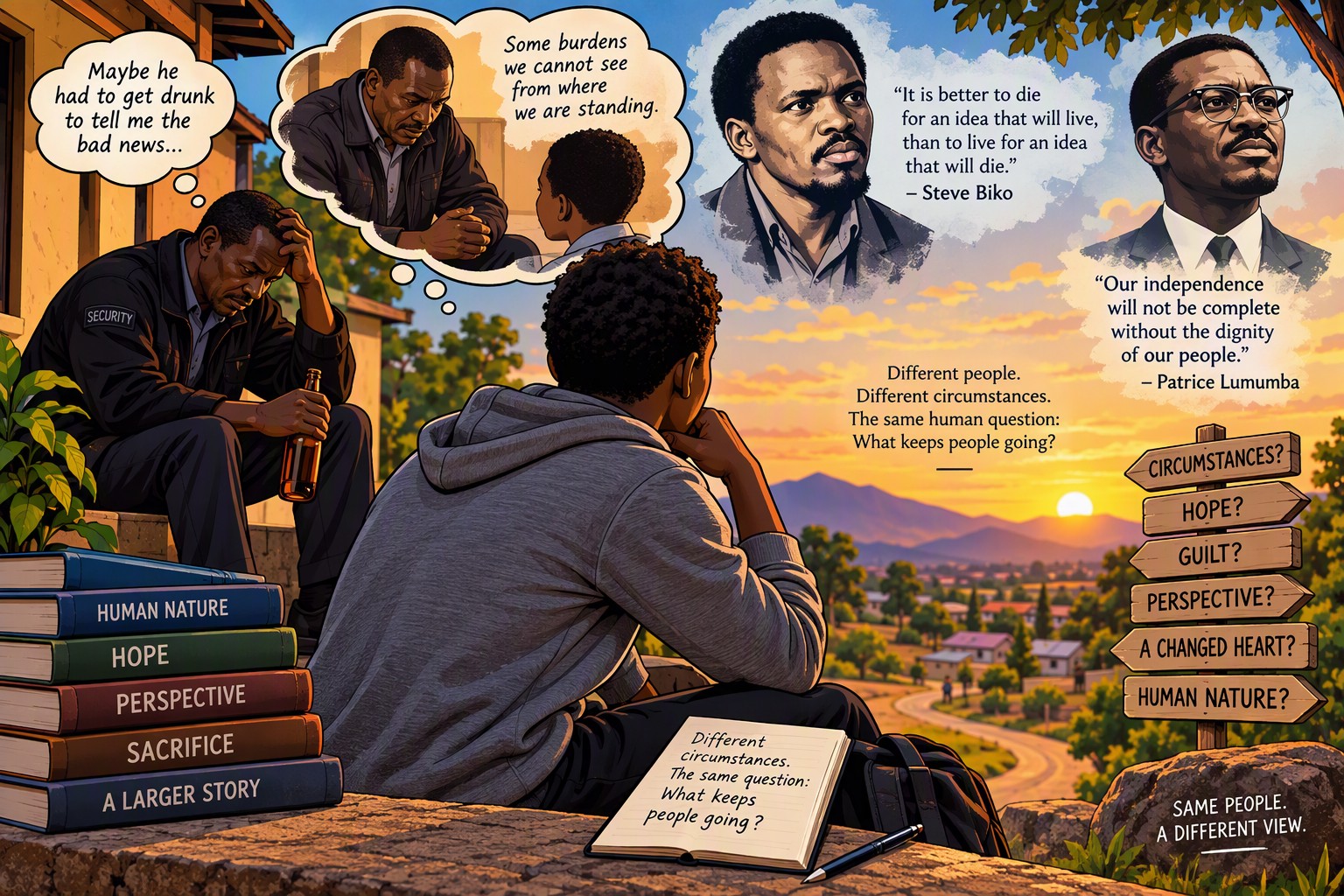
    He was the security guard who paid my first-year university registration fees. He was also the uncle who would later confide in a family friend that it was not that he did not want to help me. He simply could not afford to do as much as he wanted.

    That account becomes even more interesting when I connect it with something my cousin has maintained about an earlier incident.

    My cousin’s view was that my uncle had to get drunk before he could come and deliver discouraging news to me.

    Could that situation have been eating him inside more deeply than I understood at the time?

    Could alcohol have been his way of summoning the courage to tell me something that he knew would hurt me?

    I cannot know.

    But when I put that account alongside what he later reportedly told the family friend, another picture begins to emerge.

    Perhaps while I was struggling with the pain of not receiving the help I needed, he was struggling with the pain of not being able to provide it.

    Could both of us have been suffering from the same situation, only from opposite sides?

    I could see my unpaid school fees.

    I could see that I did not have the resources I needed.

    But could I see what it was doing to the people who could not provide those things?

    I don’t think I could.

    Perhaps that is the limitation of judging human behaviour only from where we are standing.

    Could Hope Have Changed Everything?

    There is another possibility that fascinates me.

    Once I matriculated, received the scholarship and actually entered university, perhaps something that had previously looked uncertain suddenly became possible.

    Maybe my progress restored hope.

    And hope is a strange thing in the human condition.

    Throughout history, people have endured extraordinary suffering because they believed that the future they were working towards was possible.

    Steve Biko is widely credited with the words:

    “It is better to die for an idea that will live, than to live for an idea that will die.”

    Whatever one’s interpretation of Biko’s broader political philosophy, there is something profound in that statement about human beings and hope.

    Patrice Lumumba expressed something similar under very different circumstances. In his final letter, he maintained his belief in the eventual triumph of Congo’s cause despite facing the possibility that he might not live to witness it. He wrote of his confidence in the destiny of his country and of a future that remained worth struggling for.

    Their circumstances were obviously vastly different from my family’s circumstances, and I am not comparing my struggle with theirs.

    What interests me is the human mechanism underneath.

    What does hope do to people’s willingness to sacrifice?

    Perhaps people can endure enormous hardship when they believe that something meaningful lies on the other side.

    Could that have happened within my own family on a much smaller and more ordinary scale?

    During matric, perhaps they saw an endless problem that they did not have the resources to solve.

    But once I was at university, perhaps they saw a destination.

    A degree.

    A future.

    A possibility.

    And once tuition was covered by the scholarship, nobody had to solve the entire problem either. My second uncle could pay the first registration. My grandmother could help with later registration and daily transport. My mother could contribute whenever she found work.

    Maybe the burden had become divisible.

    Maybe hope had become believable.

    And perhaps my perseverance had something to do with it too.

    By continuing despite everything, matriculating, obtaining the scholarship, and actually reaching university, had I demonstrated that whatever little assistance they could provide might make a difference?

    But that introduces another uncomfortable question.

    Do people sometimes become more willing to support us once they can see evidence that we might succeed?

    And if they do, is that really a change of heart?

    Or is that simply another part of the human condition?

    I don’t know.

    Perhaps nothing fundamental changed in their hearts.

    Perhaps circumstances changed.

    Perhaps hope changed.

    Perhaps what seemed possible changed.

    Or perhaps all these things were happening simultaneously.

    I can only speculate.

    But the more I revisit these events, the more difficult it becomes for me to maintain the simple conclusion that people did not care.

    There is an important difference between someone being unwilling to help you and someone desperately wanting to help you but being unable to do so.

    The difficulty is that when you are the person who needs the help, the two can look the same.

    Sometimes it takes years, and information you did not have at the time, before you begin to see the difference.

    Join the conversation

    Have you ever looked back at someone’s failure to help you and realised that you may not have understood what was happening on their side?

  • Post 11: Perhaps I Had Misunderstood Them

    Post 11: Perhaps I Had Misunderstood Them

    Continuation from Post 10.

    There was another piece of the story that eventually forced me to reconsider how I understood those difficult years.

    My second uncle, my grandmother’s middle child, worked as a security guard.

    At some point, he confided in a family friend about his inability to assist me as much as he would have wanted.

    His explanation, as it was later related to me, was simple:

    “It is not like I don’t want to assist my nephew. I just can’t afford to.”

    What apparently made the situation even more painful for him was the way I responded to my circumstances.

    I was not demanding.

    I did not constantly ask people for help.

    I simply kept going and tried to do whatever I could with whatever was available to me.

    Seeing that, while knowing that he could not do more, apparently troubled him deeply.

    When I eventually learnt about this conversation, something shifted in my understanding.

    When you are the person experiencing hardship, you naturally see the situation from where you are standing.

    You know that your school fees have not been paid.

    You know that you do not have a scientific calculator.

    You know that you do not have the study materials you need.

    You know what it feels like to watch others have things that would make your own journey easier.

    Those experiences are real.

    But there is something you may not know.

    You may not know what is happening on the other side.

    For years, I could have looked back at that period and concluded that the adults around me simply did not care enough.

    It would have been an understandable conclusion.

    But would it have been the correct one?

    My second uncle’s words complicated that interpretation.

    Then there was my eldest uncle, who quietly wrote “Well done and keep it up” on my school report years earlier and second uncle who later paid my first university registration fee.

    There was my grandmother, stretching her pension to help with registration and the money I needed to travel from the village to university every day.

    And there was my mother, taking whatever work she could find and eventually refusing money from me while seriously ill because she feared that giving it to her could interfere with my studies.

    Perhaps what I had experienced as abandonment was, at least in part, helplessness on the other side.

    That does not change what happened.

    The school fees were still unpaid.

    The resources were still absent.

    The difficulties were real.

    Understanding something differently does not require pretending that it never happened.

    Perhaps maturity sometimes means being able to hold two truths at the same time:

    I needed more than they were able to give.

    And:

    They may have wanted to give more than they had.

    Today, I cannot honestly say that I would have achieved what I did without my family’s assistance.

    My mother, my grandmother and my uncles helped me in different ways and at different stages of the journey.

    Looking back now, I wonder whether some of them were judging themselves just as easily as I could have judged them.

    Maybe they believed they should have done more.

    Maybe they wanted to do more.

    Perhaps their circumstances simply did not allow them to.

    And this has left me with one of the most important lessons I have learnt about the human condition:

    What looks like indifference from one side may sometimes be helplessness on the other.

    We rarely know the full story while we are living through it.

    Join the conversation

    Have you ever reached a point in life where you had to reconsider something you had long believed about the people who raised you?

  • Post 10: The Human Sacrifice

    Post 10: The Human Sacrifice

    Continuation from Post 9.

    My mother’s efforts to support my studies eventually took her to Gauteng, where she worked briefly as a domestic worker.

    While there, she became seriously ill.

    She told me that she was sick and wanted to come home, but she did not have money for transport.

    I told her that I would send her the money I had for transport to university. At the time, I was travelling from the village to university to attend classes and back home every day. That money was what allowed me to get to class.

    I told her I would send it to her and somehow I can make another plan.

    She refused.

    She told me that she had a job lined up for the weekend and that she would use the money from that job to come home.

    After that weekend, she became unreachable.

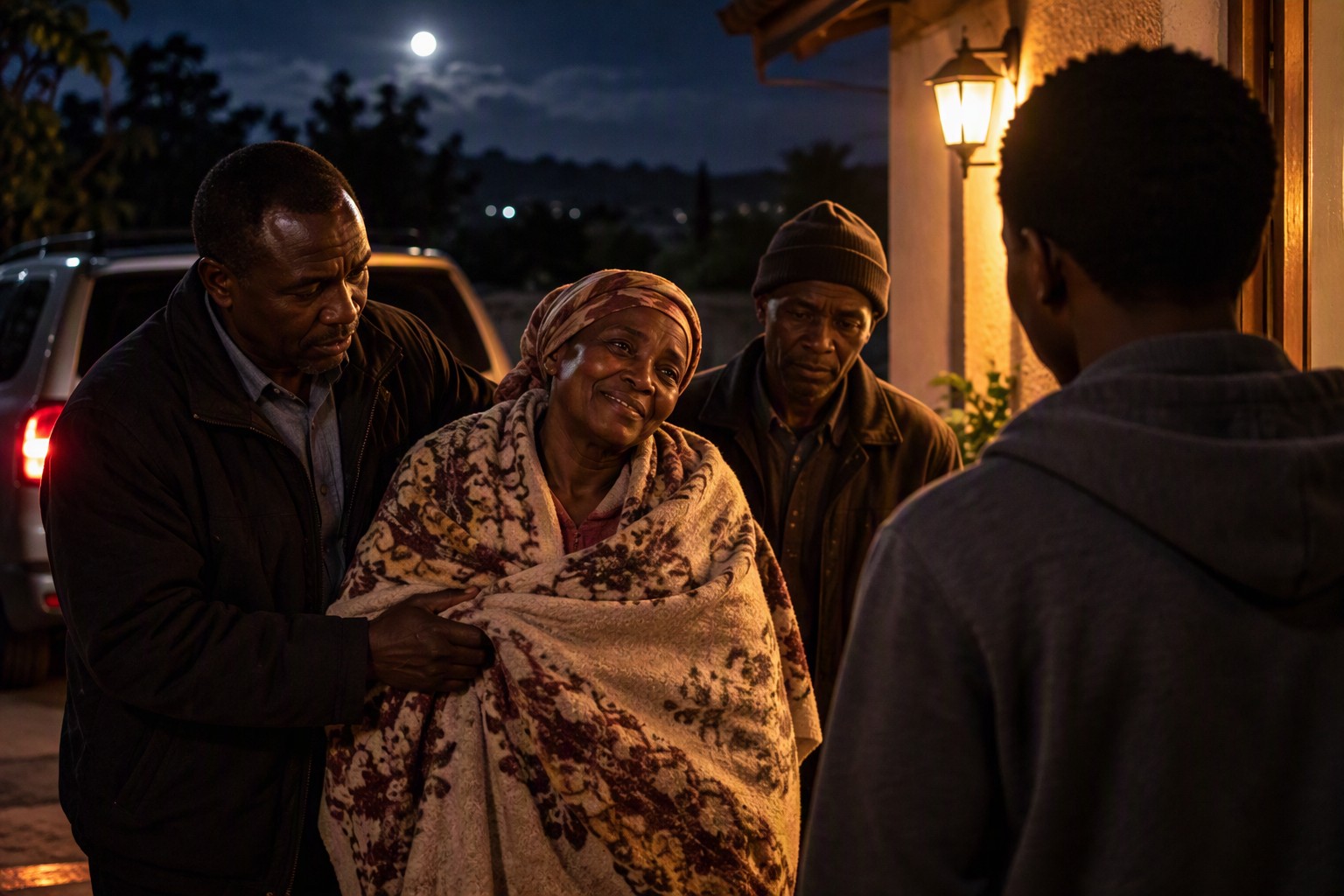
    Then, one night, in the dark hours of the early morning, I heard the sound of a car parking in the driveway behind the house.

    I could hear faint voices approaching the house. As they came closer, I could make out three people speaking. Two of the voices were familiar. One belonged to my eldest uncle, who lived next door. The other was my mother’s. The third belonged to a distant relative from Gauteng who had brought my mother home.

    I woke up and went outside.

    Before stepping out of the house, I switched on the outside light.

    Three figures emerged from the darkness.

    And then I saw my mother.

    She smiled.

    It was the same smile she used to give me even when she was teasing me or making fun of me.

    But this time, the words that accompanied the smile were not funny.

    She said:

    “Zwidofhela nwananga, ndi khou fa, nwananga.”

    Loosely translated into English:

    “Zwidofhela, my son, I am dying, my son.”

    Exactly a month later, she passed away.

    But before she passed on, I had an opportunity to ask her something that had been troubling me.

    Why had she refused my help when I offered to send her the money I depended on to travel to university every day?

    She told me that she had lied.

    There had been no job lined up for that weekend.

    Her condition was already serious.

    She simply did not want me to give up the money I needed to attend classes. She did not want to take the risk that I might struggle to get to the university to attend class.

    She wanted me to stay at university.

    She wanted me to complete my studies.

    I have thought about that decision many times since.

    I cannot say what would have happened had she accepted the money and returned home earlier. I cannot know whether anything would have been different.

    But I know why she refused it.

    Even while seriously ill, she was thinking about my education.

    This was the same person who had been there when my school fees went unpaid. At the time, I could easily have asked why she had not done something about it.

    Now, circumstances were different, and she was willing to make sacrifices that I still struggle to comprehend.

    That contradiction forced me to reconsider many things I thought I understood about the human condition.

    How could someone appear unable to help at one point, and later be prepared to sacrifice so much?

    I still do not have a complete answer.

    Maybe there are forms of human sacrifice that cannot be neatly explained.

    They can only be witnessed.

    Join the conversation

    What does sacrifice mean when someone gives not because they have plenty, but from the very little they have?

  • Post 9: When Everyone Started Helping

    Post 9: When Everyone Started Helping

    Continuation from post 6.

    I matriculated and went to university, as you know, but the challenges remained.

    The Vice-Chancellor’s scholarship covered my tuition fees, but I still had other expenses to cover. There were registration fees, study-related expenses, and, importantly, transport. I was living at home and travelling from the village to the university to attend classes and back to the village every day.

    My uncle, the middle child of my grandparents, took care of my first-year registration fees. This was the same uncle who, years earlier, had asked to see my primary school report. After looking at it, he smiled, went into his house looking for a pen, and wrote under the parent’s comments:

    “Well done and keep it up.”

    Those few words had stayed with me.

    In the following years, my grandmother managed to save from her pension to pay my registration fees. She also helped with the money I needed to travel to university every day and continued supporting me until I completed my first degree.

    My mother also started taking odd jobs to assist whenever she could.

    Whenever she managed to get work and was paid, there were times when she would want to give me everything she had earned. If I suggested that she should keep some of the money for herself, she would become angry.

    She wanted me to stay at university. She did not want to take chances with my education.

    Suddenly, everyone was chipping in.

    And that left me with a question that I have never completely answered:

    What had changed?

    Was it a change of heart?

    Or had I misunderstood what was happening during those earlier years?

    Could it be that my guardians had also been overwhelmed when I reached rock bottom in matric?

    Perhaps after carrying family responsibilities for many years, my grandmother had simply reached the limit of what she could manage at the time. Or perhaps seeing me matriculate and actually make it to university restored hope.

    Maybe what had previously appeared uncertain now seemed possible.

    I can only speculate.

    What I know is that the same family that had been unable to provide some of the things I desperately needed during matric was now doing everything within its means to help keep me at university.

    It made me reconsider something about human nature.

    It is easy to judge people’s intentions by what they fail to do for us, particularly when we are the ones suffering the consequences. But sometimes we do not know what is happening on the other side.

    Perhaps lack of help does not always mean lack of care.

    Sometimes people may simply have nothing more to give.

    Join the conversation

    Have you ever looked back at someone’s actions and realised that what you once interpreted as not caring may have been something more complicated?

  • Post 7: Is the Pattern Becoming Clear?

    Post 7: Is the Pattern Becoming Clear?

    In an earlier post, I suggested that there might be a pattern emerging from these stories:

    A difficult situation arises. I cannot see how it will be resolved. Eventually, I recognise what is beyond my control and focus on the small part that remains within it.

    Then I carry on.

    What happens afterwards is not always something I could have predicted.

    The stories I have just shared about my uncle, my school fees, and simply continuing to go to school are examples of this.

    I am still not suggesting that everything happens for a reason, or that doing what is within your control guarantees that things will work out.

    But perhaps the philosophy is becoming clearer:

    Do what is within your control, even when you cannot see how circumstances will resolve themselves.

    And then allow the unknown to unfold.

    Join the conversation

    Is this pattern becoming apparent to you too, or do you interpret these events differently?

  • Post 6: When the Situation Became Worse

    Post 6: When the Situation Became Worse

    Continuing from Post 5, where my uncle had told me that โ€œthe situation is now in your hands,โ€ the situation was about to become even more difficult.

    The following year, I was in matric.

    Until then, there was at least one thing I had always been able to depend on. My grandmother had taken us to school and paid our school fees from primary school through secondary school. She had also provided us with lunch money.

    But during my matric year, my grandmother decided that she was no longer responsible for paying my school fees.

    Once again, I accepted the situation.

    And it was during this period that I remembered the words of my late grandfather. May his soul rest in peace.

    โ€œU Do Vhona Iweโ€

    Growing up, whenever I felt that I was being excluded or unfairly treated, I would go to my grandfather. I would report the injustice to him and cry.

    He would almost always respond with the same words.

    In Tshivenda, he would say:

    โ€œFhumula uri hwi iwe, u litshe heya manwe mamange heya, u do vhona iwe.โ€

    Loosely translated into English:

    โ€œYou just stop crying and stop fussing about these people. You will see.โ€

    Those words comforted me because of the sincerity with which he said them. He spoke almost as though he knew something I did not, as though he knew what the future held and that, somehow, everything would eventually be okay.

    I did not necessarily understand what he wanted me to โ€œsee.โ€

    But I trusted his words.

    So when my grandmother decided not to pay my school fees, I remained composed and focused on my path. I did not use it as an excuse to quit school. I did not quarrel with my uncle or my grandmother.

    I accepted that these people did not owe me the future I wanted.

    And at that particular moment, there was still one thing I could do.

    I could go to school.

    So I went to school, even though my school fees had not been paid.

    The Unpaid School Fees

    Early in the second quarter of my matric year, one of the teachers came to my classroom and called me outside.

    He reminded me that I had not paid that yearโ€™s school fees.

    I acknowledged the fact and assured him that I would get the matter sorted out as a matter of urgency.

    But I knew very well that I was unlikely to follow through with that promise.

    I did not have a solution.

    I returned home later that day and told nobody about the conversation. My grandmother had already made her position clear. There was no reason to disturb her peace by reopening a matter she had already decided.

    So once again, I accepted the situation.

    And I went back to school.

    That was the only part that remained within my control.

    As you may probably have guessed by now, like some of the other hopeless situations I had encountered, this one eventually took an unexpected turn.

    A few months later, one of the teachers was accused of misappropriating school funds. The matter became an issue involving the School Governing Body and parents.

    After that, nobody followed up with me about my outstanding school fees.

    The reminders simply disappeared.

    I was spared the embarrassment of repeatedly being called aside to explain why the fees had not been paid when I already knew that I had no means of paying them.

    I had not solved the problem.

    My grandmother had not changed her position. My uncle had not suddenly found the money.

    And yet, the immediate problem disappeared without anything I had done to resolve it.

    It had never really been within my control.

    What Was Actually in My Hands?

    Looking back, I do not tell this story to suggest that people should simply ignore their problems and expect those problems to disappear.

    That would be the wrong lesson.

    What interests me is the pattern.

    I could not control what my uncle could afford.

    I could not control my grandmotherโ€™s decision.

    I could not control whether the school demanded its fees.

    But I could control whether I continued going to school.

    And I did.

    Perhaps that is why my grandfatherโ€™s words remained with me:

    โ€œU do vhona iwe.โ€
    โ€œYou will see.โ€

    Perhaps he was telling me not to allow what other people did, or failed to do, to determine what I did next. Perhaps he was simply teaching me patience. Or perhaps there was something more in those words that I still do not fully understand.

    Some people might call what happened chance. Others might call it luck. Others might attribute it to God, ancestors, destiny or other supernatural forces.

    I cannot prove which explanation is correct.

    But looking back, I can now see the irony in my uncleโ€™s words from the previous story:

    โ€œThe situation is now in your hands.โ€

    Having your life in your hands does not mean having the power to control everything that happens to you.

    Sometimes it means something much smaller.

    You identify whatever remains within your control, however insignificant it may appear, and you do that.

    For me, it was going to school.

    I did not know how the school fees would be resolved. I did not know how I would get to university. I did not even know whether university would eventually become possible.

    I only knew that the next morning I could wake up and go to school.

    So I did.

    And perhaps sometimes that is enough.

    Do what is within your control, even when you cannot see how circumstances will resolve themselves.

    Join the conversation

    Have you ever reached a point where an important situation was completely beyond your control, and the only thing left was to keep doing the small part that remained within your hands?

  • Post 5: The Situation Is Now in Your Hands

    Post 5: The Situation Is Now in Your Hands

    Just to emphasise how hopeless my situation had become, as a continuation from Post 3, I remember one early evening when I was sitting with my eldest cousin.

    A figure appeared from the darkness and started walking in our direction. It was my uncle.

    He was the middle child of my grandmother. My eldest cousinโ€™s father was my grandparentsโ€™ first-born child, while my uncle was the middle child. He worked at the university as a security guard.

    As he emerged from the darkness, my uncle greeted me with an unfamiliar voice and an unusual walk. He was holding something in one of his hands. The closer he came, the clearer it became that he was intoxicated and that what he was holding was a beer bottle.

    I still remember that early evening very well.

    It was just a year before I matriculated. I was doing Grade 11 at the time.

    After exchanging pleasantries, my uncle went straight to the point. His attention was directed almost entirely towards me, as though he could not see his older brotherโ€™s son sitting beside me.

    โ€œMy nephew,โ€ he said, โ€œI am here to apologise to you. I am sorry.โ€

    He explained that he had been thinking about my prospects of furthering my education. He had made arrangements for the tertiary education of his own children, some of whom were around my age, but had not included me in that educational scheme.

    Perhaps, he reflected, he should have done something earlier.

    But he had never imagined that the situation would reach this stage.

    He told me that he had a friend whom he had been counting on to find a way for me to further my education, even if what they were planning was not entirely ethical. Unfortunately, his friend had passed away.

    That option was gone.

    He then told me plainly that he could not afford to take me to a tertiary institution with his salary as a security guard while he also had his own family to support.

    There were no other options that he could see.

    Then he concluded with words that would remain with me for years:

    โ€œThe situation is now in your hands.โ€

    He turned his back on us and disappeared into the evening darkness.

    I barely said a word.

    Even today, I sometimes become completely silent when confronted with information that requires serious processing. My mind first needs time to understand what has happened and what it means.

    I was still processing my uncleโ€™s words when my cousin suddenly burst into laughter.

    He was eight years older than me and was more like an elder brother than a cousin. After all, we lived together.

    I asked him politely, โ€œWhat are you laughing at?โ€

    โ€œNo, I am not laughing at you,โ€ he replied. โ€œI am laughing at your uncle. He had to get himself drunk to summon the courage to come and tell you that. That is what I find funny.โ€

    That was when the seriousness of the situation truly settled in.

    The situation was now in my hands.

    But I was only a Grade 11 learner.

    What exactly was I supposed to do?

    When There Is Nothing You Can Do

    I spent some time trying to process everything and understand what it meant for the situation to be entirely in my hands.

    Eventually, I came to a difficult but simple conclusion:

    There was nothing I could do about it.

    I had no money. I had no employment. I could not force anyone to finance my education. I could not bring back my uncleโ€™s deceased friend. I could not suddenly create opportunities that did not exist.

    The situation really was hopeless, at least from where I stood at that moment.

    But perhaps this was when I began learning something that would stay with me for the rest of my life:

    Some situations are completely beyond our control.

    Recognising that does not necessarily mean giving up.

    I could not solve the question of how I would one day go to university.

    But there was still something I could do.

    I could complete my studies.

    So that is what I decided to do.

  • Post 4: Does Everything Really Happen for a Reason?

    Post 4: Does Everything Really Happen for a Reason?

    Looking back at some of the issues I have written about so far, I have started noticing a pattern.

    A problem appears and, at times, the situation feels uncertain, difficult, or even unfair. I try to reason through it, understand what is happening, worry about the possible outcomes, and search for a way forward. Often, I still cannot see one.

    Eventually, I reach the boundary of my control. I realise that there are things I can do, and a large part of the situation that I simply cannot control.

    But I do not quit. I focus on the positive decisions still available to me. I continue studying, working, applying, researching, building, moving, or simply carrying on.

    Then, somewhere along the way, something happens. Circumstances change, often in a way I could not have planned or even imagined when the problem first appeared.

    Does Everything Happen for a Reason?

    It would be easy to look back at these experiences and conclude that everything happens for a reason. But I am not sure that is something I can prove.

    Perhaps something more useful is emerging from these experiences: you do not need to know how the whole journey will unfold before taking the next reasonable step.

    A person starting from a village does not necessarily see the entire chain connecting where he is standing to becoming a GISc Professional, researcher, writer, or whatever comes afterwards. Only much later do the pieces begin to look like a path.

    The trick may simply be not to give up. Resolve one issue at a time, make the decisions that are available to you, and keep moving.

    What I Am Learning

    If there is a philosophical takeaway from what I have posted so far, for me it is this:

    Uncertainty is not necessarily evidence that there is no path ahead. I may simply be standing at a point from which the next part of the path cannot yet be seen.

    My responsibility, therefore, is not to control the whole outcome, but to act responsibly on what is within my reach and allow the rest to unfold.

    This does not mean that this way of thinking will solve every problem. Nor does a good outcome prove that everything was destined to happen.

    Interestingly, someone who had been reading the blog recently summarised their takeaway as:

    โ€œDo what is within your control and let the unknown unfold.โ€

    They went further and said:

    โ€œThis will be one of the rules I live by.โ€

    Perhaps that captures the philosophy better than saying that everything happens for a reason. I do not have to know what lies around the corner. I just have to deal responsibly with what is in front of me and keep going.

    And if this pattern has not been apparent in the stories I have shared so far, then perhaps keep it in mind as you read the ones that are still to come. Consider it a simple schema: a problem arises, the way forward is unclear, I eventually identify what is within my control and act on it, and then I allow circumstances beyond my control to unfold. The interesting question is what happens next.

    Join the conversation

    When you look back at difficult periods in your own life, do you think things happened for a reason, or did the path only become visible after you kept moving?

  • Post 3: Do What Is Within Your Control and Let the Unknown Unfold

    Post 3: Do What Is Within Your Control and Let the Unknown Unfold

    When the Future Seemed Impossible

    I had little hope of attending university because of my family’s financial circumstances.

    Towards the end of my matric year, while my classmates were discussing where their academic journeys would take them next, one of them asked me where I was going to study.

    I replied, โ€œNowhere.โ€

    She responded almost angrily. As one of the better-performing students in our class, she could not understand how I could have no idea where I was going. She continued scolding me, saying that my problem was that I did not communicate or socialise enough with other people.

    But there was something she did not understand.

    I knew my financial background.

    I had been raised by my grandparents, who at the time were pensioners. University required money that I simply could not see where it would come from. So, when my classmates spoke excitedly about university, I could not allow myself the same expectations.

    Yet I remained at school and continued studying.

    I concentrated on something much simpler: doing what was within my power and control, and doing it to the best of my ability, without allowing myself to be consumed by things beyond my control.

    Perhaps something deep inside me believed that somehow things would work out. Was it a sense that the universe had my back? Was it my ancestors? Was it God? Was it some combination of these? Or was what happened next simply coincidence and luck?

    I cannot answer that scientifically. Where evidence can neither establish nor reject such explanations, perhaps intellectual honesty requires us to acknowledge the limits of what we know.

    What I do know is what happened next.

    Despite having almost no expectation of attending university, I did not give up on my studies. I matriculated with a distinction.

    A Form I Did Not Expect

    At the beginning of the following year, after I had received my matric results, my uncle, who was working as a security guard at the University of Venda, brought me an application form.

    He told me that I should apply.

    I completed the application with neither confidence nor any clear idea of how I would finance my studies. Once again, I was simply doing what was within my control.

    I had seen students from my own village enrol at university, complete their first year and subsequently drop out because of financial difficulties. As I filled in that application form, their experience seemed a much more realistic picture of my own possible future than graduating from university.

    Nevertheless, I applied.

    Eventually, I found myself beginning the unfamiliar process of registering as a first-year university student. There were long queues, unfamiliar buildings, and processes that I did not yet understand.

    My only apparent hope of paying the tuition fees was financial aid.

    While queuing to apply for financial assistance, an administrator assisting students took my statement of matric results from my hand. Like many first-year students confronting university administration for the first time, I was unsure of the process. I handed her my results along with the ticket number we had been given while queuing.

    She looked at my results and asked, in a manner that made me think I was wasting her already limited time:

    โ€œWhy are you here wasting time in this queue?โ€

    Before I could fully understand what was happening, she turned my statement over and wrote something on the back in red ink.

    She handed it back to me and instructed me to leave the financial-aid queue in the auditorium and proceed to another queue in the main administration building, where I should go to the bursary office.

    Then she immediately turned to the next student.

    I was left standing there, confused.

    I followed her instructions.

    As I walked out of the auditorium, trying to make sense of what had just happened, I turned the statement over to see what she had written.

    In red ink were the words:

    FULL TUITION.

    I proceeded to the bursary office and discovered that the distinction I had earned in matric qualified me for a Vice-Chancellor’s bursary covering my undergraduate tuition fees.

    The same distinction that I had worked towards without knowing whether I would ever be able to attend university had unexpectedly opened the door to university.

    Luck, Circumstance or Something More?

    That experience has stayed with me.

    What would have happened if, after deciding that university was financially impossible, I had also decided that there was therefore no reason to work hard in matric?

    I did not know that a distinction would open this particular door.

    I did not know that my uncle would bring me an application form.

    When I was standing in that financial-aid queue, I did not know that an administrator would look at my results and redirect me somewhere completely different.

    All I had done was continue doing what was within my control.

    And this raises a question that has followed me through much of my life:

    What happens when a person continues doing what they are supposed to do even when hope seems distant and almost alien?

    Sometimes circumstances take a favourable turn that could not reasonably have been anticipated.

    But how should we understand such moments?

    Is it perseverance finally meeting opportunity?

    Is it coincidence?

    Is it luck?

    Is it the universe?

    Is it the intervention of our ancestors?

    Is it God?

    Perhaps different people will arrive at different answers according to their experiences and beliefs. Science may help us understand probabilities, causes, and observable relationships, but there are questions of meaning that are much more difficult to settle through empirical evidence alone.

    I do not present my experience as proof of any supernatural explanation.

    I simply know what happened.

    I kept going when I could not see the road ahead.

    And somehow, a road appeared.

    Why I Am Writing This

    There is another reason I am sharing this story.

    My former Grade 12 Biology teacher at Nthetsheleseni Secondary School has twice asked me to return and give a motivational talk to learners from my village. The idea was simple: to show them that someone who attended the same school, came from the same village and experienced financial difficulties similar to those facing some of them could eventually obtain a PhD.

    A former classmate has also suggested arranging an opportunity for me to speak to young people.

    I have never found the opportunity to do it. My work has taken me far from home.

    But there is also another truth.

    I am not sure that I have it in me to stand in front of young people and give what is conventionally called a motivational talk.

    Perhaps that is not how I communicate best.

    And perhaps this is partly why The Philosophy of a Village Boy exists.

    This platform allows me to tell the stories instead.

    Not to tell young people that success is guaranteed if they simply work hard. Life is more complicated than that. Hard work does not automatically remove poverty, inequality, circumstance, or bad luck.

    But my journey has taught me something more modest, and perhaps more defensible:

    Even when you cannot control the outcome, you can still attend to what is within your control.

    Sometimes that may lead nowhere.

    And sometimes, without you knowing it, you may already be preparing yourself for a door that you do not yet know exists.


    Join the conversation

    Have you ever continued pursuing something even when there seemed to be no realistic path forward, only for circumstances to change unexpectedly? How did you interpret what happened: perseverance, opportunity, coincidence, luck, faith, ancestral intervention, or something else? Share your perspective in the comments below.