The Philosophy of a Village Boy

The Philosophy of a Village Boy explores knowledge, science, African spirituality, indigenous thought, identity, and the territory between experience and evidence.

Category: Part I: The Autobiographical Journey

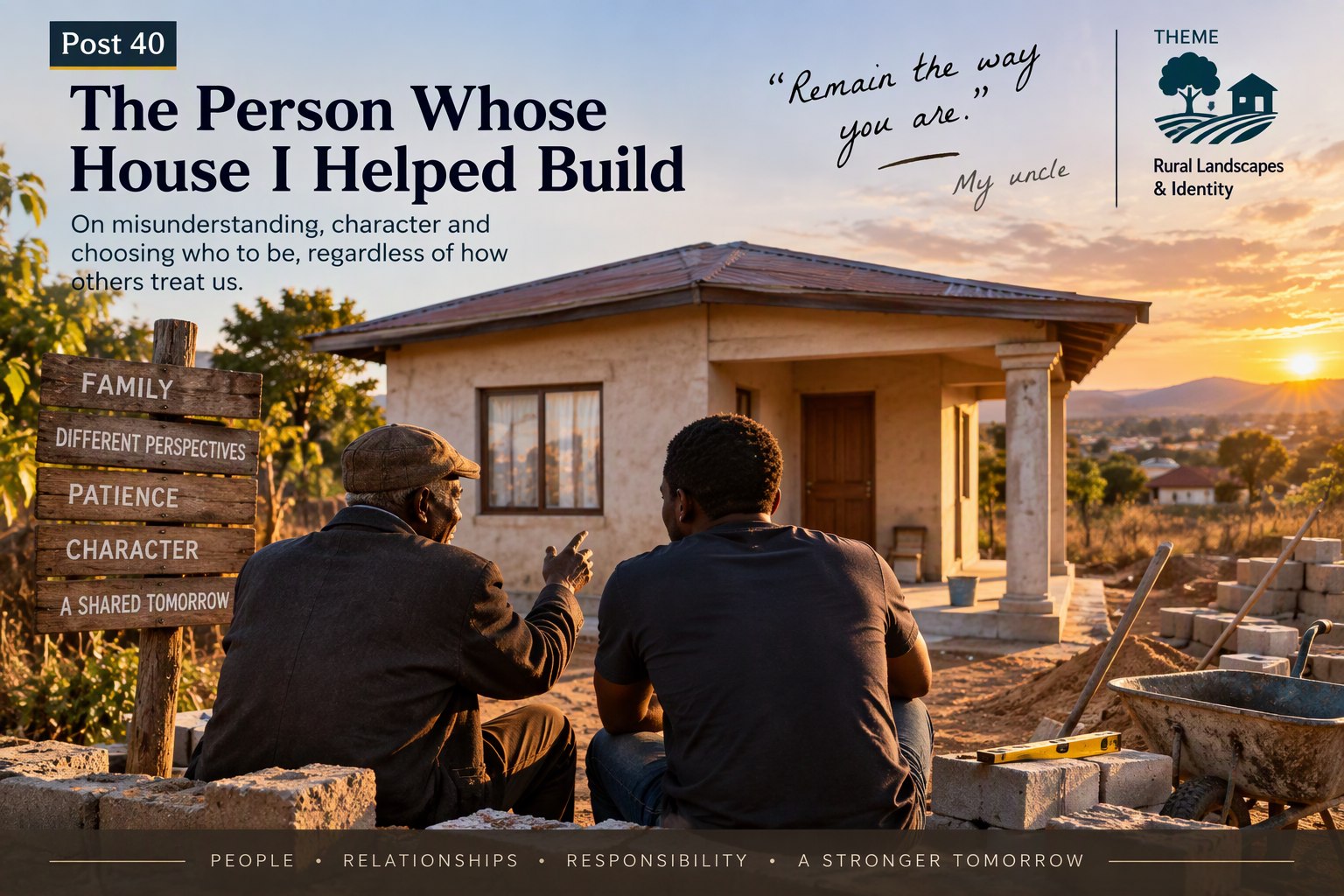
  • Post 40: The Person Whose House I Helped Build

    Post 40: The Person Whose House I Helped Build

    There was another dimension to my cousinโ€™s house that made the experience particularly meaningful to me.

    Years earlier, before my first uncle passed away, he arrived at our home early one morning.

    He had been drinking and was still heavily under the influence.

    He complained to his mother, my grandmother, that his son had insulted him the previous night while they were drinking.

    My grandmother did not give the complaint much attention because he was still intoxicated.

    Then he turned towards me.

    โ€œAnd you.โ€

    I looked at him silently.

    โ€œYes, you.โ€

    He told me that his son, my cousin, hated me.

    He said he did not know why. According to him, his son often complained that I was my grandmotherโ€™s favourite.

    My uncle then explained that if I had sometimes observed behaviour from him that made me think he hated me, I should not assume that was how he genuinely felt. He said his son had been influencing him against me.

    Then he said something important.

    He told me that he had now observed things for himself.

    He could see that I did not have a problem with anyone.

    Then he told me:

    Remain the way you are.

    That was the end of the conversation.

    Years later, the person whose house I helped build was that same cousin.

    It would be easy to reduce this story to:

    He hated me, but I helped him anyway.

    But looking at it now, I think that would be too simple and perhaps unfair.

    Hate is a very strong word.

    My uncle used it, but he was describing what he believed was happening inside another person.

    Was it really hate?

    I do not know.

    And perhaps there is a more fundamental question:

    What exactly do we mean when we use a word like hate?

    Humans use familiar words every day as though their meanings are obvious because everybody knows the words. But knowing a word is not necessarily the same as fully understanding what it describes.

    This reminds me of the kind of questioning associated with Socrates. Familiar concepts could appear simple until someone was asked exactly what they meant. Something like courage could appear to be common knowledge until the meaning itself was examined.

    Perhaps emotions deserve the same questioning.

    What my uncle called hate might have involved resentment around the belief that I was our grandmotherโ€™s favourite.

    It might have involved jealousy, competition, hurt or something more complicated.

    Or perhaps it really was hate.

    I cannot know.

    Even if my cousin himself had told me that he hated me, another question would still remain:

    Does being able to name an emotion necessarily mean that we fully understand what we are feeling?

    Perhaps not always.

    A person may use the word that seems closest to what they are experiencing at a particular moment. Over time, their actions may complicate what those earlier words appeared to mean.

    But actions are not perfect windows into another person either.

    Words can be misunderstood.

    Actions can be contradictory.

    People can change.

    And sometimes, perhaps, people themselves do not fully understand everything happening within them.

    So I cannot confidently say that my cousin hated me.

    I can only say that hate was the word my uncle used to describe what he believed was happening.

    But there was something else in that conversation that I now find even more interesting.

    My uncle said that he had observed things for himself.

    Perhaps there was a lesson in that too.

    When people resent you, misunderstand you or mobilise others against you, there can be a strong temptation to defend yourself.

    To explain yourself.

    To prove that what is being said about you is wrong.

    To convince people that they have misunderstood you.

    But perhaps not every accusation requires a campaign of defence.

    Sometimes there may be another option:

    Remain the way you are.

    Continue allowing your character to reveal itself through your actions over time.

    If people have formed a particular understanding of who you are based on what they have heard from others, some may eventually begin comparing what they were told with what they observe for themselves.

    If the two do not agree, questions may begin to emerge.

    You may not need to destroy the union that has formed against you.

    Perhaps parts of that union may begin to loosen naturally as individuals start reaching their own conclusions.

    But there is a difficult part to this philosophy.

    Time.

    Misunderstandings do not necessarily disappear quickly.

    They may survive for years.

    Some people may eventually see something differently.

    Others may never change their minds.

    And that leads to an important distinction.

    Remaining true to my character cannot simply become a strategy for eventually proving other people wrong.

    If I am only behaving according to my values because I am waiting for the day when everyone finally realises that I was right, then their judgement still has power over me.

    I would merely be defending myself in another way.

    Perhaps remaining true to your character means remaining true to it even when there is no guarantee that anyone will eventually understand you.

    If people eventually see things differently, let them arrive at that conclusion through what they observe for themselves.

    If they do not, your character still remains yours.

    That brings me back to the person whose house I helped build.

    Whatever my cousin might once have felt about me, what should that have meant for the person I chose to be?

    Should I respond according to what I had once been told about him?

    Or should I respond according to the person I believed myself to be?

    That returned me to something my mother had taught me when I was still in primary school:

    Do not allow other peopleโ€™s behaviour to determine your own.

    Perhaps character is partly about that.

    My character remains mine even when another person behaves badly towards me.

    What another person does may influence the boundaries I establish.

    It may determine how close I allow that person to come.

    It may change the kind of relationship that remains possible.

    But it does not have to determine the kind of person I become.

    That does not mean accepting abuse.

    It does not mean remaining in destructive relationships.

    It does not mean living without boundaries.

    There is a difference between protecting myself from another person and allowing that person to redefine my character.

    If somebodyโ€™s cruelty makes me cruel, their cruelty has reproduced itself through me.

    If somebodyโ€™s resentment causes me to abandon generosity where generosity is still possible, then their behaviour has changed something in me too.

    Perhaps that is one of the more difficult forms of personal responsibility.

    I am responsible not only for how I treat other people, but also for deciding how much authority their behaviour should have over the person I become.

    So perhaps the real question is:

    Can I protect myself from what another person does without becoming what their behaviour invites me to become?

    All those years earlier, my uncle had told me:

    Remain the way you are.

    Perhaps he was telling me something larger than either of us realised at the time.

    Do not spend your life trying to control what everybody thinks about you.

    Do not make every misunderstanding a battle that has to be won.

    Do not make another personโ€™s resentment the architect of your character.

    Remain true to who you are.

    Let people observe.

    Let time pass.

    Some may eventually see things differently.

    Some may not.

    But either way, your character remains your responsibility.

    Years later, when his son needed safer shelter, I had a choice.

    I could respond according to something I had once been told about how he might have felt about me.

    Or I could respond according to the values I believed should remain mine regardless of what he felt.

    Perhaps helping to build his house was one way of trying to do exactly what my uncle had told me all those years earlier:

    Remain the way you are.

    Join the conversation

    How do we remain true to our character when others misunderstand or mistreat us, without turning that commitment into another attempt to prove them wrong?
  • Post 39: When the We Became I Again

    Post 39: When the We Became I Again

    After I had been employed permanently for some time, I visited one of my cousins in Tshivhulani Village.

    After his father passed away, he remained in the family home.

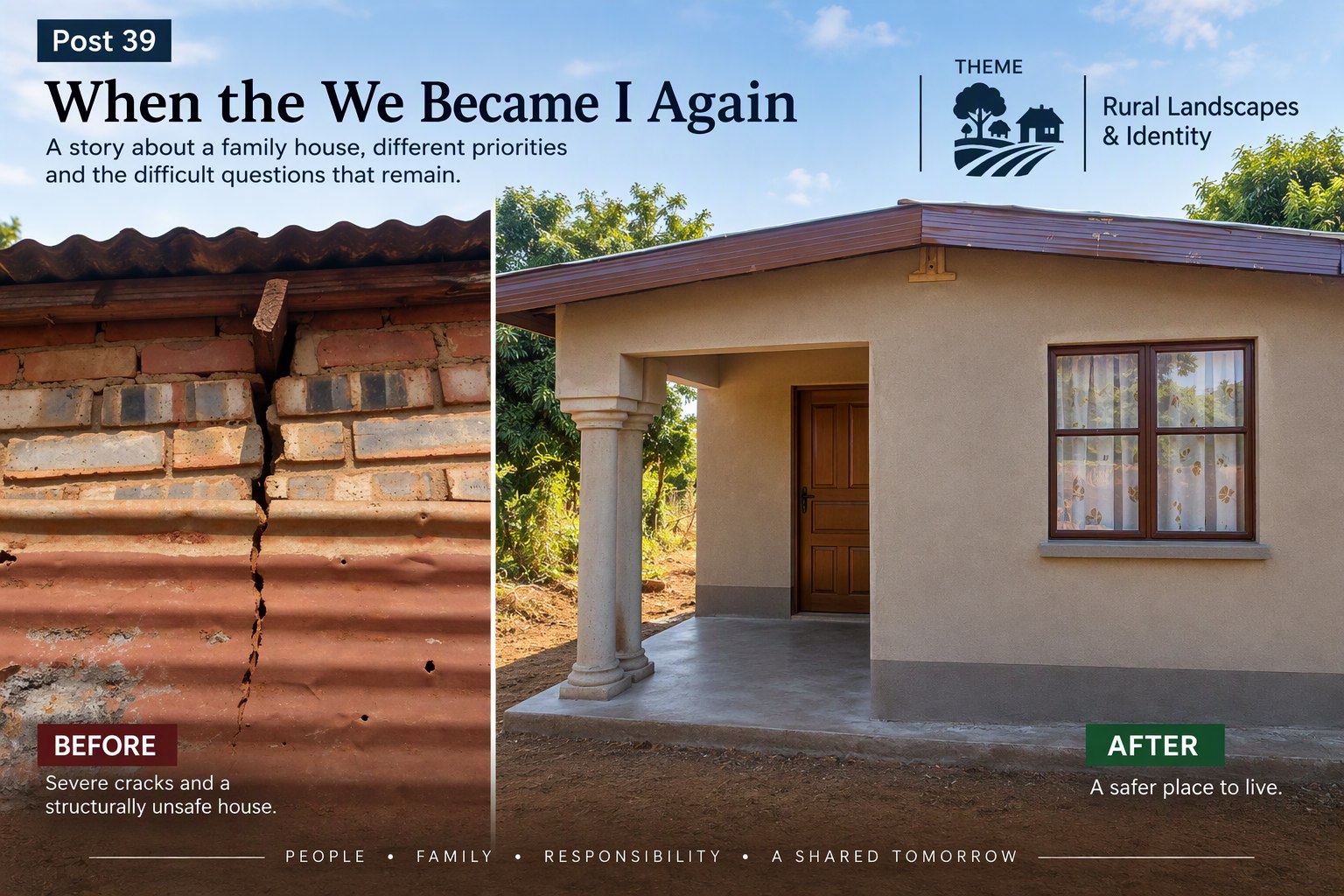
    When I visited, I was disturbed by the condition of the house.

    It had deteriorated considerably.

    The windows no longer had proper panes. Instead, rusted corrugated iron sheets had been nailed to the walls, covering even the window frames.

    The doors were broken and no longer functioning properly.

    Parts of the smooth concrete floor had cracked and disappeared, leaving patches of bare earth.

    But the most serious problem was the structure itself.

    There were multiple cracks running from the foundation all the way to the roof. In some places, the cracks were wide enough for a finger to fit inside.

    Something needed to be done.

    I spoke to other members of the extended family about what could be done. A family friend who was a builder became involved and, together with another relative, inspected the house.

    The inspection revealed something worrying.

    It appeared that the roof timbers and corrugated iron roofing might actually have been helping to hold the structure together and keeping the walls from collapsing.

    The conclusion was that we should not renovate the house.

    The problem was not simply the windows, doors, floors, or even the visible cracks.

    The foundation itself was weak.

    Repairing what we could see would not solve the underlying problem.

    It made more sense to build another house alongside it.

    Then our family friend did something significant.

    After seeing the condition of the house, he offered to build the new one without charging for his labour.

    He could not provide everything.

    But he could provide something.

    I approached other members of the family and suggested that each of us contribute towards the building costs.

    My reasoning was simple.

    A burden that might be difficult for one person could become manageable when distributed among several people.

    That was the “we”.

    Initially, people contributed.

    Then the contributions stopped.

    Different reasons followed.

    One person was installing tiles in their own house. Another needed money to repair an expensive phone. Another said she was paying rent for her son in another province.

    At first, it might be tempting to reduce all these choices to selfishness.

    But I do not think it is that simple.

    People have their own needs and responsibilities. Paying rent for a son was itself an act of responsibility towards another person. In that case, perhaps the “we” had not disappeared.

    Its boundary had simply been drawn somewhere else.

    But were all these needs equally urgent?

    Should improving an already habitable house carry the same urgency as helping someone living in a structurally unstable one?

    Should repairing a phone be weighed in the same way as providing safer shelter to someone living behind broken doors, rusted sheets covering the windows, damaged floors and walls that appeared capable of collapsing?

    Perhaps having a legitimate need does not necessarily mean that every need carries the same weight.

    When resources are limited, where are they needed most?

    At that point, I thought about my mother.

    Through her life, she had shown me the level of sacrifice that is humanly possible. She would often place what she considered a worthy cause ahead of her own needs, sometimes even ahead of her own health.

    But perhaps that also made the question more difficult.

    Just because such sacrifice is humanly possible, does it mean that it is a reasonable price to expect everyone to pay?

    Perhaps not.

    People have different limits, responsibilities, and understandings of sacrifice. I could not necessarily measure everyone against my mother.

    But neither could I escape the other question.

    When the choice is between something that can wait and another personโ€™s basic safety, where should the “I” end and the “we” begin?

    The house did not stop deteriorating because everyone had other priorities.

    Eventually, most of the responsibility for completing the project came back to me.

    With the family friend continuing to provide his labour without charging us, I completed the house.

    It was modest.

    Two rooms.

    But it provided something the old structure could no longer reliably provide.

    A safer place to live.

    I had hoped the project would demonstrate what could happen when the family acted as “we”.

    Instead, it made me think more deeply about what we actually means.

    Perhaps the question is not simply whether a person chooses the “I” or the “we”.

    People cannot be expected to help others at the expense of their own survival. Boundaries still matter, especially when generosity can be exploited.

    But what happens when what the “I” is protecting is not survival, while what the “them” needs concerns something as basic as safe shelter?

    Does that distinction matter?

    And if it does, who decides which need should come first?

    Perhaps collective responsibility becomes most difficult precisely at that point. Not when there is enough for everyone, but when resources are limited and different needs compete for priority.

    The experience did not give me a simple answer.

    It did, however, make something harder for me to ignore:

    Not every choice between “I”, “them”, and “we” involves needs of equal urgency.

    Sometimes the “we” works because everyone carries a share.

    Sometimes the shares are unequal.

    And sometimes, when something still needs to be done, somebody ends up carrying more.

    Join the conversation

    When resources are limited, and several legitimate needs compete, should some needs take priority over others?

  • Post 38: I, Them and We

    Post 38: I, Them and We

    Perhaps my grandmotherโ€™s younger brotherโ€™s understanding of help should not have surprised me as much as it did.

    Long before I understood reciprocity, collective responsibility or Ubuntu as ideas, I had already encountered something similar in my own home.

    My first lesson about collective responsibility came long before I had the words to describe it.

    I was still in primary school.

    My mother occasionally found odd jobs. Whatever she earned was not much, and what she had was already insufficient for the needs of her own children.

    But whenever she had something, she did something that puzzled me.

    She shared her limited resources not only between me and my sister, but also with the children of her older brother.

    One day, I asked her why.

    Why, when she had so little, would she divide it further among children who were not hers?

    I had seen other people concentrate only on their own children.

    My mother became angry.

    She told me that if I was developing that kind of mentality, she would rather not do anything for me.

    I quickly explained myself.

    I was not telling her to stop helping them. I was curious. I wanted to understand why she chose to do it when I could see other people behaving differently.

    Her answer was simple.

    Those were her brotherโ€™s children.

    She regarded them as part of her responsibility too.

    Whatever little she had was to be shared between me, my sister, and them.

    Then came the part that stayed with me.

    She effectively told me:

    Ignore what other people are doing.

    At the time, I thought I was asking about money.

    Looking back, I think she was answering a much bigger question about character.

    There is the “I”.

    I have needs. I have responsibilities. My own survival matters.

    Then there is “them”.

    Other people also have needs. But it is easy to place those needs outside the boundaries of our responsibility.

    Then there is “we”.

    The we emerges when the boundary between my problem and their problem becomes less rigid.

    My mother did not wait until she had abundance before sharing.

    More importantly, she did not make her behaviour dependent on what other people were doing.

    That does not mean that a person should help others at the expense of their own survival. Boundaries still matter, especially when generosity can be exploited.

    But there was another principle underneath what my mother was teaching me:

    Other people should not automatically determine who I become.

    If somebody else does not help, I still have to decide what my own values require of me.

    If somebody treats me badly, I still have to decide who I am going to be in response.

    At primary school, I did not know that this small conversation would follow me into adulthood.

    Years later, I would have to confront the same philosophy under very different circumstances.

    Join the conversation

    Should the willingness to help others depend on whether they would do the same for us?

  • Post 37: When Help Was Not a Loan

    Post 37: When Help Was Not a Loan

    Reaching a more stable stage of my life eventually made me look backwards at the people who had helped me get there.

    There is one part of my university journey that I had not fully reflected on.

    At some point, I had an unpaid SRC debt at the university, and my academic results were withheld. My grandmotherโ€™s younger brother eventually paid that debt for me.

    Years later, after one of my financial breakthroughs, my grandmother and I decided that we should pay him back.

    I no longer remember exactly which breakthrough had put me in a position to do this. It might have been the savings from my NRF bursary, my first GIS internship, one of my periods in George, the PhD scholarship, or even after I had obtained permanent employment.

    I do not want to manufacture a chronology that I can no longer remember with certainty.

    What I remember clearly is the decision.

    It had been a substantial amount of money. My grandmother suggested that we should repay him, and I agreed. We gathered the money, and she took it to him.

    But he was not pleased with the gesture.

    He later came to explain why.

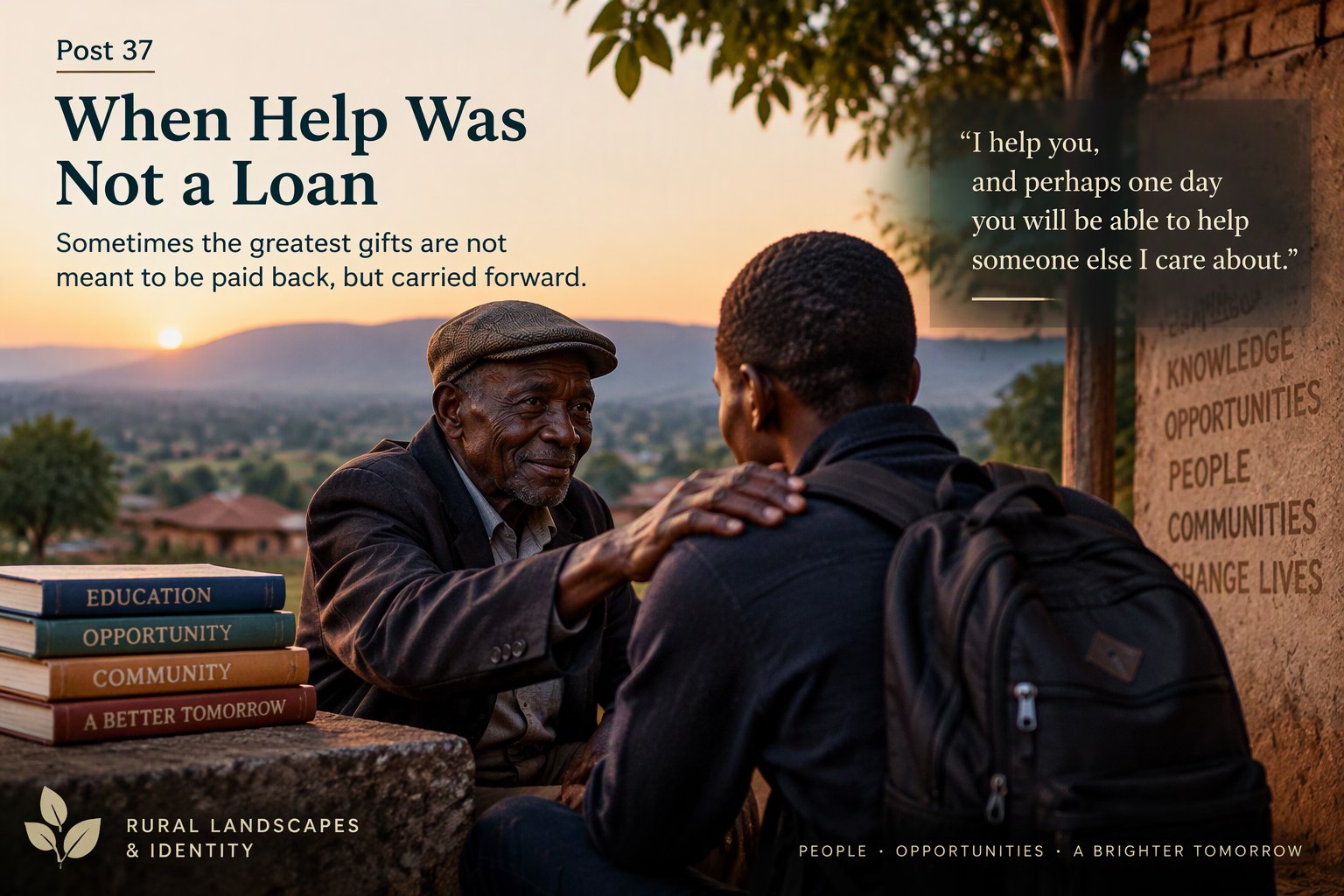
    When he had assisted me, he had not done so because he expected us to return his money one day. He had helped because he knew that, if he helped me to move forward, perhaps I would one day be in a better position to take care of his older sister, my grandmother.

    I had understood what he did as a debt.

    He had understood it differently.

    His thinking was not:

    I help you, and one day you repay me.

    It was:

    I help you, and perhaps one day you will be able to help someone else I care about.

    The benefit was never supposed to travel backwards to him.

    It was supposed to continue forward.

    That conversation changed how I understood assistance.

    There are people whose sacrifices I can never repay directly. Some are no longer alive. Some expected nothing in return. Others may not even know how significantly their intervention altered the direction of my life.

    Perhaps repayment is sometimes too narrow a concept.

    Someone helps you.

    You move forward.

    Then, when circumstances allow, you help somebody else.

    What was given to you continues moving.

    Perhaps that is another way of paying a debt.

    Not by returning it.

    By carrying it forward.

    His gesture also taught me something else about family.

    Family sticks together.

    In my maternal extended family, there are people with practical skills such as welding and bricklaying. As my circumstances improved, I began to think differently about where I should look when I needed that kind of work done.

    If someone within my family can do the work equally well, why should my first instinct be to look outside the family?

    That question matters to me because I did not move forward through my own efforts alone.

    My maternal extended family contributed to my journey in different ways. When I needed help, people within that family helped me. Sometimes what they gave me was money. Sometimes it was something else. But I benefited from a family network that was willing to assist when assistance was needed.

    It would therefore seem strange for me to benefit from that network when I had little, but overlook the same network when I eventually had something to give.

    So when I am in the village and there is work that someone within the family can competently perform, I try to consider the family first before looking outside.

    Perhaps this is part of what is meant by the saying:

    Charity begins at home.

    That does not mean that family should be given opportunities regardless of ability.

    It does not mean that I should never look beyond the family.

    It means that, where people within the family can equally perform the work, I should remember the network from which I myself benefited.

    Perhaps my grandmotherโ€™s younger brother was teaching me something larger than I understood at the time.

    He did not want his money back.

    What he wanted was for the assistance he had given me to continue producing something beyond me.

    He helped me so that I could move forward.

    And perhaps moving forward carries a responsibility of its own.

    Not simply to remember who helped you.

    But, when you eventually have the ability to do so, to make sure that the help does not end with you.

    Join the conversation

    Has someone ever helped you without expecting repayment, and did that experience influence how you later supported your own family or others around you?

  • Post 36: Returning to the Ten Modules

    Post 36: Returning to the Ten Modules

    Permanent employment solved one problem, but it also gave me the stability to return to something I had postponed years earlier.

    My professional registration.

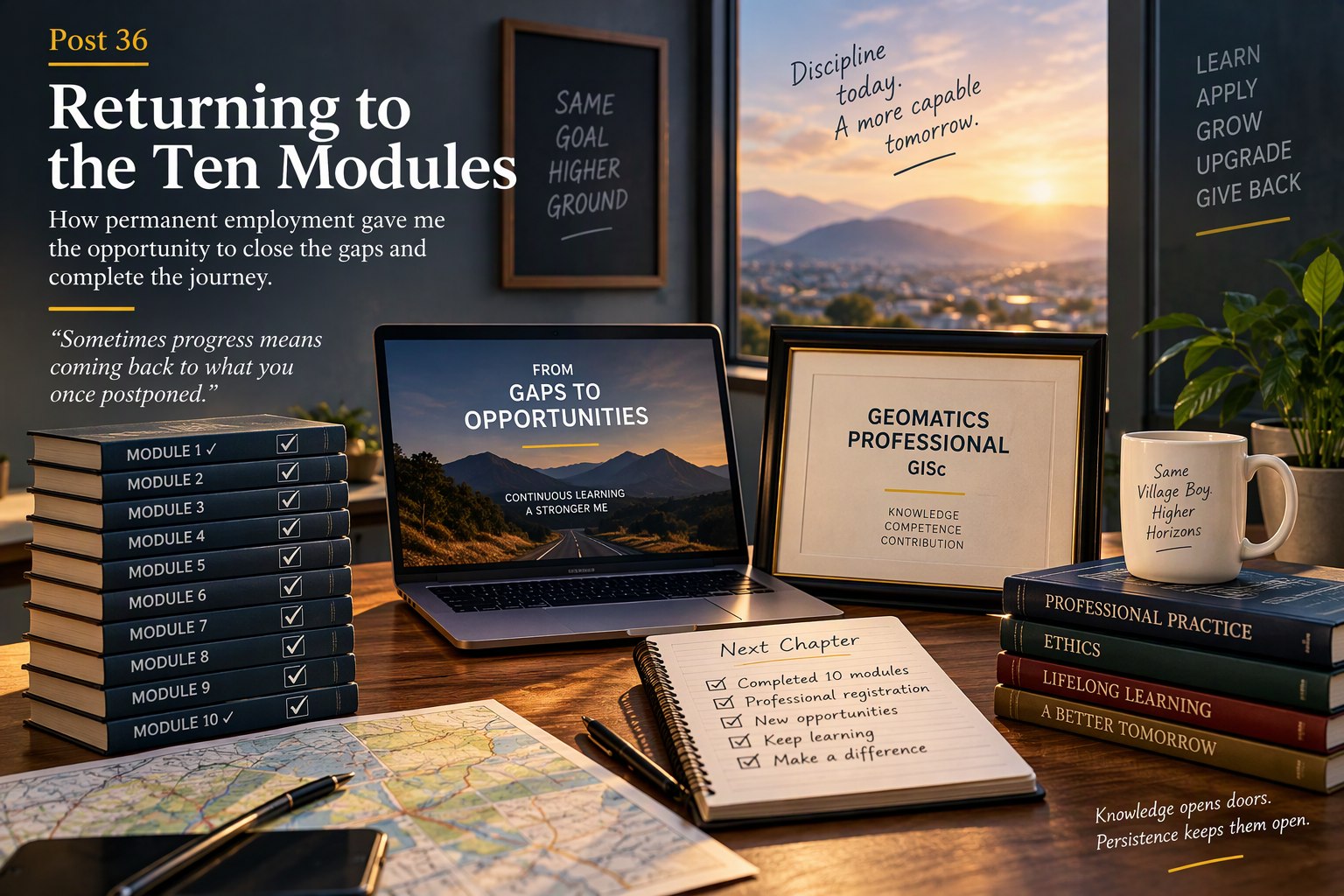
    Earlier in my journey, my academic background had been assessed and ten modules had been identified as gaps in my learning.

    At the time, I had more immediate priorities.

    I needed to complete the PhD.

    I needed employment.

    I needed an income.

    So I had postponed the professional upgrade.

    I had not abandoned it.

    Now my circumstances were different.

    I had permanent employment, and government provided me with a bursary that enabled me to complete the ten modules that had previously been identified as my learning gaps.

    So I returned to studying.

    There was something important about this stage of the journey.

    The gaps had been identified.

    I knew what I needed to complete.

    And now I had financial support that made it possible for me to do it.

    One by one, I completed the modules.

    I thought that would settle the matter.

    It did not.

    By the time I had completed the modules, the South African Geomatics Council (SAGC) wanted my qualification to be evaluated again.

    This brought me back to the same problem that had frustrated me earlier in my professional-registration journey.

    Consistency.

    My qualification had already been assessed.

    That assessment had identified the gaps in my learning.

    I had then spent time completing the modules that had been identified.

    So I had a simple question:

    What was the purpose of the original assessment if its outcome could simply be disregarded after I had fulfilled what it required?

    I challenged the decision.

    Again.

    My argument was not that professional standards should be lowered for me.

    It was that the outcome of the earlier assessment should be honoured.

    If an assessment says:

    These are the gaps you must address,

    and an applicant subsequently addresses those gaps, surely that earlier assessment has to mean something.

    People eventually intervened, and the original assessment was honoured.

    In 2022, I finally upgraded my registration to Geomatics Professional: GISc.

    It had taken years.

    But achieving the professional category taught me something beyond the technical knowledge contained in those ten modules.

    What I Learned About Professional Registration

    If I were giving advice to someone who wants to enter the GISc profession today, I would start much earlier than the registration application itself.

    I would start with the choice of university qualification.

    If professional registration forms part of your long-term ambition, investigate whether the qualification you intend to study has been evaluated for professional registration and for which registration category.

    Don’t assume that because a qualification contains GIS, Geoinformatics, Geography or Geomatics in its name, it automatically provides the registration pathway you expect.

    Find out.

    But I would also not tell someone to abandon a university simply because its curriculum has not followed the easiest registration pathway.

    Not everybody has the same choices.

    Finances, geography, admission requirements and personal circumstances can determine where someone is able to study.

    I am evidence that a more difficult route does not necessarily mean that the destination is impossible.

    But if you take that route, understand that you may be required to demonstrate in detail what you studied and perhaps address additional learning gaps.

    And there is another lesson from my experience.

    Do not be afraid to question an assessment that appears inconsistent.

    That does not mean every rejection is wrong.

    Sometimes an assessment identifies genuine deficiencies in someone’s learning.

    When that happens, address them.

    That was exactly what I did.

    But professional standards should also be accompanied by consistent processes.

    Ask questions.

    Understand the reasons for the decision.

    Keep copies of assessments and correspondence.

    If learning gaps are identified, know exactly what they are.

    And if you later fulfil what was required but receive a decision that appears inconsistent with what you were previously told, do not be afraid to challenge it.

    My professional-registration journey required me to do that more than once.

    There is one further caution.

    Processes change.

    What happened during my registration journey describes what I encountered at that particular time. Anyone going through professional registration today should check the current SAGC requirements rather than assuming that my route remains unchanged.

    My experience is not a registration manual.

    It is a lesson in what can happen when education, professional standards, institutional processes and individual circumstances meet.

    Looking back, those ten modules represented something much bigger than ten courses.

    Initially, they represented what I did not know.

    Then they became something I could work towards.

    Professional registration taught me to recognise the gaps in my own learning.

    But the process also taught me something equally important:

    There are times when I must accept that I still have something to learn, and there are times when I must have the courage to question the people assessing what I have learned.

    Knowing the difference matters.

    Join the conversation

    If you have pursued professional registration in GISc or another profession, have you ever had to address identified learning gaps or challenge an assessment that you believed was inconsistent?

  • Post 35: Coincidence, Providence or Something Else?

    Post 35: Coincidence, Providence or Something Else?

    Looking backwards at this period of my life presents me with a different problem.

    Not simply whether dreams can carry messages.

    A problem about knowledge.

    How much can I honestly claim to know about something simply because I experienced it?

    Post 34 left me with events that I can describe, but an explanation I cannot prove.

    The temptation is to arrange those events into a clear pattern and then treat the pattern as an explanation.

    But is a pattern the same thing as an explanation?

    I donโ€™t think so.

    Could It Have Been My Great-Grandfather?

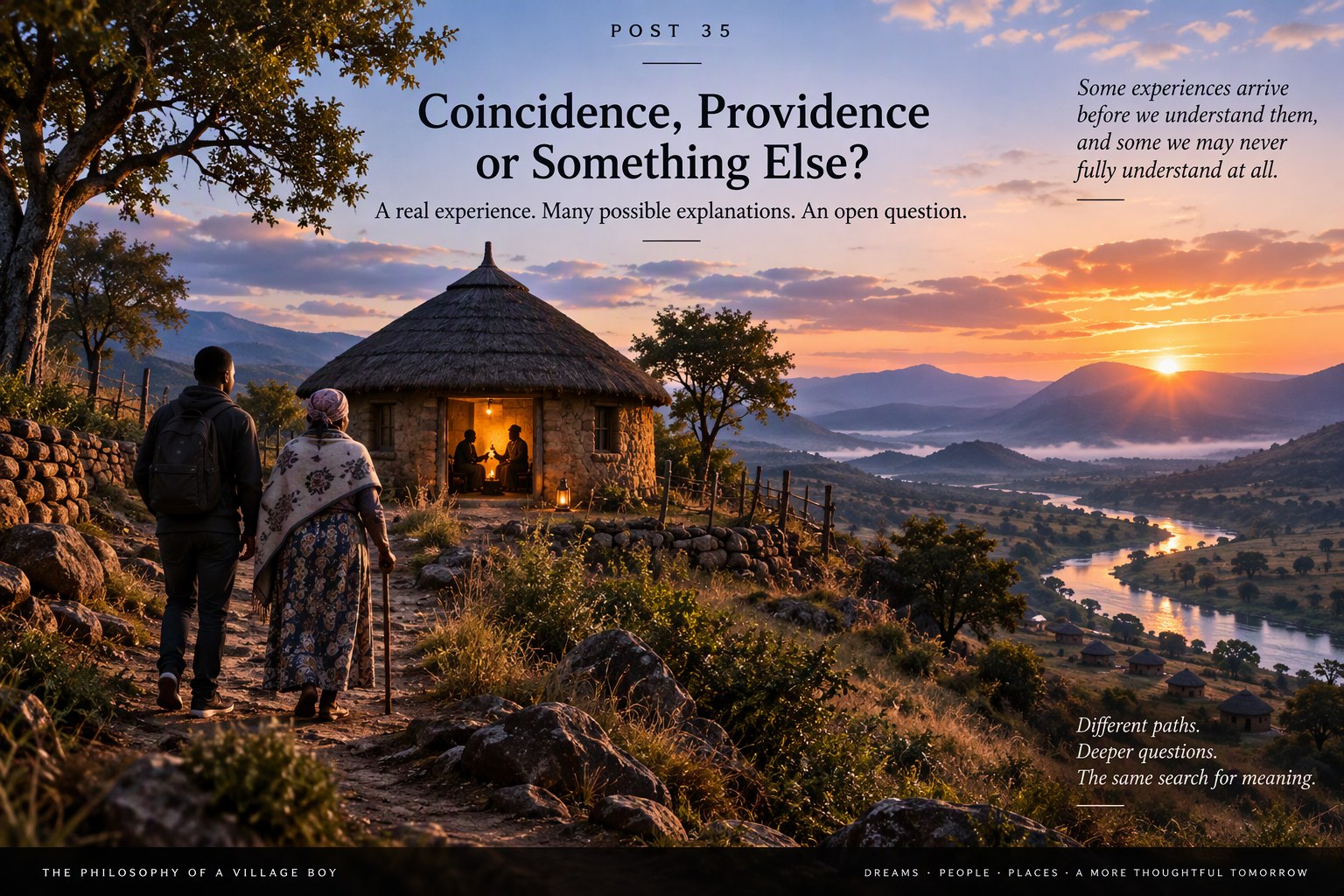
    Someone approaching my experience through African spirituality might interpret it quite simply.

    My great-grandfather wanted to reassure his daughter. I became the messenger, and the traditional healer in the dream became the person through whom the message was communicated.

    From that perspective, perhaps the most interesting part is not what happened afterwards.

    It is the description.

    How did I describe a man I had never met?

    A spiritual explanation would be straightforward:

    Because the message came from him.

    I understand that interpretation. I have considered it myself.

    But does an explanation fitting an experience mean that the explanation has been proven?

    I donโ€™t think I can go that far.

    What About God?

    A Christian could look at the same experience differently.

    The answer would not necessarily be my great-grandfather.

    It could be God.

    The opportunities, the timing, the people who appeared at different stages, and the eventual movement from uncertainty towards stability could be understood as providence.

    Again, I understand that interpretation.

    But understanding an interpretation is different from proving it.

    What About the Mind?

    There is another possibility.

    Perhaps information about my great-grandfather had entered my memory earlier in life and I had forgotten its source.

    Perhaps something heard long ago remained somewhere in my mind and later appeared in a dream.

    And perhaps the uncertainty surrounding my life at the time gave that dream particular significance.

    That possibility cannot simply be dismissed either.

    Or Was It Chance?

    Perhaps the dream and what happened afterwards were unrelated.

    Each event may have had its own ordinary explanation.

    Then, looking backwards, I connected them into a meaningful story.

    That is possible.

    But the word chance also interests me.

    When humans call something coincidence, have they actually explained what happened?

    Or are they sometimes simply saying:

    I do not know of any causal connection between these events.

    Those are not necessarily the same thing.

    Not being able to prove ancestral communication does not prove coincidence.

    Not being able to prove divine intervention does not establish a psychological explanation.

    And not having a scientific explanation for an experience does not make another explanation automatically true.

    Perhaps sometimes the evidence simply does not allow a conclusion.

    What Can I Honestly Say?

    This, for me, is the more important question.

    I can describe what happened.

    What I cannot establish with the same confidence is why it happened that way.

    That is where interpretation begins.

    Perhaps my great-grandfather communicated with us.

    Perhaps God was working through circumstances I could not see.

    Perhaps my subconscious produced the dream from information already stored somewhere in my memory.

    Perhaps coincidence created a sequence that became meaningful only when I looked backwards.

    Or perhaps there are possibilities I have not considered.

    I donโ€™t know.

    And perhaps โ€œI donโ€™t knowโ€ is not a weak answer.

    โ€œI cannot prove this.โ€

    There is a difference between saying:

    and saying:

    โ€œTherefore, this could not have happened.โ€

    The first recognises the limits of my knowledge.

    The second goes beyond those limits.

    Perhaps that is where I have become comfortable leaving some experiences.

    Not with certainty.

    Not with disbelief.

    With an open question.

    Because there may be things humans experience long before they understand what those experiences mean.

    And perhaps there are some things humans may never understand at all.

    Join the conversation

    When an experience feels meaningful but its explanation cannot be proven, should we believe it, dismiss it, or have the humility to say, โ€œI donโ€™t knowโ€?

  • Post 34: Was This What the Dream Meant?

    Post 34: Was This What the Dream Meant?

    I attended the interview in January 2019.

    Then I waited.

    By that stage, waiting had become familiar to me.

    I had waited for opportunities. I had waited for funding. I had waited for different stages of the PhD journey to unfold. Now I was waiting again.

    Then the breakthrough came.

    I was offered the permanent position.

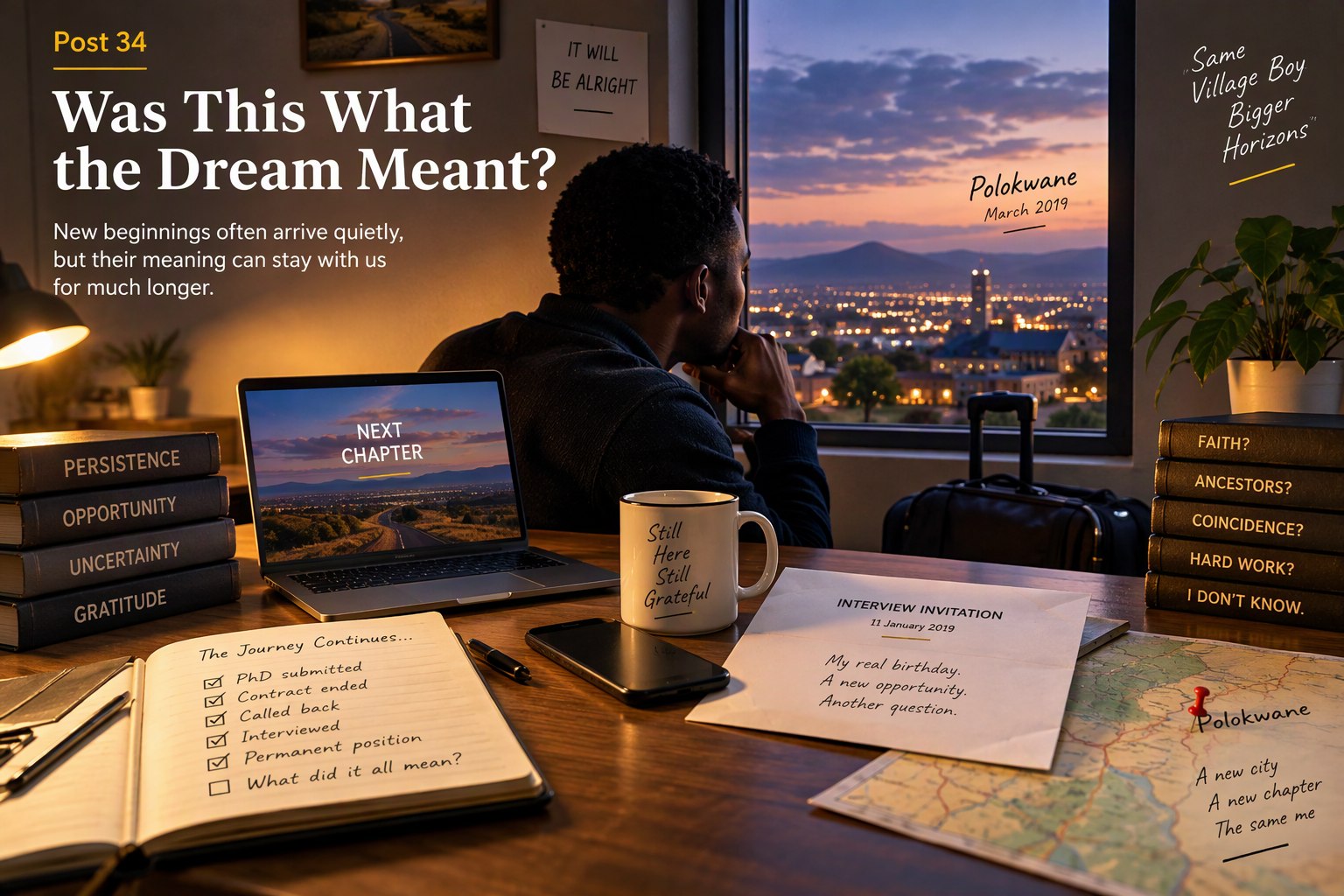
    In March 2019, I left George and started my first permanent job in Polokwane.

    After years of studying, internships, temporary work, financial uncertainty and applications, I finally had permanent employment.

    Naturally, my mind returned to the dream.

    โ€œYour father says you must not worry. Everything will be alright.โ€

    Was this what the message had meant?

    Looking backwards, it would be very easy for me to say yes.

    But can I honestly know that?

    The dream never said:

    You are going to get permanent employment.

    It never mentioned Polokwane.

    It never mentioned March 2019.

    In fact, the message was not even addressed directly to me.

    The traditional healer in the dream had told my grandmother:

    โ€œYour father says you must not worry.โ€

    Perhaps I was only the messenger.

    Perhaps what subsequently happened in my own life had nothing to do with the message at all.

    That possibility has to remain open.

    But there is something about the experience that I still struggle to explain.

    The permanent employment came afterwards.

    The description of my great-grandfather came before.

    I had never met him. He had died before I was born.

    Yet after the dream, before any of these later events occurred, I called my grandmother from George and asked her about her father.

    Was he tall?

    Was he slender?

    Was he a clean man who dressed well?

    Did he have that particular green jacket?

    She recognised the description.

    That telephone conversation happened before I knew what would happen with my employment.

    It happened before I submitted my final PhD thesis for external examination.

    It happened before I left George believing that my contract had ended.

    It happened before I was unexpectedly called back.

    And it happened before the invitation for a permanent position arrived on my actual birthday.

    That distinction matters to me.

    If something good had happened first and I later remembered a vague dream and attached meaning to it, retrospective interpretation would provide a fairly straightforward explanation.

    But the dream was important enough for me to call my grandmother when I had it.

    The message existed before the outcome.

    The question existed before the outcome.

    Neither my grandmother nor I knew what was supposed to become alright.

    Then, over the following months, several things that had been uncertain began to resolve.

    The final PhD thesis was submitted for external examination.

    The employment contract that I thought had ended was unexpectedly extended.

    Before that extension was even properly formalised, another opportunity opened.

    Then permanent employment followed.

    So was this what the dream meant?

    I still cannot say.

    Perhaps I had heard something about my great-grandfather earlier in life and forgotten where I had heard it.

    Perhaps information stored somewhere in my memory later appeared in the dream.

    Perhaps the dream and the events that followed were completely unrelated.

    Perhaps I am connecting them because I now know how the story ended.

    Those possibilities cannot simply be dismissed.

    But neither can I honestly say that I know that one of them must be the explanation.

    And perhaps this is where I have to separate two questions.

    What happened?

    That I can describe.

    Why did it happen that way?

    That is much harder.

    I cannot prove that my great-grandfather communicated through my dream.

    But neither can I prove that he did not.

    The permanent job did not settle that question.

    If anything, it gave me another reason to keep asking it.

    Months earlier, during a period of uncertainty, there had been a simple message:

    โ€œEverything will be alright.โ€

    Months later, several of the things that had been uncertain were beginning to become alright.

    Whether those two facts are connected is something I still cannot claim to know.

    Join the conversation

    When something meaningful happens before an outcome, how do we distinguish coincidence from a connection we simply do not understand?

  • Post 33: Everything Will Be Alright

    Post 33: Everything Will Be Alright

    In 2018, I was back in George, working on a one-year contract while completing my PhD.

    Although I was employed, there was still uncertainty about what would happen next. The contract was supposed to end in December, while the PhD journey was also approaching its final stages.

    It was during this period that I had a dream that has remained with me ever since.

    In the dream, my grandmother wanted me to accompany her to consult a traditional healer.

    At first, I refused.

    She said she would go alone.

    I felt guilty about allowing her to go by herself, so I decided to accompany her.

    When we arrived at the traditional healer’s place, we sat outside because he was still attending to another client.

    When he finished, he came out of the consultation hut just as my grandmother was about to enter.

    Instead of allowing her inside, he closed the door and greeted her outside.

    He was laughing.

    Then he asked my grandmother whether she was the daughter of a particular man.

    He started describing him.

    A tall, slender gentleman.

    A clean man who was always well dressed.

    He also described a particular green jacket that the man used to wear.

    My grandmother said yes.

    The man he was describing was her father.

    My great-grandfather.

    Then the traditional healer delivered a very simple message:

    โ€œYour father says you must not worry. Everything will be alright.โ€

    That was the dream.

    When I woke up the following morning, I was still in George.

    My grandmother was at home, far away from me.

    I called her first thing in the morning.

    Before telling her the entire dream, I started asking her questions.

    Was her father tall?

    Was he slender?

    Was he a clean man who dressed well?

    Did he have a particular green jacket that he used to wear?

    My grandmother was shocked.

    She wanted to know how I knew these things about her father.

    I had never met him. He had died before I was born.

    That was when I told her about the dream.

    I explained how we had gone together to consult a traditional healer and how the healer had described her father before giving her the message:

    โ€œYou must not worry. Everything will be alright.โ€

    But there was a problem.

    Neither my grandmother nor I knew what was supposed to be alright.

    The message did not say that I would get a job.

    It did not say anything about the PhD.

    It did not mention money.

    It did not give us a date.

    It simply said:

    Everything will be alright.

    So we were left with the message and a question:

    What was going to be alright?

    Life continued.

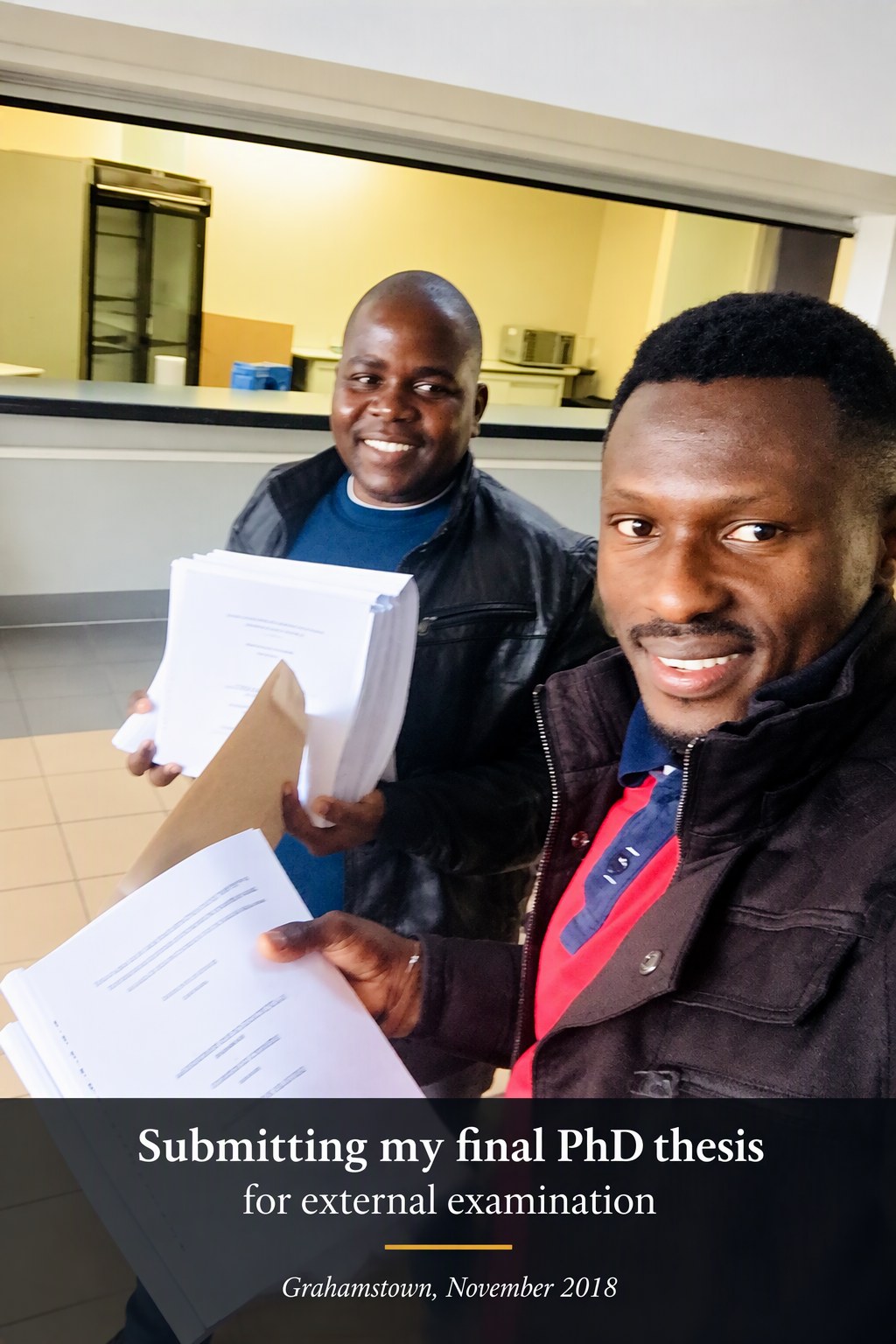
    In November 2018, I travelled from George to Grahamstown to submit my final PhD thesis for external examination.

    After everything that had happened during the PhD journey, the thesis was finally out of my hands.

    One uncertainty was moving towards resolution.

    Another remained.

    My one-year employment contract was supposed to expire in December.

    When I left George for the December holidays, I therefore left believing that my time there had come to an end.

    I acted accordingly.

    I gave away my belongings.

    My bed.

    My plates.

    My pots.

    As far as I knew, I was leaving George.

    I went home.

    Then, while I was at home, something unexpected happened.

    I was informed that I should return to work in January because the contract was going to be extended.

    So I returned to George.

    But there was still no new contract.

    We were told to continue working while the new contracts were being prepared.

    There was something almost strange about returning.

    Only weeks earlier, I had given away my belongings because I genuinely believed that this chapter had ended. Now I was back, working again, without even having the new contract in my hands.

    Then another opportunity appeared.

    On 11 January 2019, I received an invitation to attend an interview for a permanent GIS position.

    There was also a funny coincidence in the date.

    11 January is my real birthday, although it is not the date of birth recorded on my identity document.

    Did that mean anything?

    I did not know.

    Perhaps it was simply a coincidence.

    But I noticed it.

    I accepted the invitation and later attended the interview in January.

    By then, the dream had already happened.

    My grandmother had already heard me describe a father I had never met.

    She had already recognised him from the description.

    And she had already heard the message:

    โ€œYour father says you must not worry. Everything will be alright.โ€

    When that message came, neither of us knew what it meant.

    Since then, I had submitted my final PhD thesis for external examination.

    My temporary contract had reached what I believed was its end.

    I had given away my belongings and gone home.

    I had unexpectedly been called back to George.

    I had returned without a new contract having been signed.

    And now, before that situation had even fully settled, an invitation to interview for a permanent position had arrived on my actual birthday.

    At this point, I still did not know how the story would end.

    That matters to me.

    It is easy to look backwards at events after we already know the outcome and arrange them into a meaningful pattern.

    But at that moment, there was no outcome to work backwards from.

    When I called my grandmother after the dream, neither she nor I knew that I would submit my thesis in November, leave George in December believing that my job had ended, be unexpectedly called back, or receive an invitation for a permanent position on my birthday.

    We knew none of that.

    We had only the dream.

    We had the description of a man I had never met.

    And we had a message whose meaning neither of us understood:

    โ€œEverything will be alright.โ€

    Perhaps it was reassurance.

    Perhaps it was coincidence.

    Perhaps it was something else.

    At that point in the story, however, there was simply no way of knowing.

    There was only one unanswered question:

    What exactly was going to be alright?

    Join the conversation

    Have you ever experienced something that seemed meaningful before you had any idea what, if anything, it meant?

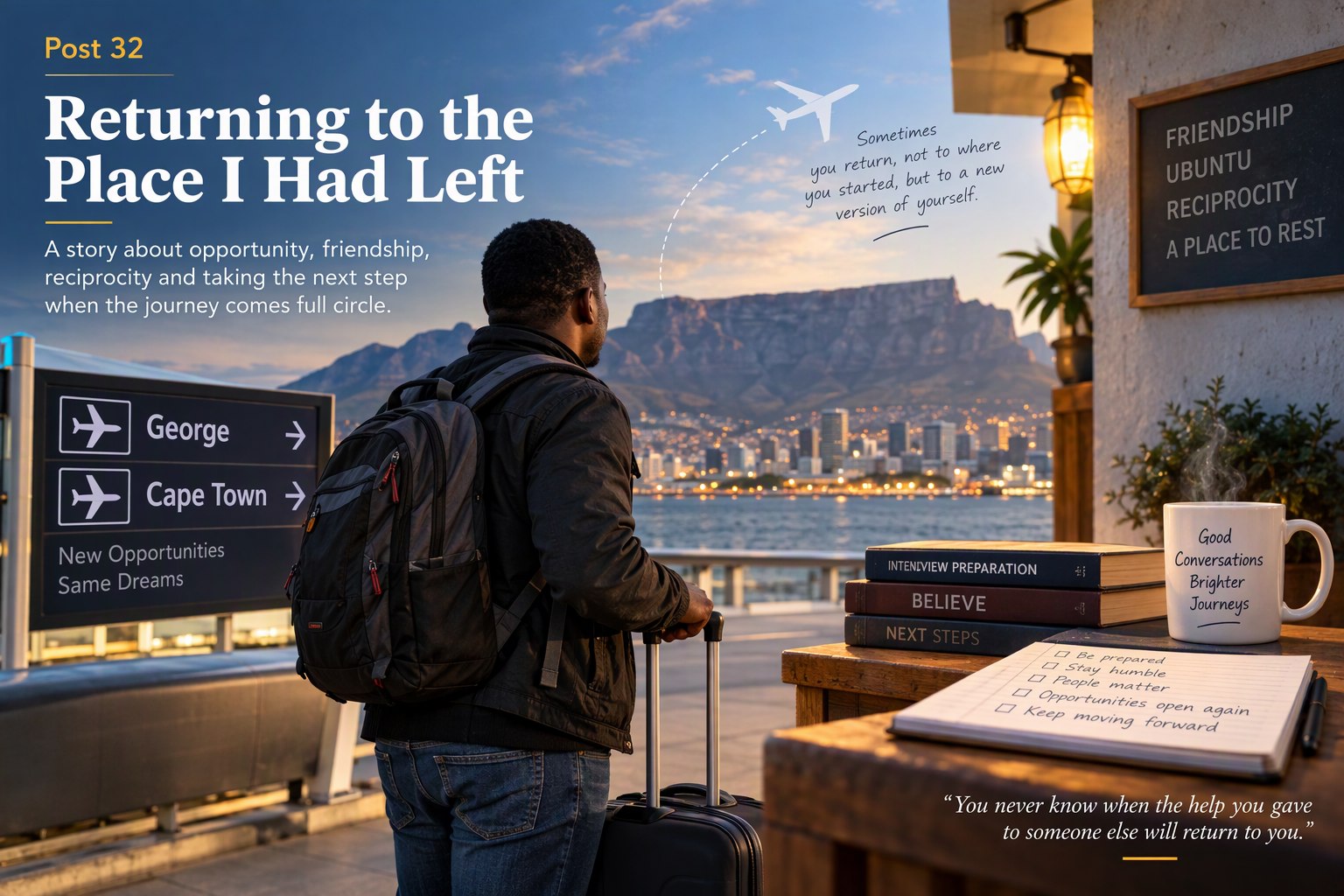
  • Post 32: Returning to the Place I Had Left

    Post 32: Returning to the Place I Had Left

    While I was at home trying to complete my PhD, I continued applying for jobs.

    One of those applications took me back to a familiar organisation.

    I was called for an interview in Cape Town by the same conservation agency I had left earlier when I went to pursue my PhD.

    There was something almost circular about it.

    I had left the agency because the PhD opportunity had opened. Now the scholarship had run out, I was trying to finish the PhD from home, and the same agency was giving me another opportunity.

    But first, I had to get to Cape Town.

    My lady friend from KwaZulu-Natal, whom I had assisted during an earlier part of my journey, was now in Cape Town furthering her studies.

    I told her about the interview and asked her to help me find accommodation for the night before the interview.

    She refused.

    Not because she did not want to help me.

    She refused because she did not want me to spend money unnecessarily.

    She insisted that she and her housemates would accommodate me at their residence. She reminded me that I had assisted her before and that I should now allow her to assist me.

    I accepted.

    The ladies changed their arrangements for that night and provided me with my own space.

    It was a little uncomfortable, but I could have said no.

    What mattered was their generosity.

    They also provided supper and helped orientate me around Cape Town, a city that was unfamiliar to me.

    The following morning, I went for the interview.

    Some of the panel members seemed excited that I wanted to return to the agency that I had previously left to complete my studies.

    Then I travelled back home.

    Before the end of that week, I received the breakthrough.

    I had been offered the job.

    It was a one-year contract.

    I took it.

    My former GIS manager, the person who had helped me with professional registration and recommended me for the PhD scholarship, had already left the agency some time before.

    So, although I was returning to a familiar organisation, things had changed.

    I had changed too.

    I returned carrying a PhD that still had to be completed, the experience of losing the financial security of a scholarship and a clearer understanding of how quickly circumstances could change.

    The contract solved one problem.

    But it did not solve everything.

    It was still temporary employment.

    So I continued applying for permanent positions.

    Looking back, however, I also remember something else about that trip to Cape Town.

    At an earlier point in my journey, I had been in a position to assist someone else.

    Now circumstances had shifted.

    I needed help.

    She remembered.

    I had only asked her to help me find accommodation.

    Instead, she effectively said:

    You helped me before. Allow me to help you now.

    Perhaps reciprocity does not always arrive according to a schedule.

    Sometimes what you give to another person returns years later, in another city, under completely different circumstances.

    And sometimes it does not return from the person you helped at all.

    But on this occasion, it did.

    Join the conversation

    Have you ever received help from someone you once helped, at exactly the point when you needed someone yourself?

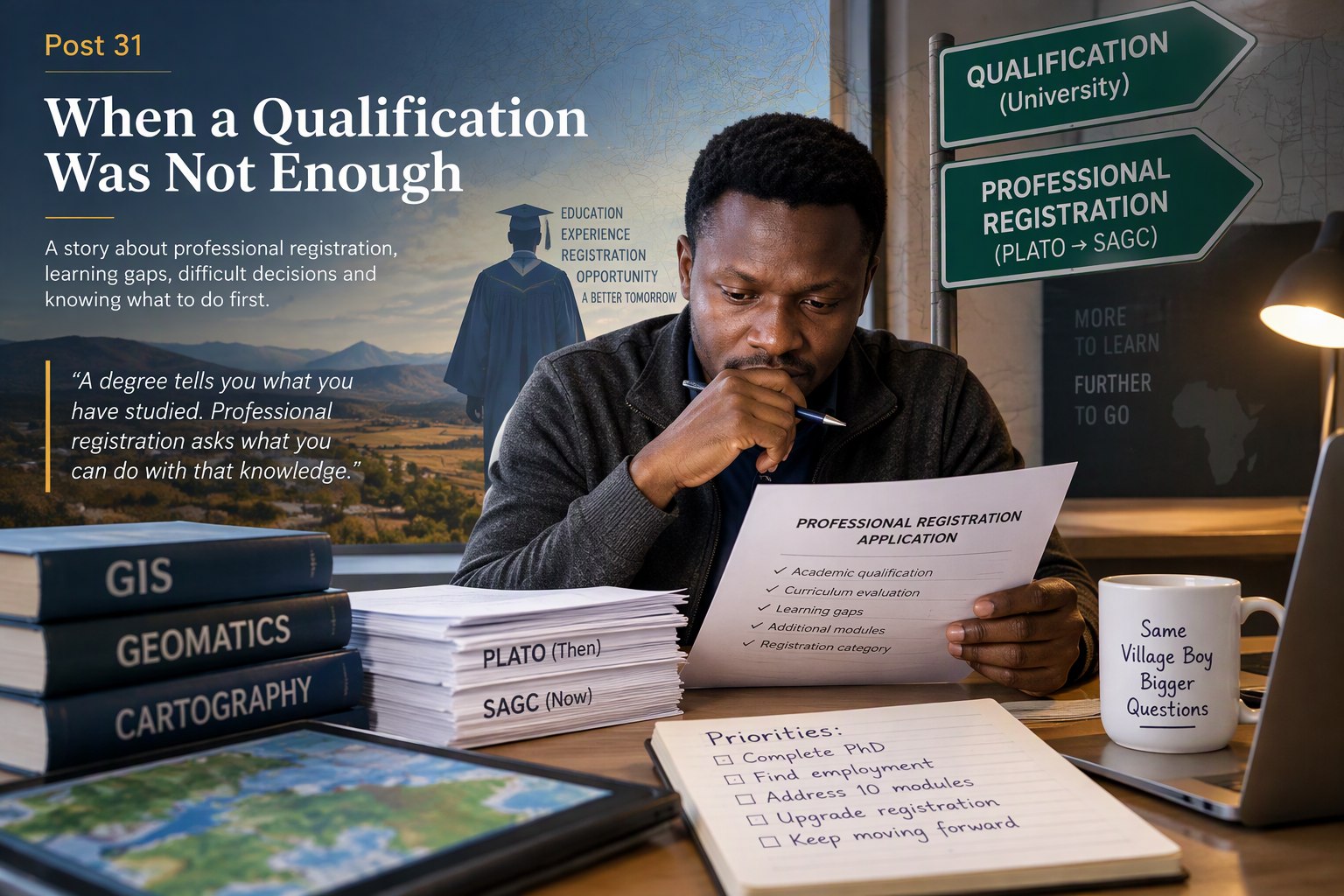
  • Post 31: When a Qualification Was Not Enough

    Post 31: When a Qualification Was Not Enough

    When my PhD scholarship ran out and I had to continue working on the PhD from home, I was also applying for almost any opportunity I could find.

    At least I was already professionally registered as a GISc Technician.

    My former supervisor at the conservation agency had assisted me with the registration process shortly before I started my PhD journey. At the time, the professional body was the South African Council for Professional and Technical Surveyors (PLATO). Today, it is the South African Geomatics Council (SAGC).

    Although I still had ambitions to upgrade my registration to the professional category, getting registered as a GISc Technician had itself been a major fight.

    My initial application had been for registration at the professional level.

    The problem was my undergraduate qualification.

    I had completed my degree at the University of Venda, but at the time I applied, I was informed that its curriculum had not been evaluated and approved for the registration category I was pursuing.

    This meant that having the degree was not enough.

    I had to manually evaluate the contents of the qualification using a prescribed template. I had to go back to the individual modules I had completed and demonstrate what had actually been covered in my studies.

    In principle, I did not have a problem with this.

    If there were gaps in my learning, I wanted those gaps to be identified.

    My problem was with what appeared to me to be inconsistencies in the assessment process.

    Two people could have completed the same degree, at the same university, and studied the same modules, yet receive different assessment outcomes because their applications had been assessed by different people.

    One person could be approved.

    Another could be rejected.

    How could people with essentially the same academic preparation receive different conclusions about what they had learned?

    That was the source of my frustration.

    Eventually, I wrote a letter of complaint to the committee.

    I was not arguing that I should automatically be registered at the professional level simply because I had a degree.

    My argument was much simpler:

    Evaluate what I have studied consistently. If there are gaps in my learning, identify them and allow me to address them.

    Eventually, my registration as a GISc Technician was approved.

    More importantly for my longer-term ambition, the assessment identified ten individual modules that I needed to complete as short courses before I could upgrade my registration to the professional category.

    That changed the situation.

    There is a difference between being told:

    You do not qualify.

    and being told:

    These are the gaps in your learning.

    The second gives you something to work towards.

    It also taught me something about professional registration that may be useful to someone considering a career in GISc.

    A university degree and professional registration are not necessarily the same thing. Anyone who has ambitions of becoming professionally registered should not only look at the name of the degree they want to study. They should also investigate whether that particular curriculum has been evaluated for professional registration and, importantly, for which category.

    That is something I wish more prospective GISc students understood before choosing their qualifications.

    But I would also not want my experience to discourage someone simply because the qualification available to them has not already been evaluated.

    I went through the longer route.

    My modules had to be examined and gaps in my learning had to be identified.

    The important thing is to understand the requirements and be prepared for the process.

    Professional-registration processes also change over time. Someone reading this today should therefore check the current requirements with SAGC rather than assuming that the process I went through remains exactly the same. The current SAGC guidance still distinguishes qualifications recognised for particular registration categories from other qualifications that may require individual consideration.

    For me, however, those ten modules would have to wait.

    By then, I had another major problem.

    I had a PhD to finish.

    My scholarship had run out.

    I needed employment.

    I needed an income.

    I therefore decided that upgrading my professional registration would have to wait.

    It was not that the professional ambition had disappeared.

    I now knew where I wanted to go.

    I even knew what learning gaps I needed to address to get there.

    But not everything important can be pursued at the same time.

    For now, two things had to come first:

    Finish the PhD.

    Find a job.

    I would return to those ten modules later.

    Join the conversation

    Have you ever had to postpone an important professional goal, not because you had abandoned it, but because another priority had to come first?

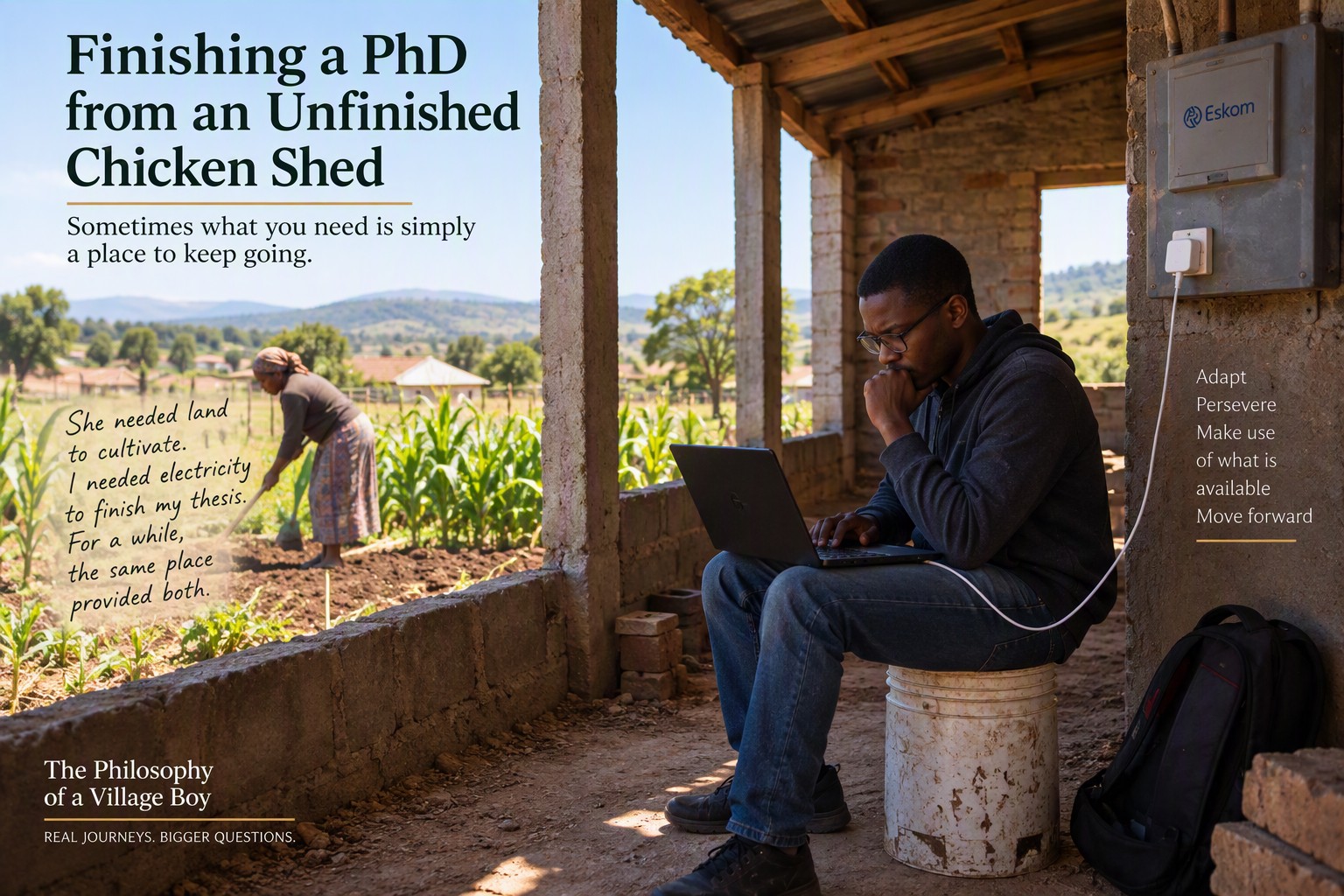
  • Post 30: Finishing a PhD from an Unfinished Chicken Shed

    Post 30: Finishing a PhD from an Unfinished Chicken Shed

    One of the major challenges towards the end of my PhD came from delays in completing the study.

    My thesis had effectively been completed, but I was still waiting for my supervisor’s comments. He had several students under his supervision and other responsibilities.

    As the delays continued, most of the funding from my scholarship eventually came to an end.

    The monthly stipend stopped.

    I had to return home unemployed.

    Fortunately, most of the work on the thesis had already been done. Whatever remained could largely be completed remotely, just as I had done during my Master’s. I would only need to return to the university when my physical presence was necessary, particularly to discuss comments, print, and eventually submit the final thesis.

    But working from home introduced another problem.

    A Home Without Electricity

    By then, my grandmother and I had moved into the modest home I had been building using some of my savings from the PhD scholarship.

    We had a place to call home again.

    But the house was in a new settlement expansion, and the area had not yet been connected to the electricity grid.

    I still needed to work through my supervisor’s comments whenever they came.

    For that, I needed my laptop.

    And the laptop needed electricity.

    Sometimes I crossed the road to my grandmother’s younger brother’s house so that I could work.

    There was also another unlikely option.

    Nearby stood a structure that had been intended for a chicken business. Construction had been abandoned before the facility was completed and before it had ever been used for that purpose.

    But the unfinished structure had something I needed.

    Electricity.

    Cultivation Returns to the Story

    That place also brought an earlier part of our story back into the picture.

    In Post 8: Do Your Part, Even If It Is Only a Drop in the Ocean, I wrote about the decline of subsistence farming in rural areas and what it meant to my grandmother.

    Growing up, I watched her cultivate several masimu, or farming plots, every season. I remember her small circular storage hut being filled with maize after harvest. In many years, that harvest would sustain the household until the following season.

    Then, a few years after I enrolled at university, the subsistence farmers were told to stop cultivating those plots.

    The land was no longer going to be available for cultivation. It would be demarcated into residential stands.

    Eventually, a large settlement arose where those masimu had once been.

    There was little my grandmother could do about it.

    Years later, after relocating to the village where she had been born, cultivation somehow returned to her life.

    Her cousin was cultivating vacant land around the unfinished chicken facility. There was a portion that he was not using, and my grandmother asked whether she could cultivate it.

    Her cousin approached the owner.

    Permission was granted.

    My grandmother began cultivating maize again.

    It was not her land.

    She had not regained the masimu that had been lost.

    And there was no guarantee that this arrangement would last.

    But after years without the farming plots she had once cultivated, she once again had access to a piece of land.

    And unexpectedly, I also benefited from the same arrangement.

    While my grandmother cultivated outside, I could sit inside the unfinished chicken facility, plug in my laptop, and continue working through my supervisor’s comments.

    After all the university offices, academic discussions, research, conferences, and international travel that had formed part of my PhD journey, some of the final work on my thesis was being done from an unfinished chicken facility in a village.

    There was nothing glamorous about it.

    It did not need to be glamorous.

    It had electricity.

    That was what I needed.

    Another Temporary Solution

    Eventually, I completed the thesis and submitted it.

    Not long afterwards, our new home was connected to the electricity grid.

    The cultivation arrangement also eventually came to an end.

    The owner returned to the original plan, completed the chicken facility, and started the business for which it had originally been intended.

    My grandmother and her cousin could therefore no longer cultivate there.

    Once again, my grandmother’s access to agricultural land had been temporary.

    There is something interesting about how the different needs came together at that particular place.

    Years earlier, she had lost access to the masimu she cultivated when agricultural land was converted into residential stands.

    Much later, in another village, somebody else’s unused land temporarily allowed her to cultivate again.

    That same temporary arrangement indirectly gave me something I needed to complete my PhD.

    She needed land to cultivate.

    I needed electricity to finish my thesis.

    For a while, the same place provided both.

    Neither arrangement was permanent.

    Perhaps it did not need to be.

    Throughout the journey I have described in these posts, many solutions did not necessarily remove the larger problem permanently. Sometimes they simply provided what was needed to move through a particular moment.

    An internship did not guarantee permanent employment.

    A scholarship did not remove every financial challenge.

    Temporary access to land did not solve the wider problem of disappearing masimu.

    And electricity from an unfinished chicken facility did not solve the lack of electricity at our new home.

    But each provided something that was needed at the time.

    Perhaps this takes me back to the philosophy behind Post 8:

    Do your part. Work with what is within your control and make use of the opportunities available to you, even if what you can do seems like only a drop in the ocean.

    Join the conversation

    Have you ever found that a temporary or unlikely solution was enough to help you through an important stage of your journey?

  • Post 29: The I, Them, and We

    Post 29: The I, Them, and We

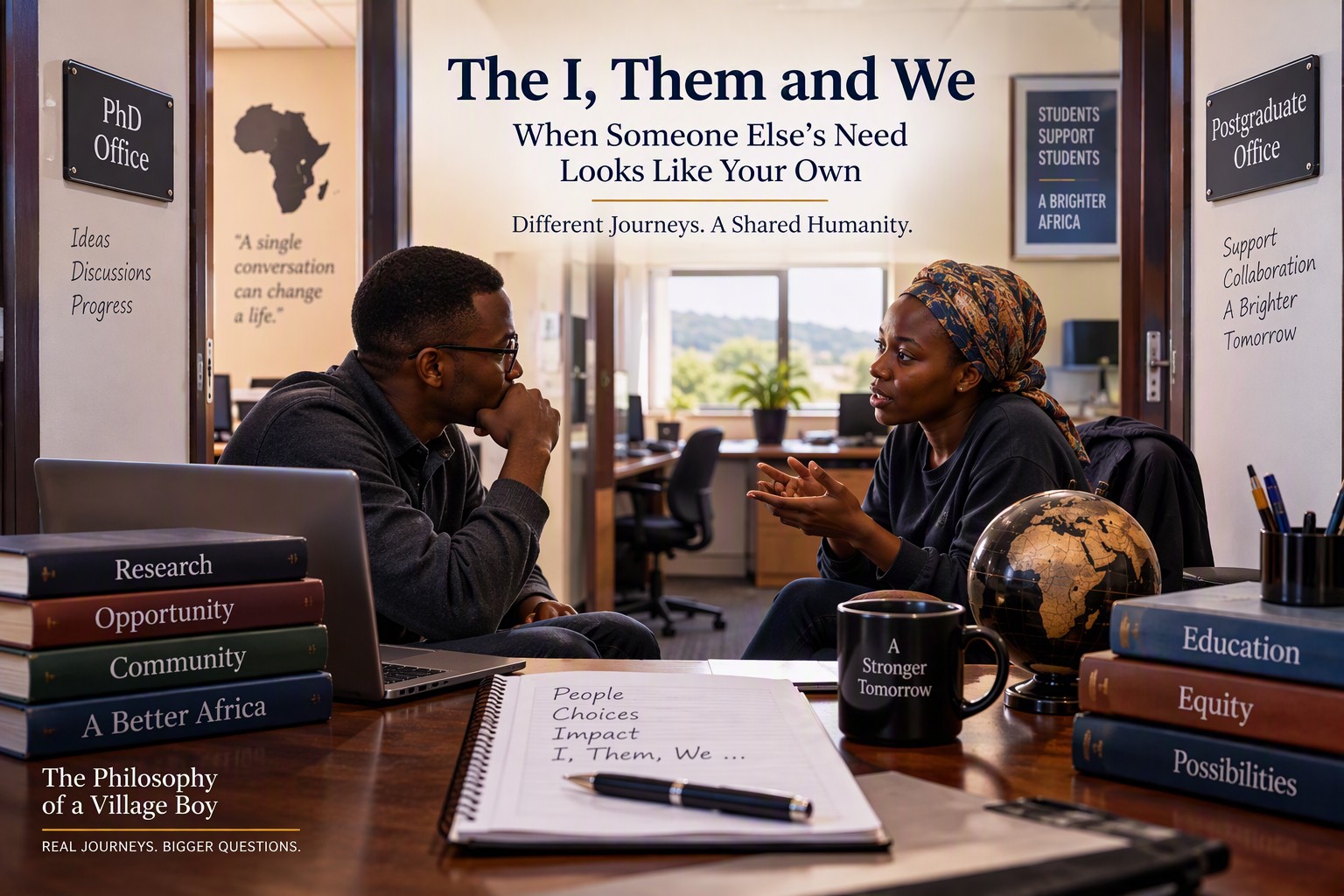
    Postgraduate students worked from offices allocated to us at the university.

    Fellow students and interns worked from the postgraduate office next to ours. Although a wall physically separated the two rooms, that barrier meant very little socially. The offices faced each other, and the relationships among the students meant that we interacted regularly. In practice, we were part of the same university community.

    One in particular was a Zulu village girl from KwaZulu-Natal whose family circumstances were not very different from my own.

    A member of her extended family had played an important role in her journey. This person had supported her financially, helped put her through school, and she was staying with this family member while doing her internship.

    Then, during the December holidays, something changed.

    There was a fallout between them.

    Suddenly, the support and living arrangement she had depended on were no longer available.

    She was now on her own.

    The First-Month Problem

    She needed to return to Grahamstown, now called Makhanda, in the Eastern Cape, where she was doing her internship.

    But returning was no longer simply a question of transport.

    She had to find her own accommodation. She needed money for transport, rent, groceries, and the other expenses that came with establishing herself independently.

    Her internship would pay her, but that did not solve the immediate problem.

    She needed enough money to survive for that first month while waiting for her internship payment.

    There is something peculiar about situations like this.

    From the outside, a person can appear to have an opportunity. She had an internship. She would receive an income. There was a path forward.

    But between having an opportunity and being able to take advantage of it stood a much smaller, more immediate problem:

    How do you get there?

    How do you pay for transport?

    How do you secure accommodation?

    What do you eat while waiting for the first payment?

    She was at home and could not see how she would return to Grahamstown and continue with her internship.

    When she explained the problem to me, she didn’t know I had experienced something remarkably similar earlier in my own journey.

    I knew what it meant to have an opportunity waiting for you but not have the immediate financial resources required to reach it.

    Then she asked me for help.

    She proposed that I lend her the money and that she would repay me through monthly instalments once her internship payments started coming through.

    Under different circumstances, perhaps the decision would have been easy.

    But I had my own pressing needs.

    My Needs or Hers?

    The family house had been sold.

    My grandmother had relocated, and I was using some of my savings from the PhD scholarship to build a modest home that we could eventually call our own.

    At that stage, I was effectively homeless myself.

    Every amount of money had a purpose.

    Redirecting some of it elsewhere would delay construction of the house.

    Both needs were real.

    This was therefore not simply a question of whether I was willing to help someone.

    It was a question of competing objectives.

    There was something I needed.

    There was something she needed.

    And I had limited resources with which to address both.

    Whose need should come first?

    There was the I: my own legitimate needs.

    There was them: the needs of another person.

    And beyond the two sits a much larger consideration: we, the collective.

    Humans constantly have to make choices between these competing interests.

    Sometimes our own needs must come first.

    Sometimes another person’s need appears more urgent.

    And sometimes the interests of the larger collective may require individuals to sacrifice something of their own.

    But how do we decide?

    She Was Another Version of Me

    In this particular situation, something made the decision easier.

    I recognised her problem.

    I had lived a version of it.

    I knew what it was like when the difference between continuing with an opportunity and losing it could come down to something as ordinary as transport, accommodation, groceries, or having enough money to survive until another source of income became available.

    I looked at what I needed.

    Then I looked at what she needed.

    If I redirected some of my money, construction of the house would slow down.

    But it would continue.

    If she could not return to Grahamstown, the consequences for her internship could be much greater.

    Her immediate need seemed greater than mine.

    And when I looked at her circumstances, I could see something of my own earlier journey.

    She was, in some ways, another version of me.

    So I lent her the money.

    Construction slowed down.

    She returned to Grahamstown, secured her own accommodation and continued with her internship.

    And, as she had promised, she repaid the money through monthly instalments.

    Our Journeys Continued

    Her internship was not the end of her journey.

    After completing it, she moved to Cape Town to further her studies.

    Our relationship also did not end with that loan.

    Over the years, there were other occasions when I assisted her as she continued along her academic and professional journey.

    But there is something important that must not disappear from this story:

    She also assisted me.

    The assistance between us did not move permanently in one direction.

    At one point, I happened to be in a position to respond to a problem she was facing. At other points in our lives, circumstances were different, and she was able to assist me.

    That complicates the distinction between I and them.

    Perhaps those positions are not as fixed as they sometimes appear.

    Today I may be the person with something to give.

    Tomorrow I may be the person who needs someone else.

    And perhaps neither of us knows, at the moment of helping, how those positions may eventually change.

    Years Later

    Much later, when we spoke about those years again, she reminded me of some of the assistance I had given her.

    Interestingly, I could not remember every individual act she mentioned.

    But I remembered why I helped.

    I told her:

    I saw myself in her.

    She agreed.

    Perhaps that tells me more about my original decision than trying to reconstruct every individual act of assistance.

    I was not looking at her circumstances entirely from the outside.

    Her struggle was familiar because I had lived a version of it myself.

    But that realisation creates another question.

    Would I have made the same decision if I could not see myself in her?

    The I, Them and We

    This is where that relatively simple financial decision becomes philosophically interesting to me.

    Humans constantly negotiate between I, them, and we.

    The individual has legitimate needs.

    So does the person standing in front of us.

    Beyond both are families, communities, societies, and humanity collectively.

    But resources are limited.

    Choosing one objective can mean postponing another.

    In this particular situation, I chose โ€œthemโ€ over โ€œIโ€, at least temporarily. I delayed something I needed because another person’s immediate need seemed greater.

    But I do not think that means โ€œthemโ€ should always come before โ€œIโ€.

    There must surely be circumstances in which choosing โ€œIโ€ is both reasonable and necessary.

    The more difficult question is how we make that distinction.

    And knowing how our relationship developed later makes the categories even less certain.

    Who exactly is โ€œthemโ€?

    The person who needs my help today may be the person who helps me tomorrow.

    Perhaps โ€œIโ€ and โ€œthemโ€ sometimes describe temporary positions rather than permanent identities.

    That possibility brings me closer to โ€œwe.โ€

    Not because everyone will help everyone else.

    Not because every act of assistance will eventually be returned.

    And certainly not because helping another person should be treated as an investment from which repayment is expected.

    When I lent her the money, I did not know what future circumstances would bring.

    I was responding to the situation in front of me.

    But looking backwards, I can see something that I could not have known then: human beings move between these positions.

    Sometimes we have.

    Sometimes we need.

    Sometimes we give.

    Sometimes we receive.

    And perhaps this is one reason the boundary between our individual interests and the interests of others deserves closer examination.

    My experience also raises another question that I find even more uncomfortable:

    How much of our willingness to help other people depends on our ability to recognise something of ourselves in them?

    Would I have moved the resources in the same way if her circumstances had been completely foreign to me?

    I do not know.

    Perhaps that is precisely why the question is worth asking.

    In her situation, I knew what it was like to have an opportunity in front of you but struggle to reach it because of something as basic as money.

    I had been there before.

    This time, however, I was standing on the other side of the problem.

    And years later, I would discover that neither of us would remain permanently on one side.

    Join the conversation

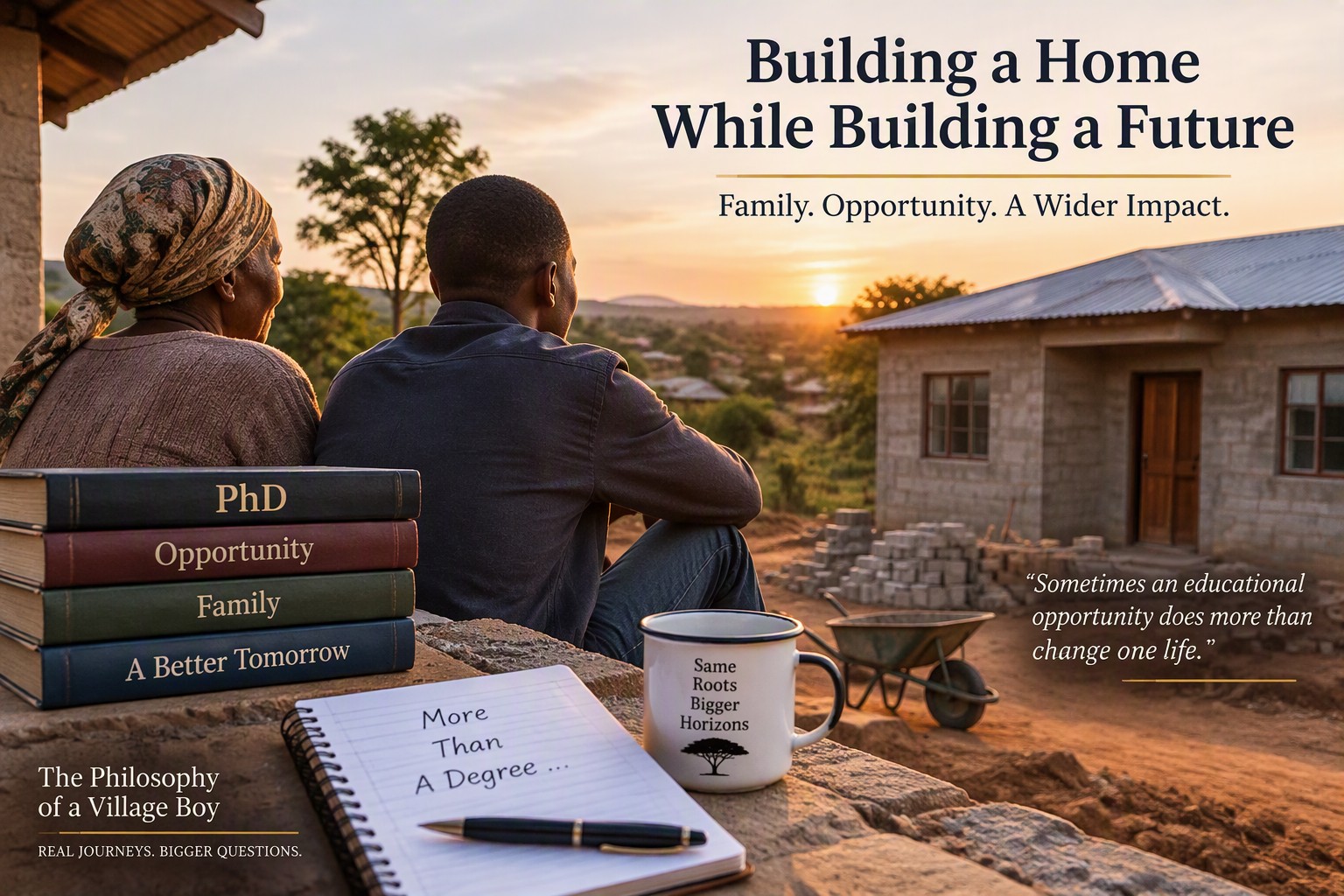
    When your own legitimate needs compete with another person’s immediate need, what should determine whether you choose โ€œI,โ€ โ€œthem,โ€ or the wider โ€œweโ€? And does knowing that any of us may one day move from the position of giver to receiver change how we should think about helping one another?

  • Post 28: Building My Grandmother a Place to Call Home

    Post 28: Building My Grandmother a Place to Call Home

    While my PhD was opening new doors for me, another part of my life was changing at home.

    My grandmother had lost all her children.

    I had also left, first for George and later to pursue my studies. She increasingly found herself alone.

    Eventually, she made a difficult but practical decision.

    She sold the family house and relocated to the village where she had been born.

    Her two younger brothers and younger sister were there, together with their families. At least she would have people around her who could keep a close eye on her.

    For me, that brought some relief.

    Initially, she stayed with her younger sister.

    It was a working solution, but she still needed a place she could call her own.

    A Scholarship Serving Another Purpose

    My PhD scholarship had given me something I had rarely enjoyed during the earlier stages of my education: enough financial room to save something.

    Some of those savings now had another purpose.

    I started building a modest home for my grandmother.

    There was an irony in this period of my life.

    Academically, I was progressing towards the highest university qualification.

    Personally, I was effectively homeless.

    When I returned home, there was no longer the family house I had previously returned to. I stayed with extended family, particularly at the home of one of the sons of my grandmother’s youngest sister.

    But I knew that situation was temporary.

    Slowly but surely, the new place began taking shape.

    Whatever I could put aside from the scholarship contributed towards creating somewhere my grandmother could eventually call her own.

    The scholarship had been awarded to enable me to pursue a PhD.

    But its effect was beginning to extend beyond the university.

    It paid my tuition and registration.

    It provided the stipend that supported me while I studied.

    And part of what I managed to save was now helping to build a home.

    There is perhaps something about educational opportunities that is difficult to see if we only look at the qualification eventually awarded to one person.

    The scholarship belonged to me on paper, but its consequences did not stop with me.

    An opportunity to pursue a PhD was indirectly helping my grandmother rebuild a place for herself after leaving the family home.

    Slowly, the construction continued.

    But my financial resources were not unlimited.

    And before the house was completed, someone else would need financial help.

    Her circumstances would confront me with a different question:

    What happens when the little that we have is needed in two places at the same time?

    Join the conversation

    When an opportunity improves one person’s circumstances, where do you think its benefits to that individual end and responsibilities towards family begin?

  • Post 27: When the PhD Made My World Bigger

    Post 27: When the PhD Made My World Bigger

    A PhD is often described in terms of research, a thesis, and eventually a qualification.

    My experience became much broader than that.

    One of the benefits I had not fully anticipated was the people I would meet.

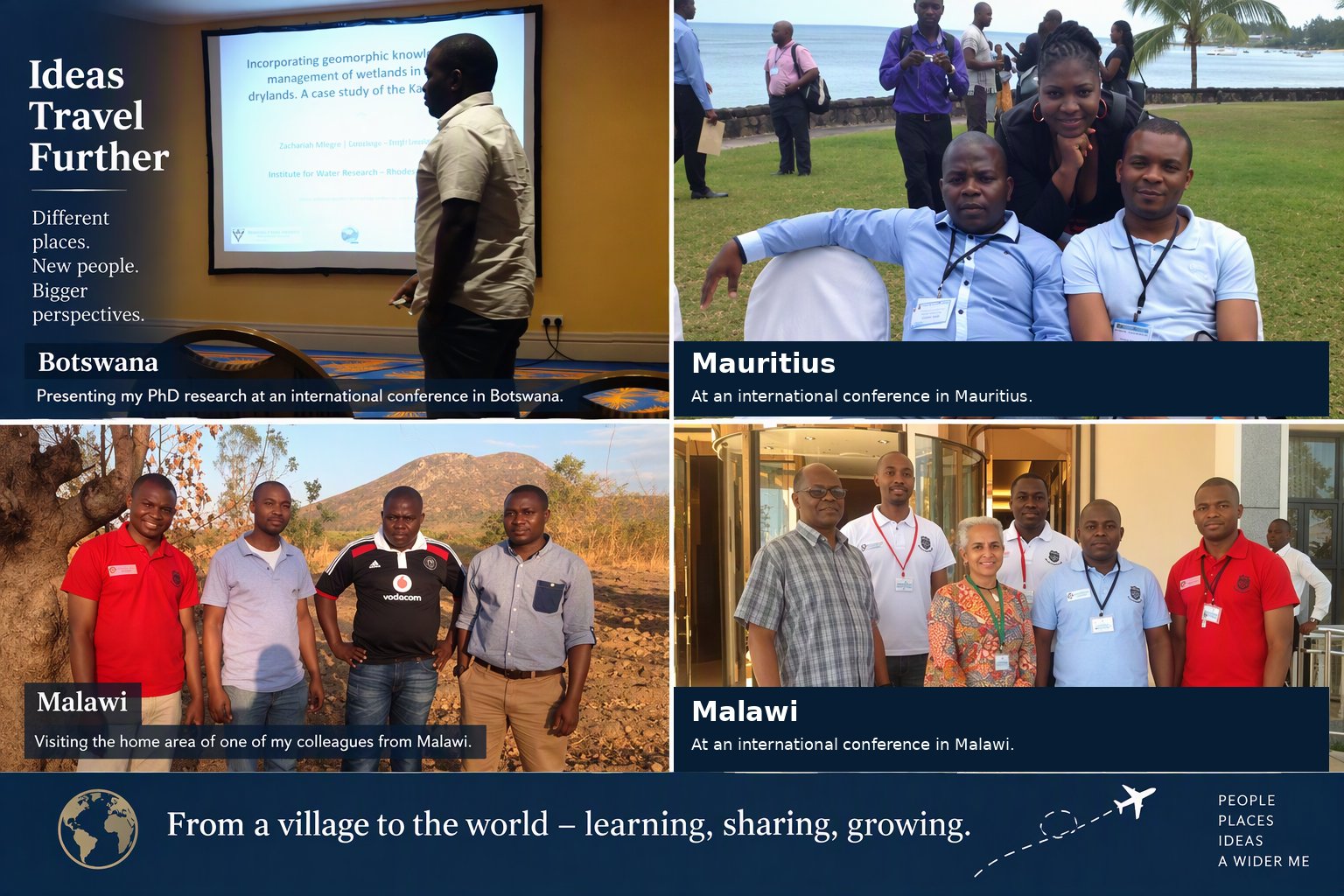
    I studied alongside students from different parts of Africa, including Zimbabwe, Zambia, Tanzania, Malawi and Eswatini, as well as students from within South Africa.

    We came from different countries and different backgrounds, but postgraduate studies brought us together.

    Over time, we formed something resembling a brotherhood and sisterhood.

    Some of those relationships extended beyond the university and beyond our research.

    During my trip to Malawi, I had an opportunity to visit the home area of one of my colleagues who was from Malawi.

    There was something meaningful about that experience.

    At university, we knew one another as postgraduate students. We shared academic spaces, discussed research and travelled to conferences. But visiting the place my colleague came from introduced another dimension to that relationship.

    It reminded me that behind each student and researcher was another story, another home and another journey that had eventually brought us into the same academic space.

    Perhaps that was another form of education.

    The PhD was not only exposing me to different ideas. Through the people I met, it was also exposing me to different places and different experiences.

    Some of those relationships did not end when our studies ended. We remained in contact, and with some colleagues I later worked on academic publications.

    Looking back, the PhD was therefore producing more than a thesis.

    It was also building friendships and professional networks.

    My First Passport

    There was another experience that postgraduate studies introduced into my life.

    International travel.

    I obtained my first passport while doing my PhD.

    That passport eventually took me to Malawi, Botswana and Mauritius to attend international conferences and present the progress of my research.

    For someone whose journey had begun in a village, this was another expansion of my world.

    The significance was not simply that I was crossing national borders.

    I was meeting researchers from other places, listening to different ideas, presenting my own work, and discovering that research could take me into spaces I had never imagined entering when my educational journey began.

    But the conferences were not valuable simply because I had an opportunity to travel to other countries.

    They were part of my education.

    Learning to Welcome Criticism

    At conferences, I had to stand in front of other researchers, present my work, and then listen to what they had to say about it.

    That meant learning to appreciate questions and constructive criticism.

    A question could identify something I had not considered.

    A comment could expose a weakness in the work.

    A different interpretation could force me to rethink part of my argument.

    When useful comments were accepted and properly implemented, the quality of my research improved.

    So, strangely, after presenting my work, I wanted questions.

    A discussion session without questions or comments could dampen the mood. Questions meant that people had engaged with the work enough to interrogate it.

    That does not mean that every criticism must simply be accepted.

    Research also requires judgement.

    Some arguments need to be defended.

    Others need to be reconsidered.

    Sometimes another person sees something that the researcher, after spending months immersed in the work, can no longer easily see.

    I began to appreciate constructive criticism not as an attack on the work, but as part of the process through which the work could become better.

    Perhaps that lesson extends beyond academic research.

    We present what we know.

    Someone challenges it.

    We reconsider it.

    We improve what needs improving and defend what remains sound.

    Then we continue.

    More Than a Qualification

    Looking back, perhaps this is one reason I cannot reduce my PhD experience to the qualification I eventually received.

    The thesis mattered.

    The research mattered.

    But so did the people.

    So did obtaining my first passport and travelling beyond South Africa.

    So did standing in front of researchers in another country and having my ideas questioned.

    And so did visiting the home area of a colleague in Malawi and seeing something of the world from which another person’s journey had begun.

    These experiences were connected.

    The PhD was teaching me about my research topic, but the academic journey was also teaching me how knowledge itself develops and how relationships can expand the world through which that knowledge travels.

    Perhaps education does more than increase what we know.

    Sometimes it also enlarges the world in which we are able to think.

    Join the conversation

    Have you ever received criticism that was uncomfortable at first but eventually helped you improve your work or thinking?

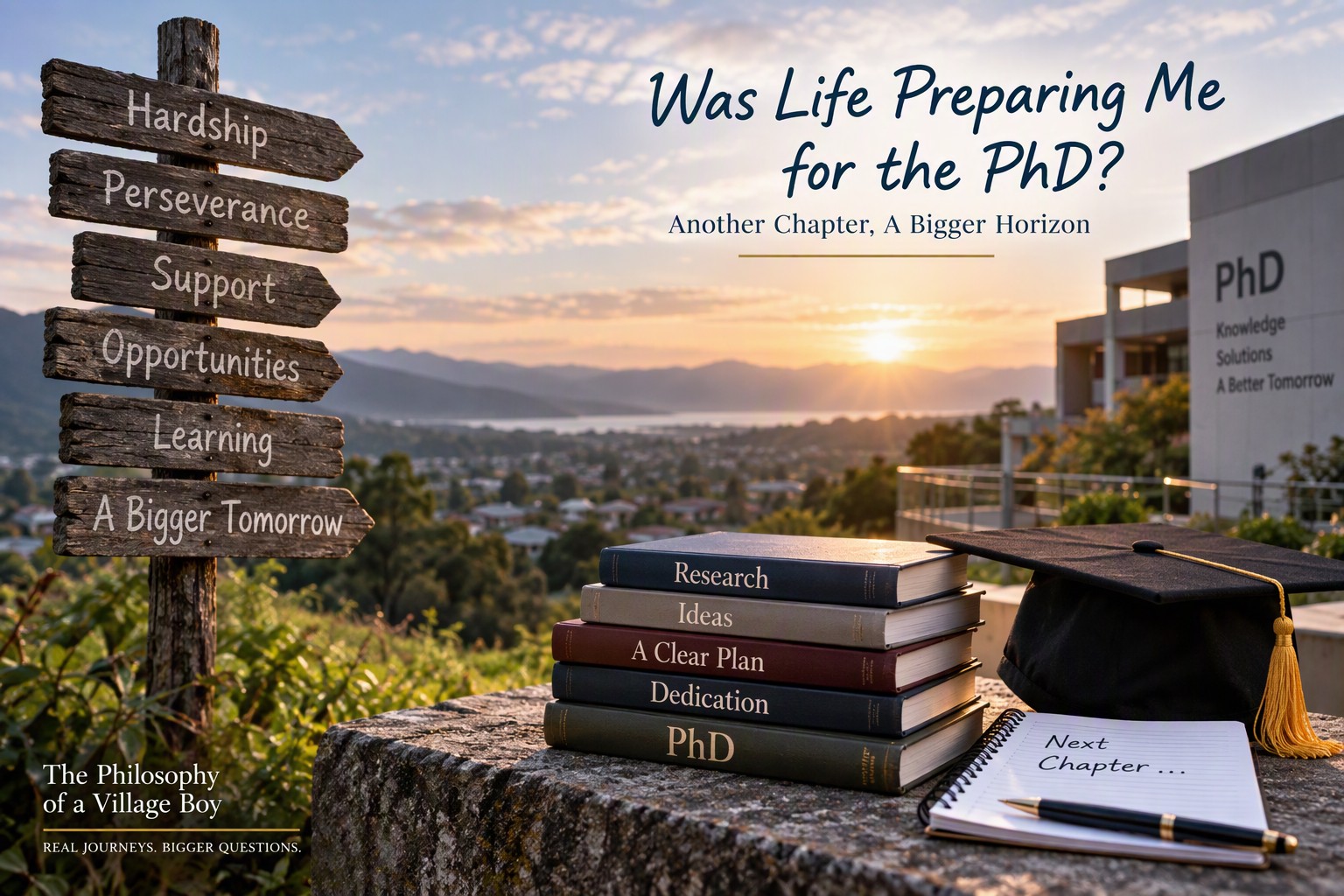
  • Post 26: Was Life Preparing Me for the PhD?

    Post 26: Was Life Preparing Me for the PhD?

    The journey had already been shaped by hardship, perseverance, hard work, dedication, humility and planning.

    There had also been interventions from people who saw potential in me and decided to help. Then there were unforeseen events that created much-needed twists and relief.

    And, as I reflected in Post 25, there were events for which different people could offer very different explanations. Science may speak of probability, circumstances, cause and effect. Religion or spirituality may offer explanations involving God, ancestors or some greater purpose. Neither necessarily provides a conclusive explanation for the entire sequence of events.

    All of this had now brought me to another chapter of my life.

    I was going to pursue a PhD.

    Another Kind of Challenge

    A PhD requires a clear plan, clear and realistic objectives, dedication and sustained hard work.

    These were not entirely new demands.

    Throughout my journey, I had already been required to develop many of these qualities, sometimes without even recognising that I was doing so.

    When financial difficulties threatened my studies, I had learned to identify the immediate problem and focus on what was within my control. When I needed employment, I developed a plan and continued applying. When professional registration became important, I deliberately pursued it.

    Now the objective was different, but the approach was familiar.

    Looking backwards, it almost seems as though life had been preparing me for what came next.

    But was it?

    Was life really preparing me for a PhD, or does it only look like preparation because I now know where the journey eventually led?

    That is difficult to answer.

    What I do know is that by the time the PhD opportunity arrived, I had already developed many of the qualities I would need to pursue it.

    The Scholarship Changed the Equation

    There was also one major difference between this stage and some of my earlier experiences at university.

    This time, I had funding.

    The PhD opportunity came with a scholarship that covered registration and tuition fees. It also provided a monthly stipend that catered for my living expenses and more.

    For someone whose educational journey had repeatedly been complicated by financial difficulties, that mattered.

    For once, the immediate struggle was not simply about finding enough money to remain at university.

    But having funding did not mean that the journey would suddenly become straightforward.

    The PhD would bring challenges of its own.

    It would also bring friendships, professional networks, international travel and experiences that I could not have imagined when I first started university.

    My world was about to become considerably bigger.

    Join the conversation

    When you look back at your own journey, have there been experiences that only later appeared to have been preparing you for something you could not see at the time?


  • Post 25: When Explaining the Parts Does Not Explain the Whole

    Post 25: When Explaining the Parts Does Not Explain the Whole

    Reflection on Posts 21โ€“24

    Posts 21 to 24 describe a period of my journey that took me from an internship in Polokwane to a short-term GIS position in George, and eventually to a PhD at Rhodes University.

    Each event can be explained individually.

    But does explaining each event necessarily explain the whole?

    What I Used to Tell People

    I used to say that if I told people the story of my life and then told them that God exists, or that my ancestors had been behind me all the way, they would believe me.

    I was not saying that my life proves that God exists, or that my ancestors were directing my journey.

    My point was about interpretation.

    Tell the story to someone who already believes in God and conclude that God was guiding the journey, and that person may agree.

    Tell the same story to someone who believes in ancestral guidance and conclude that the ancestors were behind it, and that person may also agree.

    Someone approaching the same story from a naturalistic perspective may instead see human decisions, circumstances, social networks, probability, and chance.

    The events remain the same.

    The explanation changes.

    So how do we determine which explanation, if any, is justified?

    What Can Science Explain?

    Science can explain much of my journey without requiring supernatural intervention.

    Financial relief during my Master’s changed what was possible. Education gave me qualifications. Applying for jobs exposed me to opportunities. The internship gave me professional experience. Going to George changed my professional environment. My work allowed another professional to assess my capabilities. Mentorship exposed me to opportunities I did not know about.

    My actions clearly mattered.

    But perhaps actions do not necessarily determine outcomes. Perhaps they alter the probability of certain outcomes becoming possible.

    That distinction matters.

    I could control whether I applied for a scholarship. I could not control whether a scholarship existed.

    I could decide to go to George. I could not control who would later be appointed there.

    I could demonstrate my abilities through my work. I could not control whether someone would see enough potential in that work to advocate for me.

    My agency operated within circumstances I did not control.

    What Were the Chances?

    It is tempting to look at the sequence and ask: what were the chances?

    There was the financial relief during my Master’s, the GIS internship, my decision to leave an extended internship for a short-term contract in George, the later appointment of the GIS manager, our professional interaction, the unsuccessful first scholarship application, the second opportunity, and the motivational letter written without my knowledge.

    But I cannot simply assign probabilities to these events and multiply them.

    They were not independent. One event changed the circumstances in which the next occurred. My education influenced my employment prospects. My internship changed my experience. My experience affected subsequent opportunities. Going to George changed the professional environment in which my career continued.

    And then there is hindsight.

    Am I connecting these events simply because I now know where they led? Perhaps. But even if hindsight explains why I find the sequence significant, does it explain why the sequence happened?

    I cannot calculate a meaningful numerical probability for the life I have lived. There are too many dependent events and unknown alternatives.

    What I can say is that the outcome depended on a chain of events, some influenced by my decisions and others entirely outside my control.

    That is the part I am trying to understand.

    Where Does the Mental Schema Fit?

    I have previously considered whether the mental schema explains some of these experiences.

    Perhaps knowing what we want makes us more alert to opportunities connected to our objectives.

    I wanted a career in GIS. I wanted professional registration. I had also wanted to complete a PhD.

    That may explain why I recognised and pursued certain opportunities once they appeared.

    But can it explain why they appeared?

    When I decided to leave Polokwane for George, the GIS manager who would later influence my PhD journey was not there.

    There was no opportunity for me to recognise.

    My preparedness may explain what happened after our paths crossed.

    It does not explain why they crossed.

    Is Chance an Explanation?

    Perhaps the answer is simply chance.

    I had reasons for going to George. The GIS manager had a separate professional journey that eventually led there. Rhodes University’s Institute for Water Research had its own reasons for offering the scholarships.

    Separate causal chains eventually intersected.

    There is nothing scientifically impossible about that.

    But when I call the intersection chance, what have I actually explained?

    If I mean that I could not predict the convergence, that is true.

    If I mean that I have no evidence that the events were deliberately coordinated, that is also reasonable.

    But if chance becomes the explanation for everything that remains after the individual events have been explained, I am less convinced.

    Have I explained the unexplained part, or merely given it a name?

    The Same Standard Must Apply to God and the Ancestors

    The question has to work in both directions.

    If I am unwilling to accept chance simply because I have reached the limit of an explanation, I cannot insert God, the ancestors, or the universe into the same gap and pretend that the problem has been solved.

    Not being able to explain something does not make a supernatural explanation true.

    This brings me back to what I used to tell people.

    A Christian believer may look at the journey and see providence.

    Someone who believes in ancestral guidance may see the ancestors.

    A naturalist may see human agency, circumstances, social networks, and the intersection of independent causal processes.

    My story may be compatible with all these interpretations without being capable, by itself, of proving any of them.

    When Explaining the Parts Does Not Explain the Whole

    I can explain many of the individual events.

    I can explain why I applied for the internship.

    I can explain why I left.

    I can explain why I went to George.

    I can explain how mentorship, professional networks, and scholarship opportunities subsequently influenced my journey.

    But I am still left with the convergence.

    Perhaps nothing further needs explaining. Perhaps lives emerge from countless intersecting events, and humans construct meaning from them afterwards.

    Perhaps ordinary causes and deeper meaning are not necessarily mutually exclusive.

    I do not know.

    And perhaps that is the most honest place for me to stop.

    I am not prepared to use my life as proof that God exists or that my ancestors have been directing my journey.

    But I am equally uncomfortable with using the word chance as though naming the unexplained part means that it has been explained.

    Science can explain many of the mechanisms that brought me here. What remains difficult is determining what, if anything, the convergence of those mechanisms means.

    Perhaps the question emerging from Posts 21 to 24 is therefore not whether God, the ancestors, chance, or a mental schema brought me to this point.

    It is this:

    When we can explain the individual parts of a journey, have we necessarily explained why those parts came together to produce the life that was actually lived?

    Join the conversation

    When ordinary events converge into an extraordinary turning point, how do you distinguish coincidence from meaning?

  • Post 24: A Thank You That Took More Than Ten Years

    Post 24: A Thank You That Took More Than Ten Years

    There was one unfinished part of the story.

    Gratitude.

    I knew the role my former GIS manager had played in changing the trajectory of my career.

    I had never forgotten it.

    But knowing that you are grateful and actually expressing that gratitude are two different things.

    For years, I could not find the right words.

    More than ten years after beginning my PhD, I finally did.

    I sent her a message.

    I told her that my silence over the years had never been a reflection of ingratitude. I had simply struggled to find words capable of expressing what her mentorship and intervention had meant to me.

    She had helped me professionally.

    She had encouraged me to look beyond short-term employment.

    She had sent me the first PhD scholarship opportunity even though that application was unsuccessful.

    She had sent another one.

    And behind the scenes, without my knowledge at the time, she had supported my application through a strong motivational letter.

    That second opportunity eventually took me to Rhodes University and into my PhD.

    There was something I could finally say clearly:

    I could not honestly tell the story of my career development without acknowledging the role she had played in it.

    More than ten years later, I finally thanked her.

    Why Do We Wait So Long?

    Looking back, I sometimes wonder why it took me so long.

    Perhaps people assume that those who helped them already know how important their contribution was.

    But do they?

    A lecturer can say something in a classroom and forget it.

    A supervisor can recommend someone and continue with their work.

    A mentor can forward an opportunity without knowing what that opportunity will eventually become.

    The person making the intervention may eventually forget the moment.

    The person whose life was changed by it may remember it forever.

    That is one of the strange asymmetries of mentorship.

    Nobody Is the Sole Author of Their Success

    There are many things in this journey for which I can legitimately take responsibility.

    I studied.

    I worked.

    I applied for jobs.

    I attended interviews.

    I took risks.

    I completed the tasks given to me.

    I applied for the scholarships.

    I eventually completed the PhD.

    Personal agency matters.

    But reflection becomes self-congratulation if we selectively remember only the things we did for ourselves.

    My journey contains interventions by other people.

    A lecturer whose warning about internship exploitation came back to me when I needed to make a difficult decision.

    A friend who sat with me while I deliberated over whether to remain an intern.

    Managers who saw leadership potential in me before I had consciously identified it myself.

    And later, a GIS manager whom I had not even met when I made the decision to go to George.

    Somewhere in that complicated mixture are my own effort, other people’s interventions, unexpected opportunities, unsuccessful applications, coincidence, timing and perhaps things I still cannot explain.

    I don’t know how much weight to assign to each.

    But I know this:

    Gratitude should not require us to solve that philosophical puzzle.

    If somebody helped you, acknowledge it.

    If somebody opened a door, remember them.

    If somebody spoke for you when you were not in the room, and you later discover it, tell them what it meant.

    Preferably, don’t wait more than ten years to find the words.

    Join the conversation

    Is there somebody who changed the direction of your life but may still not know how important their intervention was?

  • Post 23: Was I Supposed to Be in George?

    Post 23: Was I Supposed to Be in George?

    This is where the story becomes difficult for me to explain.

    Looking backwards, the sequence appears almost logical.

    Looking forward from the point at which I actually made the decisions, it was anything but logical.

    I left an internship in Polokwane where management had told me they recognised leadership potential in me.

    The internship was being extended.

    I still needed professional registration.

    Staying could have given me additional time to achieve it.

    Instead, I left.

    I travelled across the country to George in the Western Cape and accepted another short-term contract.

    There was no PhD scholarship waiting for me there.

    There was no future mentor waiting for me either.

    The GIS manager who would eventually influence my decision to pursue a PhD had not even been appointed when I made the decision to go to George.

    She arrived later.

    This matters because it complicates one of the ideas I have repeatedly considered while reflecting on my journey.

    Was the Mental Schema at Work Again?

    I have wondered whether some of the things people call luck can partly be explained through a mental schema.

    When you know what you want, perhaps your mind becomes particularly sensitive to opportunities related to that objective.

    You notice things other people might overlook.

    You make connections.

    You recognise opportunities and act on them.

    There is something persuasive about that explanation.

    But this particular episode troubles it.

    What opportunity did I recognise when I went to George?

    There was no PhD opportunity that I knew about.

    The person who would later encourage me to pursue one did not work there.

    I wasn’t even going to George to position myself for doctoral studies.

    When she eventually arrived, I approached her about professional registration, not about pursuing a PhD.

    There was nothing for my mental schema to recognise.

    Or at least nothing that I can identify retrospectively.

    A Decision That Looked Almost Like Career Suicide

    This is what fascinates me when I look back.

    At the time, leaving the internship could easily have turned out badly.

    I abandoned an extension designed partly to help me obtain professional registration. I walked away after management told me they saw leadership potential and wanted to develop me. I moved far from home for another temporary position.

    There was no guarantee that any of this would lead somewhere better.

    Yet it was precisely through that apparently uncertain decision that I eventually encountered someone who helped me complete my professional registration and subsequently encouraged me towards a PhD.

    She forwarded the first scholarship.

    I failed.

    She forwarded another.

    I succeeded.

    She quietly strengthened my application through a motivational letter.

    And eventually I found myself at Rhodes University’s Institute for Water Research beginning a PhD.

    How exactly am I supposed to explain that?

    Chance, Providence or Something Else?

    There is a temptation when looking backwards to impose order on events.

    Because we now know how the story ended, we can construct a clean sequence:

    I left Polokwane.

    I went to George.

    I met a mentor.

    She introduced me to an opportunity.

    I went to Rhodes.

    But that neat sequence exists only retrospectively.

    The person making the first decision did not know the second, third or fourth events were coming.

    So was it coincidence?

    Were these simply independent events that happened to intersect favourably?

    Was my mental schema operating at a level I still do not adequately understand?

    Were there supernatural forces at play beyond human comprehension?

    Or, as some people might put it, was I somehow supposed to be in George?

    I do not know.

    And perhaps “I do not know” is the most honest conclusion.

    I certainly would not advise anyone to abandon a promising opportunity on the assumption that something better will mysteriously appear. That isn’t what this story proves.

    What it demonstrates to me is something more modest.

    Humans make decisions with incomplete information.

    We can plan. We can work. We can recognise opportunities. We can estimate risks.

    But we cannot factor into our calculations people we haven’t met, appointments that haven’t happened, opportunities that don’t yet exist, or acts of kindness that somebody will one day perform without our knowledge.

    There is a point beyond which retrospective explanations begin giving us credit for knowledge we never possessed.

    I know why I left Polokwane.

    I know why I accepted the position in George.

    What I cannot explain is how that decision ultimately helped take me somewhere I could not have seen from where I was standing.

    Was I supposed to be in George?

    I still do not know.

    Join the conversation

    When an important outcome in your life depends on events you neither planned nor could have predicted, where do you draw the line between personal agency, coincidence and something beyond our understanding?

  • Post 22: I Went to George Looking for a Job, Not a PhD

    Post 22: I Went to George Looking for a Job, Not a PhD

    When I left Polokwane for George, I thought I understood what I was doing.

    I was taking another GIS job.

    It was a short-term contract, and it took me far from home, but it allowed me to continue building experience in the field I wanted to pursue.

    What I could not possibly know was that the most important consequence of moving to George had nothing to do with the job I had accepted.

    The person who would eventually play a defining role in what happened next wasn’t even working there when I arrived.

    A few months after I joined the organisation, a new GIS manager was appointed.

    When I first met her, one of the things I asked was whether she could assist me with my professional registration. She was already professionally registered and had completed a PhD herself.

    I was thinking about SAGC registration.

    She started talking to me about doing a PhD.

    That wasn’t entirely foreign to me. I had always wanted to complete a PhD. But wanting to do one and finding the financial means to do one were two very different things.

    For the time being, my attention remained on establishing myself professionally.

    She gave me GIS tasks to perform. I completed them. She assisted me with the professional registration process that I had left unfinished when I walked away from the internship.

    But she continued talking about something else.

    The PhD.

    From the work I was producing, she had apparently become convinced that I should consider furthering my studies instead of continuing to move between short-term employment opportunities.

    I explained the problem.

    Funding.

    Not long afterwards, she sent me a PhD scholarship opportunity at Rhodes University’s Institute for Water Research (IWR). The proposed research involved evapotranspiration estimates and rangeland management.

    I applied.

    I didn’t get it.

    That could easily have been the end of the story.

    It wasn’t.

    Someone Else Kept Looking

    She did not give up on the idea.

    Another scholarship became available at the same institute. This one involved wetland geomorphic origin and hydrological functioning.

    She sent it to me.

    I applied again.

    This time, I got it.

    I resigned from my position in George and began my PhD journey at Rhodes University.

    Only after commencing my studies did, I learn something that changed how I understood what had happened.

    My GIS manager had written a strong motivational letter supporting my application and submitted it to the institute without my knowledge.

    I had thought I had simply applied for a scholarship and succeeded.

    What I did not know was that somebody had been advocating for me behind the scenes.

    Mentorship Is Sometimes Advocacy

    That experience changed how I understand mentorship.

    A mentor is not simply someone who gives advice.

    Sometimes mentorship means seeing abilities in another person that they have not yet fully understood themselves.

    Sometimes it means forwarding an opportunity.

    Sometimes it means refusing to accept someone’s first unsuccessful attempt as the end of the road.

    And sometimes it means saying something positive about that person in a room they are not even in.

    I had applied for the scholarship.

    I had the qualifications.

    I had done the work.

    But telling the story as though I had achieved everything through individual effort would be dishonest.

    Someone intervened.

    Someone believed that I should be given an opportunity and was willing to put that belief into writing.

    Young professionals are often advised to find mentors. I think that advice can sometimes make mentorship sound transactional, as though one simply finds a successful person and asks to be developed.

    My experience was different.

    I went to George looking for a job.

    I met someone later.

    I asked her to help me register professionally.

    Somehow, that relationship contributed to me leaving George to start a PhD.

    I couldn’t have planned any of it.

    Join the conversation

    Has someone ever seen a possibility in you that you could not yet see clearly for yourself?

  • Post 21: When an Internship Has Served Its Purpose

    Post 21: When an Internship Has Served Its Purpose

    The financial relief I received during my Master’s changed what was possible.

    Towards the end of my masterโ€™s first year, I was still working on the municipal street-cleaning and greening project. My first year of masterโ€™s study overlapped with the second year of that project, and the two-year contract we had signed was due to expire during the first quarter of my second year.

    The future was uncertain.

    But my financial circumstances had improved. For the first time, I could afford to apply for entry-level GIS jobs and attend interviews without worrying about how I would pay for the journey or meet the immediate costs associated with starting a new job.

    So, I started applying for GIS internships.

    And this time, the calls started coming.

    I attended several interviews with different government departments and in different places. About a month before the municipal project was due to end, I received two internship offers from the same national government department: one at the head office in Pretoria and another at the provincial office in Polokwane.

    I chose Polokwane. It was closer to home and within Limpopo.

    Although the municipal project was eventually extended, I left when my original contract expired. At the beginning of the second quarter of my masterโ€™s second year, I started working as a GIS intern.

    Later that year, while doing the internship, I submitted the final version of my masterโ€™s dissertation and graduated.

    For the first time, my academic training and the career I wanted were beginning to converge.

    The Value of an Internship

    The internship offered more than employment.

    My masterโ€™s research involved GIS and Remote Sensing, and that was the field in which I wanted to build my career. I also wanted to register with the professional body regulating the geomatics profession, then known as PLATO and now the South African Geomatics Council (SAGC).

    Professional registration required both appropriate qualifications and relevant experience. The internship therefore gave me an opportunity to acquire that experience while working with registered professionals who could mentor me through the process.

    But it was still a one-year contract.

    I had learned enough about temporary employment not to wait until the final month before asking what would happen next.

    So, I kept applying for jobs.

    Eventually, I received an offer for a short-term GIS position in George, Western Cape.

    Then something happened that made the decision much more difficult.

    My supervisor and director called me into the director’s office.

    They didn’t want me to leave.

    They told me they had seen potential in me. They had also noticed something that I had not fully recognised in myself. When the person directly supervising us left, I had naturally started assuming some responsibility for coordinating the other interns.

    They told me they could see me becoming a manager one day and wanted to develop me towards that.

    Initially, I was convinced.

    There was, however, one problem.

    I would have to remain an intern.

    Doing More for Less

    Over the weekend, I discussed the decision with a friend.

    Something bothered us.

    If my potential had become visible partly because I was already assuming greater responsibilities, why should recognising that potential require me to continue doing more while remaining an intern?

    That conversation reminded me of something one of my Honours lecturers at the University of Venda had told us.

    He was critical of government internship programmes, particularly because of their potential to expose young graduates to exploitation.

    He acknowledged the counterargument. Internships give graduates experience, financial independence and an entry point into professions where employers demand experience from people who have had little opportunity to obtain it.

    His objection was more specific.

    The danger begins when a graduate develops beyond the original purpose of the internship, assumes greater responsibilities and produces increasingly valuable work, but the organisation continues treating that person as cheap temporary labour.

    I finally understood what he had been warning us about.

    I declined the extension.

    I took the short-term position in George.

    And I left without completing one of the things I had hoped to achieve through the internship: professional registration.

    Looking at the decision purely from a career-security perspective, it was questionable.

    I was leaving an organisation where management said they recognised my leadership potential. The internship was being extended to give us additional time to register professionally. Instead, I was travelling from Limpopo to the Western Cape for another short-term contract.

    But there is an important distinction between being grateful for an opportunity and becoming permanently indebted to it.

    Internships and short-term employment can transform the lives of young graduates. They certainly transformed mine.

    That is precisely why they should not be allowed to become mechanisms through which capable graduates continue doing progressively more for progressively less.

    An opportunity can be valuable and still reach the end of its usefulness.

    Sometimes growth requires recognising when that point has arrived.

    Join the conversation

    How should a young professional distinguish between an opportunity that is still developing them and one that has started benefiting from their development without properly recognising it?