
After I had been employed permanently for some time, I visited one of my cousins in Tshivhulani Village.
After his father passed away, he remained in the family home.
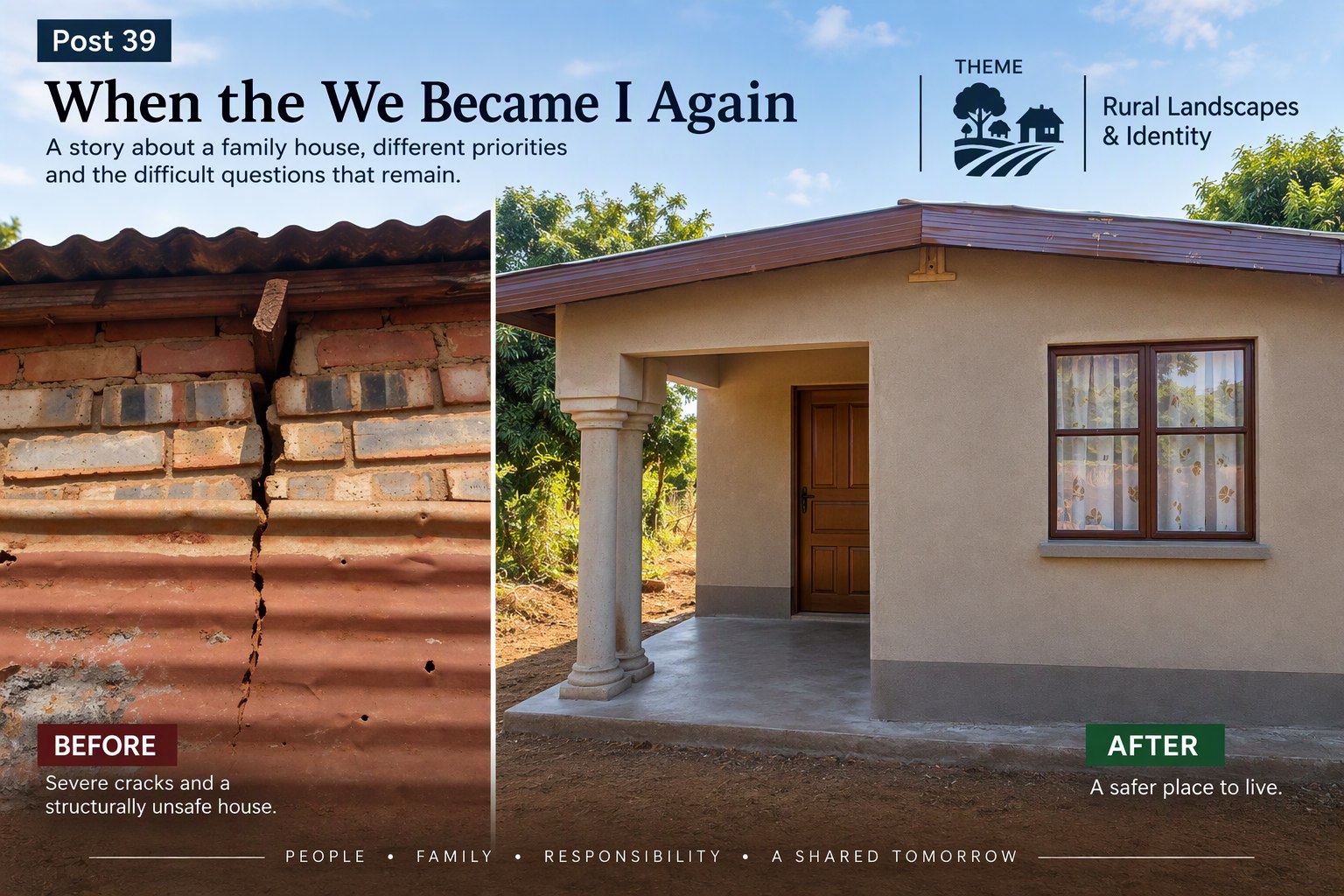
When I visited, I was disturbed by the condition of the house.
It had deteriorated considerably.
The windows no longer had proper panes. Instead, rusted corrugated iron sheets had been nailed to the walls, covering even the window frames.
The doors were broken and no longer functioning properly.
Parts of the smooth concrete floor had cracked and disappeared, leaving patches of bare earth.
But the most serious problem was the structure itself.
There were multiple cracks running from the foundation all the way to the roof. In some places, the cracks were wide enough for a finger to fit inside.
Something needed to be done.
I spoke to other members of the extended family about what could be done. A family friend who was a builder became involved and, together with another relative, inspected the house.
The inspection revealed something worrying.
It appeared that the roof timbers and corrugated iron roofing might actually have been helping to hold the structure together and keeping the walls from collapsing.
The conclusion was that we should not renovate the house.
The problem was not simply the windows, doors, floors, or even the visible cracks.
The foundation itself was weak.
Repairing what we could see would not solve the underlying problem.
It made more sense to build another house alongside it.
Then our family friend did something significant.
After seeing the condition of the house, he offered to build the new one without charging for his labour.
He could not provide everything.
But he could provide something.
I approached other members of the family and suggested that each of us contribute towards the building costs.
My reasoning was simple.
A burden that might be difficult for one person could become manageable when distributed among several people.
That was the “we”.
Initially, people contributed.
Then the contributions stopped.
Different reasons followed.
One person was installing tiles in their own house. Another needed money to repair an expensive phone. Another said she was paying rent for her son in another province.
At first, it might be tempting to reduce all these choices to selfishness.
But I do not think it is that simple.
People have their own needs and responsibilities. Paying rent for a son was itself an act of responsibility towards another person. In that case, perhaps the “we” had not disappeared.
Its boundary had simply been drawn somewhere else.
But were all these needs equally urgent?
Should improving an already habitable house carry the same urgency as helping someone living in a structurally unstable one?
Should repairing a phone be weighed in the same way as providing safer shelter to someone living behind broken doors, rusted sheets covering the windows, damaged floors and walls that appeared capable of collapsing?
Perhaps having a legitimate need does not necessarily mean that every need carries the same weight.
When resources are limited, where are they needed most?
At that point, I thought about my mother.
Through her life, she had shown me the level of sacrifice that is humanly possible. She would often place what she considered a worthy cause ahead of her own needs, sometimes even ahead of her own health.
But perhaps that also made the question more difficult.
Just because such sacrifice is humanly possible, does it mean that it is a reasonable price to expect everyone to pay?
Perhaps not.
People have different limits, responsibilities, and understandings of sacrifice. I could not necessarily measure everyone against my mother.
But neither could I escape the other question.
When the choice is between something that can wait and another person’s basic safety, where should the “I” end and the “we” begin?
The house did not stop deteriorating because everyone had other priorities.
Eventually, most of the responsibility for completing the project came back to me.
With the family friend continuing to provide his labour without charging us, I completed the house.
It was modest.
Two rooms.
But it provided something the old structure could no longer reliably provide.
A safer place to live.
I had hoped the project would demonstrate what could happen when the family acted as “we”.
Instead, it made me think more deeply about what we actually means.
Perhaps the question is not simply whether a person chooses the “I” or the “we”.
People cannot be expected to help others at the expense of their own survival. Boundaries still matter, especially when generosity can be exploited.
But what happens when what the “I” is protecting is not survival, while what the “them” needs concerns something as basic as safe shelter?
Does that distinction matter?
And if it does, who decides which need should come first?
Perhaps collective responsibility becomes most difficult precisely at that point. Not when there is enough for everyone, but when resources are limited and different needs compete for priority.
The experience did not give me a simple answer.
It did, however, make something harder for me to ignore:
Not every choice between “I”, “them”, and “we” involves needs of equal urgency.
Sometimes the “we” works because everyone carries a share.
Sometimes the shares are unequal.
And sometimes, when something still needs to be done, somebody ends up carrying more.
Join the conversation
When resources are limited, and several legitimate needs compete, should some needs take priority over others?
Leave a Reply