
Reaching a more stable stage of my life eventually made me look backwards at the people who had helped me get there.
There is one part of my university journey that I had not fully reflected on.
At some point, I had an unpaid SRC debt at the university, and my academic results were withheld. My grandmother’s younger brother eventually paid that debt for me.
Years later, after one of my financial breakthroughs, my grandmother and I decided that we should pay him back.
I no longer remember exactly which breakthrough had put me in a position to do this. It might have been the savings from my NRF bursary, my first GIS internship, one of my periods in George, the PhD scholarship, or even after I had obtained permanent employment.
I do not want to manufacture a chronology that I can no longer remember with certainty.
What I remember clearly is the decision.
It had been a substantial amount of money. My grandmother suggested that we should repay him, and I agreed. We gathered the money, and she took it to him.
But he was not pleased with the gesture.
He later came to explain why.
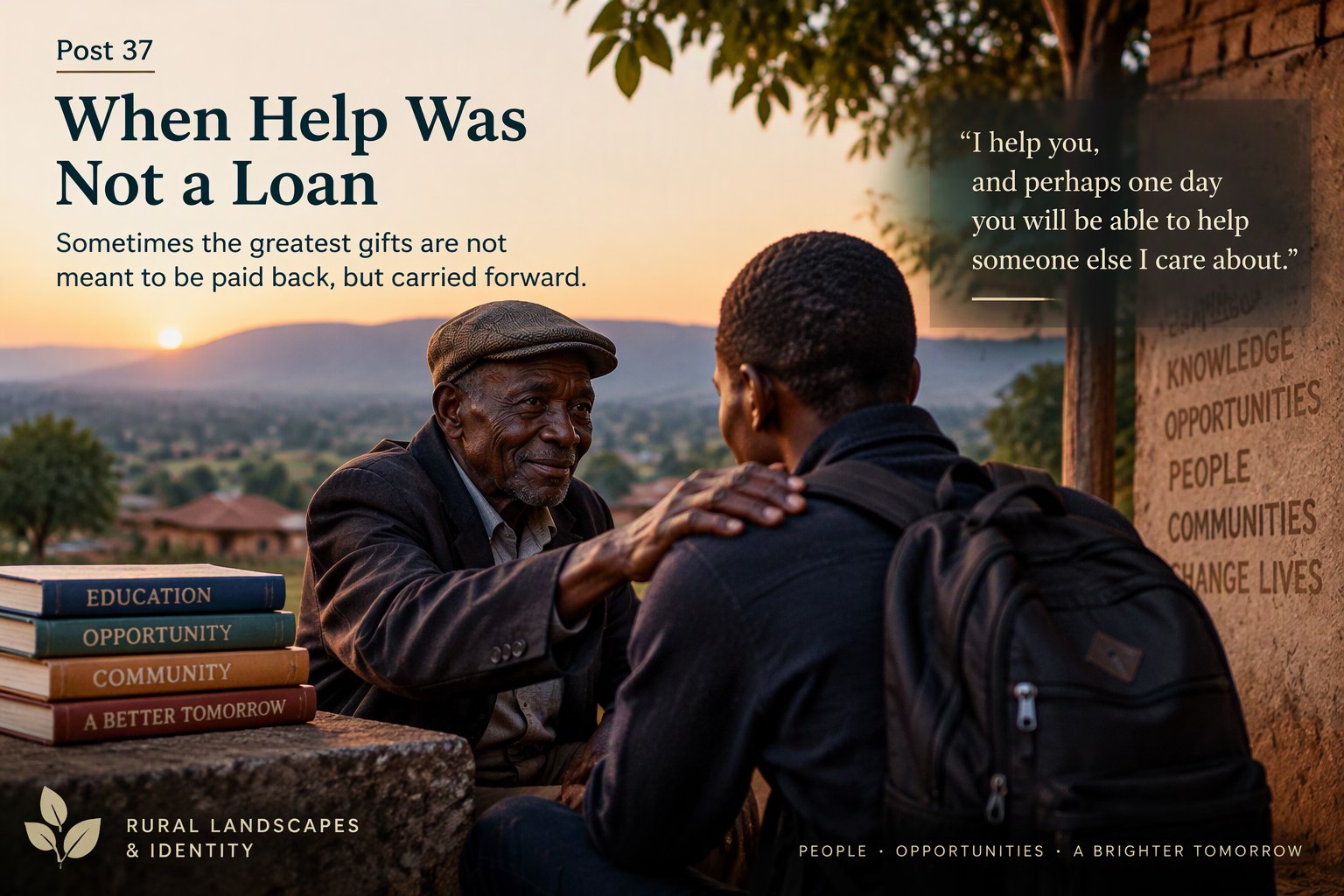
When he had assisted me, he had not done so because he expected us to return his money one day. He had helped because he knew that, if he helped me to move forward, perhaps I would one day be in a better position to take care of his older sister, my grandmother.
I had understood what he did as a debt.
He had understood it differently.
His thinking was not:
I help you, and one day you repay me.
It was:
I help you, and perhaps one day you will be able to help someone else I care about.
The benefit was never supposed to travel backwards to him.
It was supposed to continue forward.
That conversation changed how I understood assistance.
There are people whose sacrifices I can never repay directly. Some are no longer alive. Some expected nothing in return. Others may not even know how significantly their intervention altered the direction of my life.
Perhaps repayment is sometimes too narrow a concept.
Someone helps you.
You move forward.
Then, when circumstances allow, you help somebody else.
What was given to you continues moving.
Perhaps that is another way of paying a debt.
Not by returning it.
By carrying it forward.
His gesture also taught me something else about family.
Family sticks together.
In my maternal extended family, there are people with practical skills such as welding and bricklaying. As my circumstances improved, I began to think differently about where I should look when I needed that kind of work done.
If someone within my family can do the work equally well, why should my first instinct be to look outside the family?
That question matters to me because I did not move forward through my own efforts alone.
My maternal extended family contributed to my journey in different ways. When I needed help, people within that family helped me. Sometimes what they gave me was money. Sometimes it was something else. But I benefited from a family network that was willing to assist when assistance was needed.
It would therefore seem strange for me to benefit from that network when I had little, but overlook the same network when I eventually had something to give.
So when I am in the village and there is work that someone within the family can competently perform, I try to consider the family first before looking outside.
Perhaps this is part of what is meant by the saying:
Charity begins at home.
That does not mean that family should be given opportunities regardless of ability.
It does not mean that I should never look beyond the family.
It means that, where people within the family can equally perform the work, I should remember the network from which I myself benefited.
Perhaps my grandmother’s younger brother was teaching me something larger than I understood at the time.
He did not want his money back.
What he wanted was for the assistance he had given me to continue producing something beyond me.
He helped me so that I could move forward.
And perhaps moving forward carries a responsibility of its own.
Not simply to remember who helped you.
But, when you eventually have the ability to do so, to make sure that the help does not end with you.
Join the conversation
Has someone ever helped you without expecting repayment, and did that experience influence how you later supported your own family or others around you?
Leave a Reply