
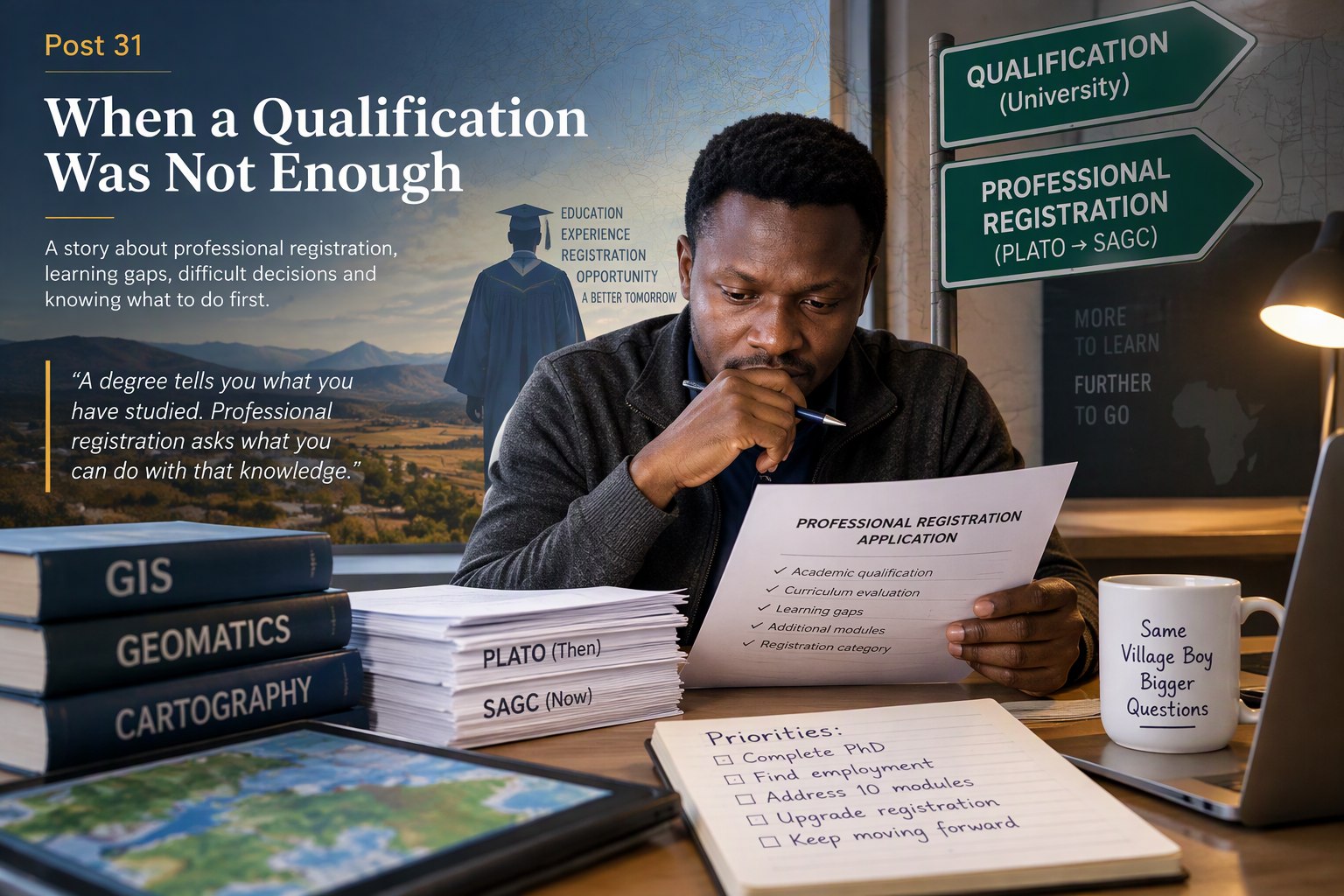
When my PhD scholarship ran out and I had to continue working on the PhD from home, I was also applying for almost any opportunity I could find.
At least I was already professionally registered as a GISc Technician.
My former supervisor at the conservation agency had assisted me with the registration process shortly before I started my PhD journey. At the time, the professional body was the South African Council for Professional and Technical Surveyors (PLATO). Today, it is the South African Geomatics Council (SAGC).
Although I still had ambitions to upgrade my registration to the professional category, getting registered as a GISc Technician had itself been a major fight.
My initial application had been for registration at the professional level.
The problem was my undergraduate qualification.
I had completed my degree at the University of Venda, but at the time I applied, I was informed that its curriculum had not been evaluated and approved for the registration category I was pursuing.
This meant that having the degree was not enough.
I had to manually evaluate the contents of the qualification using a prescribed template. I had to go back to the individual modules I had completed and demonstrate what had actually been covered in my studies.
In principle, I did not have a problem with this.
If there were gaps in my learning, I wanted those gaps to be identified.
My problem was with what appeared to me to be inconsistencies in the assessment process.
Two people could have completed the same degree, at the same university, and studied the same modules, yet receive different assessment outcomes because their applications had been assessed by different people.
One person could be approved.
Another could be rejected.
How could people with essentially the same academic preparation receive different conclusions about what they had learned?
That was the source of my frustration.
Eventually, I wrote a letter of complaint to the committee.
I was not arguing that I should automatically be registered at the professional level simply because I had a degree.
My argument was much simpler:
Evaluate what I have studied consistently. If there are gaps in my learning, identify them and allow me to address them.
Eventually, my registration as a GISc Technician was approved.
More importantly for my longer-term ambition, the assessment identified ten individual modules that I needed to complete as short courses before I could upgrade my registration to the professional category.
That changed the situation.
There is a difference between being told:
You do not qualify.
and being told:
These are the gaps in your learning.
The second gives you something to work towards.
It also taught me something about professional registration that may be useful to someone considering a career in GISc.
A university degree and professional registration are not necessarily the same thing. Anyone who has ambitions of becoming professionally registered should not only look at the name of the degree they want to study. They should also investigate whether that particular curriculum has been evaluated for professional registration and, importantly, for which category.
That is something I wish more prospective GISc students understood before choosing their qualifications.
But I would also not want my experience to discourage someone simply because the qualification available to them has not already been evaluated.
I went through the longer route.
My modules had to be examined and gaps in my learning had to be identified.
The important thing is to understand the requirements and be prepared for the process.
Professional-registration processes also change over time. Someone reading this today should therefore check the current requirements with SAGC rather than assuming that the process I went through remains exactly the same. The current SAGC guidance still distinguishes qualifications recognised for particular registration categories from other qualifications that may require individual consideration.
For me, however, those ten modules would have to wait.
By then, I had another major problem.
I had a PhD to finish.
My scholarship had run out.
I needed employment.
I needed an income.
I therefore decided that upgrading my professional registration would have to wait.
It was not that the professional ambition had disappeared.
I now knew where I wanted to go.
I even knew what learning gaps I needed to address to get there.
But not everything important can be pursued at the same time.
For now, two things had to come first:
Finish the PhD.
Find a job.
I would return to those ten modules later.
Join the conversation
Have you ever had to postpone an important professional goal, not because you had abandoned it, but because another priority had to come first?
Leave a Reply