The Philosophy of a Village Boy

The Philosophy of a Village Boy explores knowledge, science, African spirituality, indigenous thought, identity, and the territory between experience and evidence.

Category: Knowledge, Science & Technology

Exploring how science, technology and different ways of knowing shape understanding of the world, from GIS and mapping to artificial intelligence, research and indigenous knowledge systems.

  • Post 36: Returning to the Ten Modules

    Post 36: Returning to the Ten Modules

    Permanent employment solved one problem, but it also gave me the stability to return to something I had postponed years earlier.

    My professional registration.

    Earlier in my journey, my academic background had been assessed and ten modules had been identified as gaps in my learning.

    At the time, I had more immediate priorities.

    I needed to complete the PhD.

    I needed employment.

    I needed an income.

    So I had postponed the professional upgrade.

    I had not abandoned it.

    Now my circumstances were different.

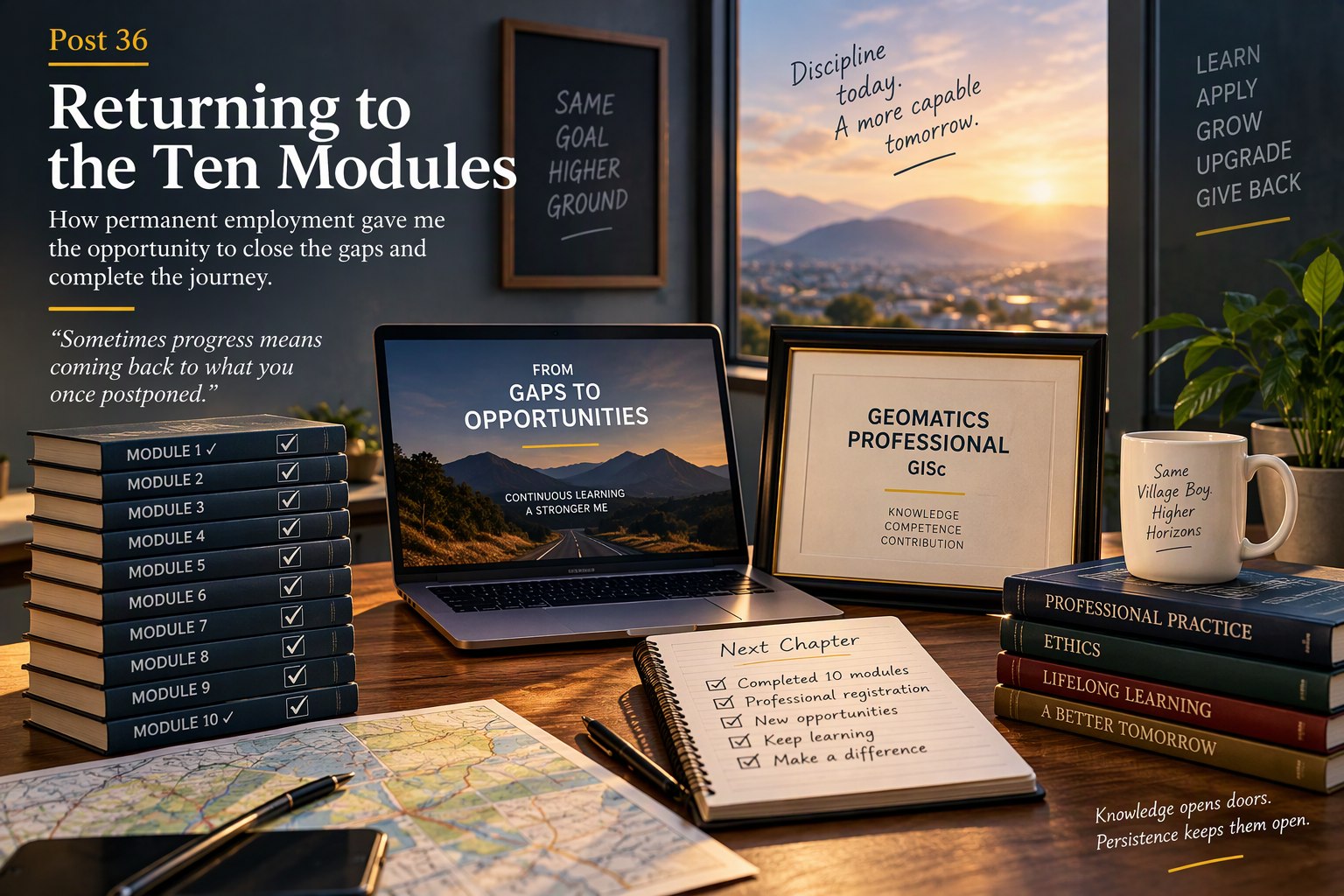
    I had permanent employment, and government provided me with a bursary that enabled me to complete the ten modules that had previously been identified as my learning gaps.

    So I returned to studying.

    There was something important about this stage of the journey.

    The gaps had been identified.

    I knew what I needed to complete.

    And now I had financial support that made it possible for me to do it.

    One by one, I completed the modules.

    I thought that would settle the matter.

    It did not.

    By the time I had completed the modules, the South African Geomatics Council (SAGC) wanted my qualification to be evaluated again.

    This brought me back to the same problem that had frustrated me earlier in my professional-registration journey.

    Consistency.

    My qualification had already been assessed.

    That assessment had identified the gaps in my learning.

    I had then spent time completing the modules that had been identified.

    So I had a simple question:

    What was the purpose of the original assessment if its outcome could simply be disregarded after I had fulfilled what it required?

    I challenged the decision.

    Again.

    My argument was not that professional standards should be lowered for me.

    It was that the outcome of the earlier assessment should be honoured.

    If an assessment says:

    These are the gaps you must address,

    and an applicant subsequently addresses those gaps, surely that earlier assessment has to mean something.

    People eventually intervened, and the original assessment was honoured.

    In 2022, I finally upgraded my registration to Geomatics Professional: GISc.

    It had taken years.

    But achieving the professional category taught me something beyond the technical knowledge contained in those ten modules.

    What I Learned About Professional Registration

    If I were giving advice to someone who wants to enter the GISc profession today, I would start much earlier than the registration application itself.

    I would start with the choice of university qualification.

    If professional registration forms part of your long-term ambition, investigate whether the qualification you intend to study has been evaluated for professional registration and for which registration category.

    Don’t assume that because a qualification contains GIS, Geoinformatics, Geography or Geomatics in its name, it automatically provides the registration pathway you expect.

    Find out.

    But I would also not tell someone to abandon a university simply because its curriculum has not followed the easiest registration pathway.

    Not everybody has the same choices.

    Finances, geography, admission requirements and personal circumstances can determine where someone is able to study.

    I am evidence that a more difficult route does not necessarily mean that the destination is impossible.

    But if you take that route, understand that you may be required to demonstrate in detail what you studied and perhaps address additional learning gaps.

    And there is another lesson from my experience.

    Do not be afraid to question an assessment that appears inconsistent.

    That does not mean every rejection is wrong.

    Sometimes an assessment identifies genuine deficiencies in someone’s learning.

    When that happens, address them.

    That was exactly what I did.

    But professional standards should also be accompanied by consistent processes.

    Ask questions.

    Understand the reasons for the decision.

    Keep copies of assessments and correspondence.

    If learning gaps are identified, know exactly what they are.

    And if you later fulfil what was required but receive a decision that appears inconsistent with what you were previously told, do not be afraid to challenge it.

    My professional-registration journey required me to do that more than once.

    There is one further caution.

    Processes change.

    What happened during my registration journey describes what I encountered at that particular time. Anyone going through professional registration today should check the current SAGC requirements rather than assuming that my route remains unchanged.

    My experience is not a registration manual.

    It is a lesson in what can happen when education, professional standards, institutional processes and individual circumstances meet.

    Looking back, those ten modules represented something much bigger than ten courses.

    Initially, they represented what I did not know.

    Then they became something I could work towards.

    Professional registration taught me to recognise the gaps in my own learning.

    But the process also taught me something equally important:

    There are times when I must accept that I still have something to learn, and there are times when I must have the courage to question the people assessing what I have learned.

    Knowing the difference matters.

    Join the conversation

    If you have pursued professional registration in GISc or another profession, have you ever had to address identified learning gaps or challenge an assessment that you believed was inconsistent?
  • Post 31: When a Qualification Was Not Enough

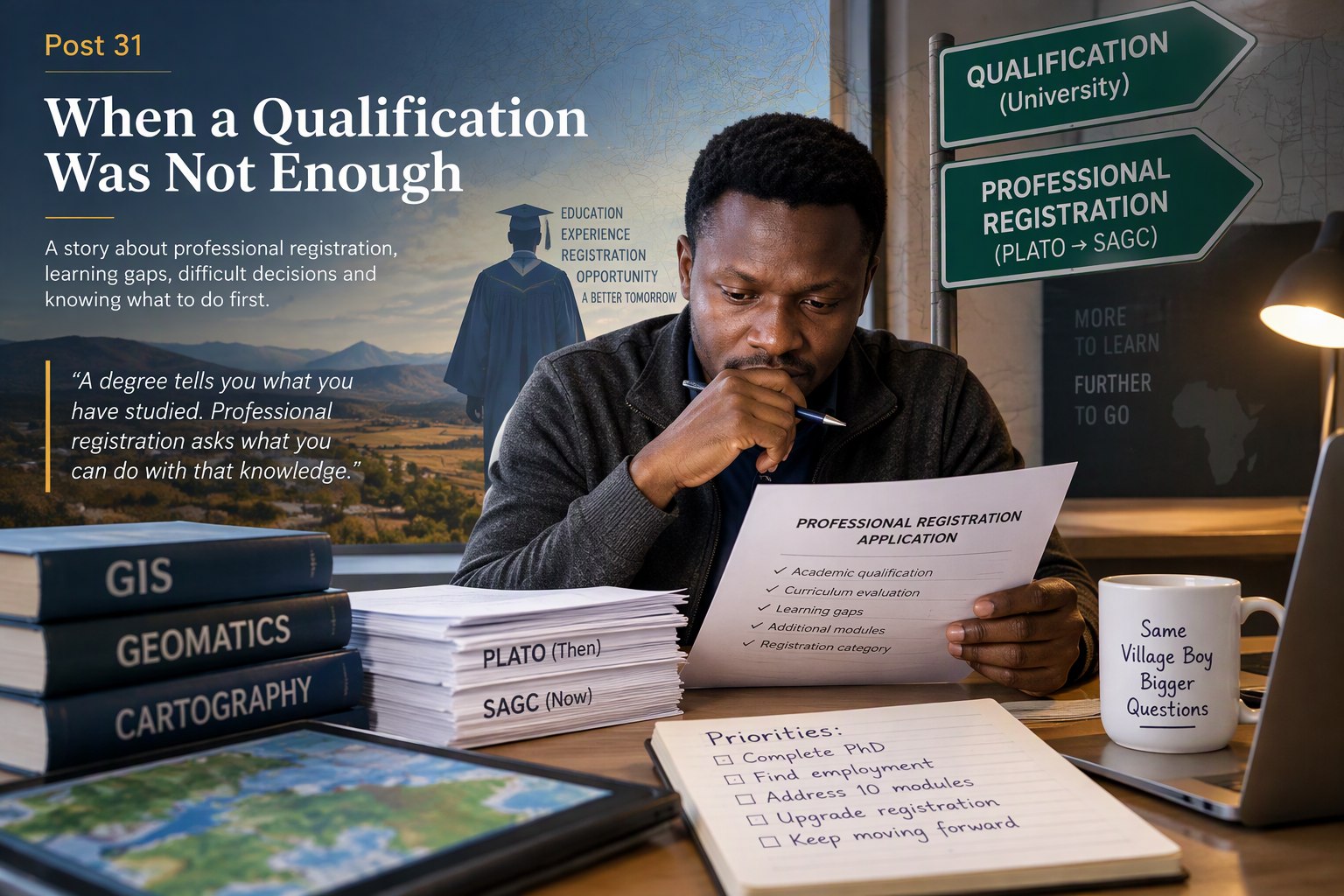
    Post 31: When a Qualification Was Not Enough

    When my PhD scholarship ran out and I had to continue working on the PhD from home, I was also applying for almost any opportunity I could find.

    At least I was already professionally registered as a GISc Technician.

    My former supervisor at the conservation agency had assisted me with the registration process shortly before I started my PhD journey. At the time, the professional body was the South African Council for Professional and Technical Surveyors (PLATO). Today, it is the South African Geomatics Council (SAGC).

    Although I still had ambitions to upgrade my registration to the professional category, getting registered as a GISc Technician had itself been a major fight.

    My initial application had been for registration at the professional level.

    The problem was my undergraduate qualification.

    I had completed my degree at the University of Venda, but at the time I applied, I was informed that its curriculum had not been evaluated and approved for the registration category I was pursuing.

    This meant that having the degree was not enough.

    I had to manually evaluate the contents of the qualification using a prescribed template. I had to go back to the individual modules I had completed and demonstrate what had actually been covered in my studies.

    In principle, I did not have a problem with this.

    If there were gaps in my learning, I wanted those gaps to be identified.

    My problem was with what appeared to me to be inconsistencies in the assessment process.

    Two people could have completed the same degree, at the same university, and studied the same modules, yet receive different assessment outcomes because their applications had been assessed by different people.

    One person could be approved.

    Another could be rejected.

    How could people with essentially the same academic preparation receive different conclusions about what they had learned?

    That was the source of my frustration.

    Eventually, I wrote a letter of complaint to the committee.

    I was not arguing that I should automatically be registered at the professional level simply because I had a degree.

    My argument was much simpler:

    Evaluate what I have studied consistently. If there are gaps in my learning, identify them and allow me to address them.

    Eventually, my registration as a GISc Technician was approved.

    More importantly for my longer-term ambition, the assessment identified ten individual modules that I needed to complete as short courses before I could upgrade my registration to the professional category.

    That changed the situation.

    There is a difference between being told:

    You do not qualify.

    and being told:

    These are the gaps in your learning.

    The second gives you something to work towards.

    It also taught me something about professional registration that may be useful to someone considering a career in GISc.

    A university degree and professional registration are not necessarily the same thing. Anyone who has ambitions of becoming professionally registered should not only look at the name of the degree they want to study. They should also investigate whether that particular curriculum has been evaluated for professional registration and, importantly, for which category.

    That is something I wish more prospective GISc students understood before choosing their qualifications.

    But I would also not want my experience to discourage someone simply because the qualification available to them has not already been evaluated.

    I went through the longer route.

    My modules had to be examined and gaps in my learning had to be identified.

    The important thing is to understand the requirements and be prepared for the process.

    Professional-registration processes also change over time. Someone reading this today should therefore check the current requirements with SAGC rather than assuming that the process I went through remains exactly the same. The current SAGC guidance still distinguishes qualifications recognised for particular registration categories from other qualifications that may require individual consideration.

    For me, however, those ten modules would have to wait.

    By then, I had another major problem.

    I had a PhD to finish.

    My scholarship had run out.

    I needed employment.

    I needed an income.

    I therefore decided that upgrading my professional registration would have to wait.

    It was not that the professional ambition had disappeared.

    I now knew where I wanted to go.

    I even knew what learning gaps I needed to address to get there.

    But not everything important can be pursued at the same time.

    For now, two things had to come first:

    Finish the PhD.

    Find a job.

    I would return to those ten modules later.

    Join the conversation

    Have you ever had to postpone an important professional goal, not because you had abandoned it, but because another priority had to come first?

  • Post 27: When the PhD Made My World Bigger

    Post 27: When the PhD Made My World Bigger

    A PhD is often described in terms of research, a thesis, and eventually a qualification.

    My experience became much broader than that.

    One of the benefits I had not fully anticipated was the people I would meet.

    I studied alongside students from different parts of Africa, including Zimbabwe, Zambia, Tanzania, Malawi and Eswatini, as well as students from within South Africa.

    We came from different countries and different backgrounds, but postgraduate studies brought us together.

    Over time, we formed something resembling a brotherhood and sisterhood.

    Some of those relationships extended beyond the university and beyond our research.

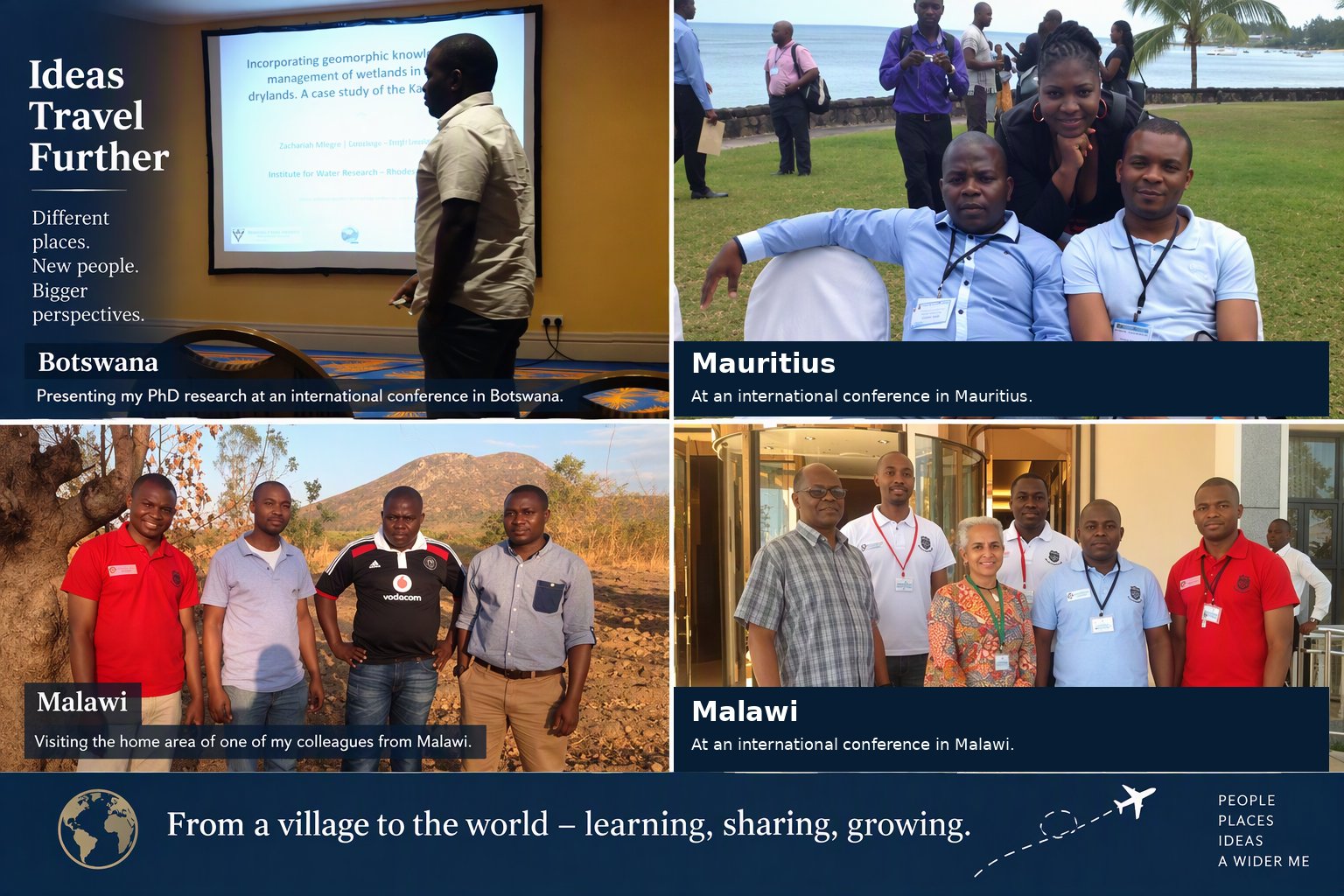
    During my trip to Malawi, I had an opportunity to visit the home area of one of my colleagues who was from Malawi.

    There was something meaningful about that experience.

    At university, we knew one another as postgraduate students. We shared academic spaces, discussed research and travelled to conferences. But visiting the place my colleague came from introduced another dimension to that relationship.

    It reminded me that behind each student and researcher was another story, another home and another journey that had eventually brought us into the same academic space.

    Perhaps that was another form of education.

    The PhD was not only exposing me to different ideas. Through the people I met, it was also exposing me to different places and different experiences.

    Some of those relationships did not end when our studies ended. We remained in contact, and with some colleagues I later worked on academic publications.

    Looking back, the PhD was therefore producing more than a thesis.

    It was also building friendships and professional networks.

    My First Passport

    There was another experience that postgraduate studies introduced into my life.

    International travel.

    I obtained my first passport while doing my PhD.

    That passport eventually took me to Malawi, Botswana and Mauritius to attend international conferences and present the progress of my research.

    For someone whose journey had begun in a village, this was another expansion of my world.

    The significance was not simply that I was crossing national borders.

    I was meeting researchers from other places, listening to different ideas, presenting my own work, and discovering that research could take me into spaces I had never imagined entering when my educational journey began.

    But the conferences were not valuable simply because I had an opportunity to travel to other countries.

    They were part of my education.

    Learning to Welcome Criticism

    At conferences, I had to stand in front of other researchers, present my work, and then listen to what they had to say about it.

    That meant learning to appreciate questions and constructive criticism.

    A question could identify something I had not considered.

    A comment could expose a weakness in the work.

    A different interpretation could force me to rethink part of my argument.

    When useful comments were accepted and properly implemented, the quality of my research improved.

    So, strangely, after presenting my work, I wanted questions.

    A discussion session without questions or comments could dampen the mood. Questions meant that people had engaged with the work enough to interrogate it.

    That does not mean that every criticism must simply be accepted.

    Research also requires judgement.

    Some arguments need to be defended.

    Others need to be reconsidered.

    Sometimes another person sees something that the researcher, after spending months immersed in the work, can no longer easily see.

    I began to appreciate constructive criticism not as an attack on the work, but as part of the process through which the work could become better.

    Perhaps that lesson extends beyond academic research.

    We present what we know.

    Someone challenges it.

    We reconsider it.

    We improve what needs improving and defend what remains sound.

    Then we continue.

    More Than a Qualification

    Looking back, perhaps this is one reason I cannot reduce my PhD experience to the qualification I eventually received.

    The thesis mattered.

    The research mattered.

    But so did the people.

    So did obtaining my first passport and travelling beyond South Africa.

    So did standing in front of researchers in another country and having my ideas questioned.

    And so did visiting the home area of a colleague in Malawi and seeing something of the world from which another person’s journey had begun.

    These experiences were connected.

    The PhD was teaching me about my research topic, but the academic journey was also teaching me how knowledge itself develops and how relationships can expand the world through which that knowledge travels.

    Perhaps education does more than increase what we know.

    Sometimes it also enlarges the world in which we are able to think.

    Join the conversation

    Have you ever received criticism that was uncomfortable at first but eventually helped you improve your work or thinking?

  • Post 22: I Went to George Looking for a Job, Not a PhD

    Post 22: I Went to George Looking for a Job, Not a PhD

    When I left Polokwane for George, I thought I understood what I was doing.

    I was taking another GIS job.

    It was a short-term contract, and it took me far from home, but it allowed me to continue building experience in the field I wanted to pursue.

    What I could not possibly know was that the most important consequence of moving to George had nothing to do with the job I had accepted.

    The person who would eventually play a defining role in what happened next wasn’t even working there when I arrived.

    A few months after I joined the organisation, a new GIS manager was appointed.

    When I first met her, one of the things I asked was whether she could assist me with my professional registration. She was already professionally registered and had completed a PhD herself.

    I was thinking about SAGC registration.

    She started talking to me about doing a PhD.

    That wasn’t entirely foreign to me. I had always wanted to complete a PhD. But wanting to do one and finding the financial means to do one were two very different things.

    For the time being, my attention remained on establishing myself professionally.

    She gave me GIS tasks to perform. I completed them. She assisted me with the professional registration process that I had left unfinished when I walked away from the internship.

    But she continued talking about something else.

    The PhD.

    From the work I was producing, she had apparently become convinced that I should consider furthering my studies instead of continuing to move between short-term employment opportunities.

    I explained the problem.

    Funding.

    Not long afterwards, she sent me a PhD scholarship opportunity at Rhodes University’s Institute for Water Research (IWR). The proposed research involved evapotranspiration estimates and rangeland management.

    I applied.

    I didn’t get it.

    That could easily have been the end of the story.

    It wasn’t.

    Someone Else Kept Looking

    She did not give up on the idea.

    Another scholarship became available at the same institute. This one involved wetland geomorphic origin and hydrological functioning.

    She sent it to me.

    I applied again.

    This time, I got it.

    I resigned from my position in George and began my PhD journey at Rhodes University.

    Only after commencing my studies did, I learn something that changed how I understood what had happened.

    My GIS manager had written a strong motivational letter supporting my application and submitted it to the institute without my knowledge.

    I had thought I had simply applied for a scholarship and succeeded.

    What I did not know was that somebody had been advocating for me behind the scenes.

    Mentorship Is Sometimes Advocacy

    That experience changed how I understand mentorship.

    A mentor is not simply someone who gives advice.

    Sometimes mentorship means seeing abilities in another person that they have not yet fully understood themselves.

    Sometimes it means forwarding an opportunity.

    Sometimes it means refusing to accept someone’s first unsuccessful attempt as the end of the road.

    And sometimes it means saying something positive about that person in a room they are not even in.

    I had applied for the scholarship.

    I had the qualifications.

    I had done the work.

    But telling the story as though I had achieved everything through individual effort would be dishonest.

    Someone intervened.

    Someone believed that I should be given an opportunity and was willing to put that belief into writing.

    Young professionals are often advised to find mentors. I think that advice can sometimes make mentorship sound transactional, as though one simply finds a successful person and asks to be developed.

    My experience was different.

    I went to George looking for a job.

    I met someone later.

    I asked her to help me register professionally.

    Somehow, that relationship contributed to me leaving George to start a PhD.

    I couldn’t have planned any of it.

    Join the conversation

    Has someone ever seen a possibility in you that you could not yet see clearly for yourself?

  • Post 21: When an Internship Has Served Its Purpose

    Post 21: When an Internship Has Served Its Purpose

    The financial relief I received during my Master’s changed what was possible.

    Towards the end of my master’s first year, I was still working on the municipal street-cleaning and greening project. My first year of master’s study overlapped with the second year of that project, and the two-year contract we had signed was due to expire during the first quarter of my second year.

    The future was uncertain.

    But my financial circumstances had improved. For the first time, I could afford to apply for entry-level GIS jobs and attend interviews without worrying about how I would pay for the journey or meet the immediate costs associated with starting a new job.

    So, I started applying for GIS internships.

    And this time, the calls started coming.

    I attended several interviews with different government departments and in different places. About a month before the municipal project was due to end, I received two internship offers from the same national government department: one at the head office in Pretoria and another at the provincial office in Polokwane.

    I chose Polokwane. It was closer to home and within Limpopo.

    Although the municipal project was eventually extended, I left when my original contract expired. At the beginning of the second quarter of my master’s second year, I started working as a GIS intern.

    Later that year, while doing the internship, I submitted the final version of my master’s dissertation and graduated.

    For the first time, my academic training and the career I wanted were beginning to converge.

    The Value of an Internship

    The internship offered more than employment.

    My master’s research involved GIS and Remote Sensing, and that was the field in which I wanted to build my career. I also wanted to register with the professional body regulating the geomatics profession, then known as PLATO and now the South African Geomatics Council (SAGC).

    Professional registration required both appropriate qualifications and relevant experience. The internship therefore gave me an opportunity to acquire that experience while working with registered professionals who could mentor me through the process.

    But it was still a one-year contract.

    I had learned enough about temporary employment not to wait until the final month before asking what would happen next.

    So, I kept applying for jobs.

    Eventually, I received an offer for a short-term GIS position in George, Western Cape.

    Then something happened that made the decision much more difficult.

    My supervisor and director called me into the director’s office.

    They didn’t want me to leave.

    They told me they had seen potential in me. They had also noticed something that I had not fully recognised in myself. When the person directly supervising us left, I had naturally started assuming some responsibility for coordinating the other interns.

    They told me they could see me becoming a manager one day and wanted to develop me towards that.

    Initially, I was convinced.

    There was, however, one problem.

    I would have to remain an intern.

    Doing More for Less

    Over the weekend, I discussed the decision with a friend.

    Something bothered us.

    If my potential had become visible partly because I was already assuming greater responsibilities, why should recognising that potential require me to continue doing more while remaining an intern?

    That conversation reminded me of something one of my Honours lecturers at the University of Venda had told us.

    He was critical of government internship programmes, particularly because of their potential to expose young graduates to exploitation.

    He acknowledged the counterargument. Internships give graduates experience, financial independence and an entry point into professions where employers demand experience from people who have had little opportunity to obtain it.

    His objection was more specific.

    The danger begins when a graduate develops beyond the original purpose of the internship, assumes greater responsibilities and produces increasingly valuable work, but the organisation continues treating that person as cheap temporary labour.

    I finally understood what he had been warning us about.

    I declined the extension.

    I took the short-term position in George.

    And I left without completing one of the things I had hoped to achieve through the internship: professional registration.

    Looking at the decision purely from a career-security perspective, it was questionable.

    I was leaving an organisation where management said they recognised my leadership potential. The internship was being extended to give us additional time to register professionally. Instead, I was travelling from Limpopo to the Western Cape for another short-term contract.

    But there is an important distinction between being grateful for an opportunity and becoming permanently indebted to it.

    Internships and short-term employment can transform the lives of young graduates. They certainly transformed mine.

    That is precisely why they should not be allowed to become mechanisms through which capable graduates continue doing progressively more for progressively less.

    An opportunity can be valuable and still reach the end of its usefulness.

    Sometimes growth requires recognising when that point has arrived.

    Join the conversation

    How should a young professional distinguish between an opportunity that is still developing them and one that has started benefiting from their development without properly recognising it?

  • Post 19: I Could Not Afford to Quit My Job

    Post 19: I Could Not Afford to Quit My Job

    I had finally registered for my Master’s at North-West University, Mafikeng Campus.

    Registration solved one problem, but it didn’t solve the one that had followed me throughout this journey: I still couldn’t afford to relocate.

    Fortunately, my Master’s was by research. There were no regular classes that required me to be at the university every day.

    I could continue working on my research remotely and travel to the university when my physical presence was necessary. This was mainly for discussions with my supervisor, practical work and learning that required access to software, and submitting documents such as applications for the university’s internal bursary and National Research Foundation (NRF) funding.

    This arrangement meant that I could keep the breakthrough I had received at the municipality.

    And I needed to.

    The street-cleaning and greening project was still my main source of income. The stipend was not enough to completely change my circumstances, but something important had changed.

    I was slowly becoming independent and was no longer entirely a financial burden on my family.

    I could now pay for my own upkeep and occasionally afford the trip to North-West University, including a few nights in a guesthouse when necessary.

    So that became the plan.

    I worked.

    I studied.

    When I needed to be at the university, I travelled there.

    Then I returned home and continued.

    Weeks became months, and the arrangement was working. The Master’s was a two-year programme, but towards the end of my first year, I was already close to finalising my thesis.

    Then something remarkable happened.

    The NRF application I had submitted earlier was successful.

    A lump-sum payment was deposited into my account.

    For the first time, I had substantial financial support for my research, but the money also gave me something I had been trying to achieve since completing my undergraduate degree:

    financial independence and room to move.

    I completed the Master’s within a year. I narrowly missed the first round of graduation ceremonies at the beginning of my second year, so my graduation would take place during the second round later that year.

    More importantly, I had managed to save a substantial portion of the NRF funding.

    The problem that had prevented me from seriously entering the job market was finally beginning to disappear.

    I could now afford transport to interviews.

    I could afford accommodation when necessary.

    And if an opportunity required me to move, I finally had some financial capacity to deal with what came next.

    Years earlier, I deliberately avoided internships and entry-level positions because I knew I couldn’t afford them, even if they came.

    Now the situation was different.

    I could finally afford to apply.

    Join the conversation

    If you have obtained your qualification but your breakthrough has not yet come, what is really holding you back? Is it lack of experience, a driver’s licence, the cost of travelling to interviews, relocation costs, limited opportunities, or something else? For me, one of the biggest barriers was simple: I could not afford to enter the job market.

  • Post 14: A Plan Built on Hours We Had Not Yet Worked

    Post 14: A Plan Built on Hours We Had Not Yet Worked

    Continuing with Honours was within my control. Paying for it was not.

    The scholarship that had supported my undergraduate studies did not extend to postgraduate study. Registration for honours was also expensive.

    But I was not alone now.

    I had a friend from university who was also a village boy, from a distant village called Tshaulu. Let us call him the first friend.

    His circumstances were similar to mine, but he was optimistic.

    He said, “Look, man, our situations are similar, but we can do this.”

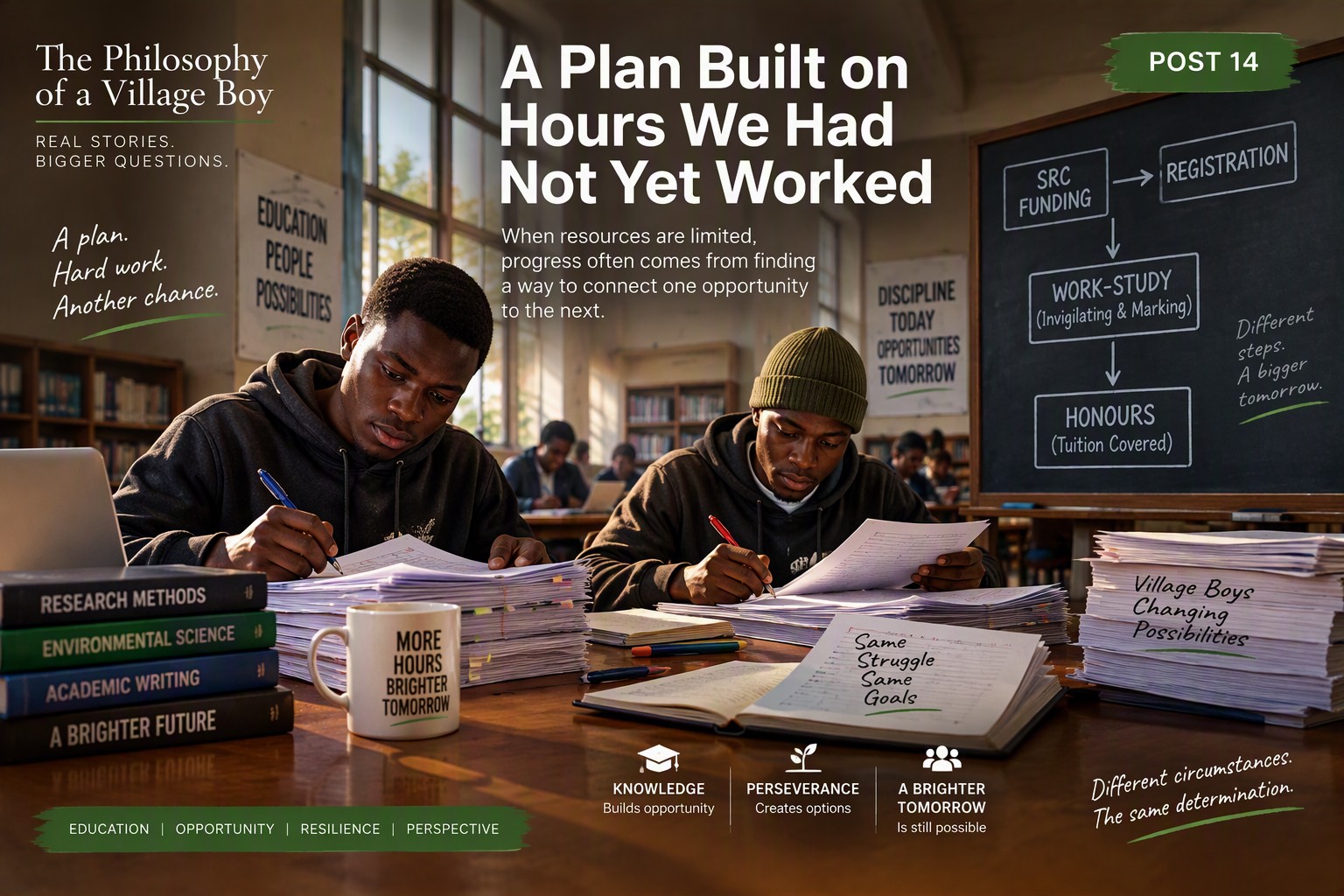
    His plan was the university’s work-study programme.

    We could work by invigilating undergraduate examinations and tests and assisting with marking scripts. We would record the hours we worked; those hours would be approved, and the programme would contribute towards our tuition fees.

    That sounded like a plan.

    Then I noticed the obvious problem.

    Work-study could assist with tuition, but first we had to be registered.

    Where would the registration money come from?

    My friend did not have the money for registration either.

    Then we remembered another possibility. The Student Representative Council (SRC) had a funding structure through which students could receive assistance with registration. The understanding was that the money would have to be repaid before results could eventually be released.

    Suddenly, everything seemed connected.

    SRC assistance would allow us to register.

    Registration would allow us to participate in work-study.

    Work-study would help cover tuition.

    We would invigilate and mark scripts, accumulating the required hours while completing Honours.

    It was not exactly financial security.

    It was a plan built largely on work that we had not even performed yet.

    But it was a plan.

    We applied through the SRC, registered and started Honours.

    Things went according to plan. We marked scripts. We invigilated. We attended classes. Eventually, we completed our examinations and submitted our mini-theses.

    Then we went our separate ways.

    Academically, the plan had worked.

    But the SRC debt remained.

    My results were withheld, and graduation was approaching.

    Once again, I had done what was within my control.

    Once again, money stood between effort and its reward.

    Perhaps our plan had worked.

    Perhaps for me, it had only carried the problem further down the road.

    Join the conversation

    When limited resources force people to construct plans from one uncertain opportunity to another, at what point does planning end and faith in the next opportunity begin?

  • Post 2: A Journey Shaped by Circumstance

    Post 2: A Journey Shaped by Circumstance

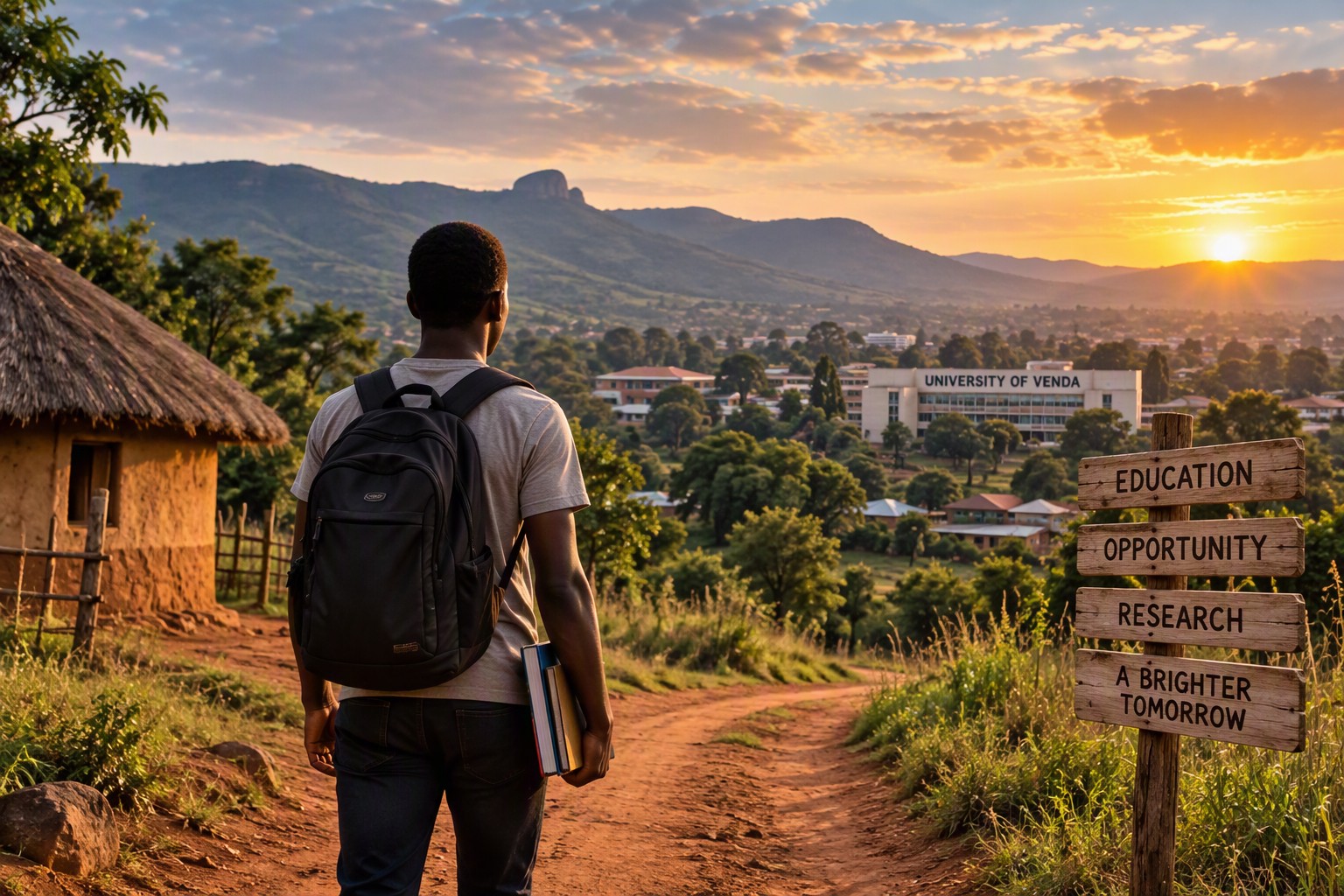
    After matriculating from a village secondary school with merit, including a distinction in Biology and TshiVenda, and a B+ in Geography, I embarked on an academic journey that began with enrolling at a local university, the University of Venda, for a degree in Environmental Sciences.

    Coming from a humble financial background, I knew that entering the workforce immediately after completing my undergraduate degree would be a challenge. Entering the job market requires financial resources that are easy to overlook: travelling to interviews, relocating after an appointment, securing accommodation, and surviving financially until the first salary arrives.

    Coming from a village made this challenge even greater. There were few, if any, opportunities for graduates within the immediate surroundings. Finding employment meant being prepared to relocate to towns, cities, or even other provinces where opportunities were available.

    The financial burden associated with taking up a first job, which often comes in the form of an internship or an entry-level position, can be substantial. Relocation requires money for the first month’s rent, a deposit, basic furniture, groceries, transport, and other necessities. I knew that my family’s financial circumstances did not afford me the luxury of entering the job market without these resources.

    Before completing my undergraduate degree, I therefore made a decision: instead of immediately entering the job market, I would continue with postgraduate studies.

    As luck would have it, the rural landscape still had a great deal to teach me.

    Or was it luck?

    Was it fate, circumstance, or the influence of forces beyond what humans can readily explain? In the absence of scientific evidence to prove or disprove such possibilities, we can only speculate. Whatever the reason, the decision to continue studying would profoundly influence the direction of my academic journey.

    After enrolling for an Honours degree in Environmental Sciences, specialising in Geography, at the University of Venda, I quickly discovered that I had a keen interest in Geographic Information Systems (GIS), Remote Sensing, research, scientific enquiry and academic writing.

    It was during this period that I was formally introduced to research methods, geographical thought and research methodologies. One lesson in particular stayed with me: a research problem does not always have to be found somewhere far away. Sometimes, you simply have to look carefully at what is happening around you.

    I learned that a researcher could observe their immediate environment, identify environmental or socio-economic challenges, and investigate those challenges from a geographical perspective. Research questions could emerge from the landscape itself, from the experiences of communities, and from patterns that were visible in everyday life.

    I also learned another route to identifying research problems: engaging with existing academic literature. By reading previous studies, examining their recommendations and identifying gaps in existing knowledge, a researcher could find questions that had not yet been adequately answered.

    Throughout my academic journey, I would eventually employ both approaches.

    I would look at the literature.

    But I would also look outside.

    And, once again, the village would give me something to investigate.