
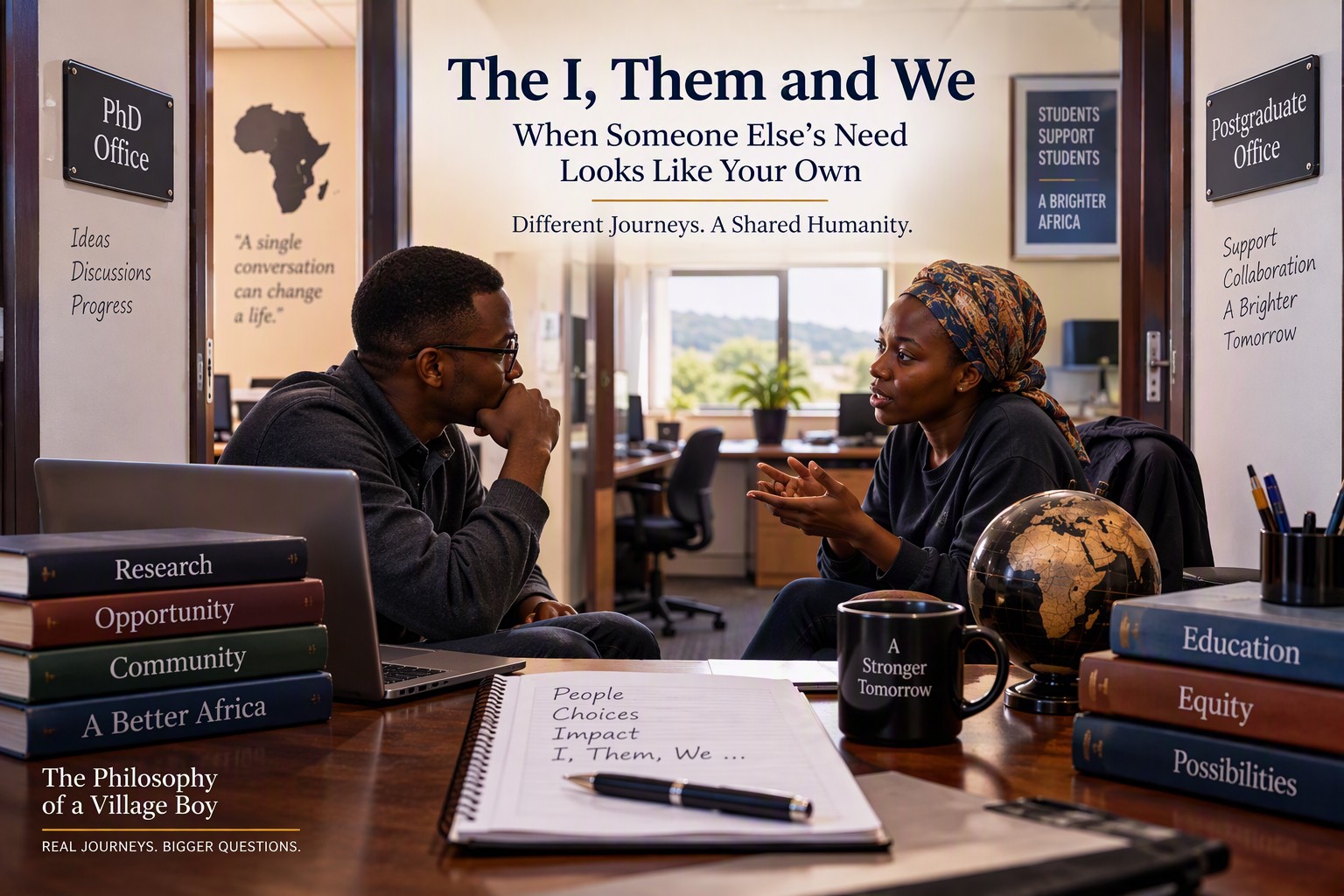
Postgraduate students worked from offices allocated to us at the university.
Fellow students and interns worked from the postgraduate office next to ours. Although a wall physically separated the two rooms, that barrier meant very little socially. The offices faced each other, and the relationships among the students meant that we interacted regularly. In practice, we were part of the same university community.
One in particular was a Zulu village girl from KwaZulu-Natal whose family circumstances were not very different from my own.
A member of her extended family had played an important role in her journey. This person had supported her financially, helped put her through school, and she was staying with this family member while doing her internship.
Then, during the December holidays, something changed.
There was a fallout between them.
Suddenly, the support and living arrangement she had depended on were no longer available.
She was now on her own.
The First-Month Problem
She needed to return to Grahamstown, now called Makhanda, in the Eastern Cape, where she was doing her internship.
But returning was no longer simply a question of transport.
She had to find her own accommodation. She needed money for transport, rent, groceries, and the other expenses that came with establishing herself independently.
Her internship would pay her, but that did not solve the immediate problem.
She needed enough money to survive for that first month while waiting for her internship payment.
There is something peculiar about situations like this.
From the outside, a person can appear to have an opportunity. She had an internship. She would receive an income. There was a path forward.
But between having an opportunity and being able to take advantage of it stood a much smaller, more immediate problem:
How do you get there?
How do you pay for transport?
How do you secure accommodation?
What do you eat while waiting for the first payment?
She was at home and could not see how she would return to Grahamstown and continue with her internship.
When she explained the problem to me, she didn’t know I had experienced something remarkably similar earlier in my own journey.
I knew what it meant to have an opportunity waiting for you but not have the immediate financial resources required to reach it.
Then she asked me for help.
She proposed that I lend her the money and that she would repay me through monthly instalments once her internship payments started coming through.
Under different circumstances, perhaps the decision would have been easy.
But I had my own pressing needs.
My Needs or Hers?
The family house had been sold.
My grandmother had relocated, and I was using some of my savings from the PhD scholarship to build a modest home that we could eventually call our own.
At that stage, I was effectively homeless myself.
Every amount of money had a purpose.
Redirecting some of it elsewhere would delay construction of the house.
Both needs were real.
This was therefore not simply a question of whether I was willing to help someone.
It was a question of competing objectives.
There was something I needed.
There was something she needed.
And I had limited resources with which to address both.
Whose need should come first?
There was the I: my own legitimate needs.
There was them: the needs of another person.
And beyond the two sits a much larger consideration: we, the collective.
Humans constantly have to make choices between these competing interests.
Sometimes our own needs must come first.
Sometimes another person’s need appears more urgent.
And sometimes the interests of the larger collective may require individuals to sacrifice something of their own.
But how do we decide?
She Was Another Version of Me
In this particular situation, something made the decision easier.
I recognised her problem.
I had lived a version of it.
I knew what it was like when the difference between continuing with an opportunity and losing it could come down to something as ordinary as transport, accommodation, groceries, or having enough money to survive until another source of income became available.
I looked at what I needed.
Then I looked at what she needed.
If I redirected some of my money, construction of the house would slow down.
But it would continue.
If she could not return to Grahamstown, the consequences for her internship could be much greater.
Her immediate need seemed greater than mine.
And when I looked at her circumstances, I could see something of my own earlier journey.
She was, in some ways, another version of me.
So I lent her the money.
Construction slowed down.
She returned to Grahamstown, secured her own accommodation and continued with her internship.
And, as she had promised, she repaid the money through monthly instalments.
Our Journeys Continued
Her internship was not the end of her journey.
After completing it, she moved to Cape Town to further her studies.
Our relationship also did not end with that loan.
Over the years, there were other occasions when I assisted her as she continued along her academic and professional journey.
But there is something important that must not disappear from this story:
She also assisted me.
The assistance between us did not move permanently in one direction.
At one point, I happened to be in a position to respond to a problem she was facing. At other points in our lives, circumstances were different, and she was able to assist me.
That complicates the distinction between I and them.
Perhaps those positions are not as fixed as they sometimes appear.
Today I may be the person with something to give.
Tomorrow I may be the person who needs someone else.
And perhaps neither of us knows, at the moment of helping, how those positions may eventually change.
Years Later
Much later, when we spoke about those years again, she reminded me of some of the assistance I had given her.
Interestingly, I could not remember every individual act she mentioned.
But I remembered why I helped.
I told her:
I saw myself in her.
She agreed.
Perhaps that tells me more about my original decision than trying to reconstruct every individual act of assistance.
I was not looking at her circumstances entirely from the outside.
Her struggle was familiar because I had lived a version of it myself.
But that realisation creates another question.
Would I have made the same decision if I could not see myself in her?
The I, Them and We
This is where that relatively simple financial decision becomes philosophically interesting to me.
Humans constantly negotiate between I, them, and we.
The individual has legitimate needs.
So does the person standing in front of us.
Beyond both are families, communities, societies, and humanity collectively.
But resources are limited.
Choosing one objective can mean postponing another.
In this particular situation, I chose “them” over “I”, at least temporarily. I delayed something I needed because another person’s immediate need seemed greater.
But I do not think that means “them” should always come before “I”.
There must surely be circumstances in which choosing “I” is both reasonable and necessary.
The more difficult question is how we make that distinction.
And knowing how our relationship developed later makes the categories even less certain.
Who exactly is “them”?
The person who needs my help today may be the person who helps me tomorrow.
Perhaps “I” and “them” sometimes describe temporary positions rather than permanent identities.
That possibility brings me closer to “we.”
Not because everyone will help everyone else.
Not because every act of assistance will eventually be returned.
And certainly not because helping another person should be treated as an investment from which repayment is expected.
When I lent her the money, I did not know what future circumstances would bring.
I was responding to the situation in front of me.
But looking backwards, I can see something that I could not have known then: human beings move between these positions.
Sometimes we have.
Sometimes we need.
Sometimes we give.
Sometimes we receive.
And perhaps this is one reason the boundary between our individual interests and the interests of others deserves closer examination.
My experience also raises another question that I find even more uncomfortable:
How much of our willingness to help other people depends on our ability to recognise something of ourselves in them?
Would I have moved the resources in the same way if her circumstances had been completely foreign to me?
I do not know.
Perhaps that is precisely why the question is worth asking.
In her situation, I knew what it was like to have an opportunity in front of you but struggle to reach it because of something as basic as money.
I had been there before.
This time, however, I was standing on the other side of the problem.
And years later, I would discover that neither of us would remain permanently on one side.
Join the conversation
When your own legitimate needs compete with another person’s immediate need, what should determine whether you choose “I,” “them,” or the wider “we”? And does knowing that any of us may one day move from the position of giver to receiver change how we should think about helping one another?
Leave a Reply