
After submitting our handwritten CVs, nothing happened immediately.
Our names were far down the municipality’s volunteer list. We had seen that ourselves.
But whenever my friend and I happened to be in town, we developed a habit.
We went to the municipality.
We would ask whether there had been any progress.
Then we would leave and continue with our lives.
We did not know it at the time, but those small visits were apparently making an impression.
Meanwhile, graduation had not transformed my everyday reality.
My cousin, who was the same age as me and had gone to university at roughly the same time, was also now a graduate. Let’s call him my second cousin.
We did whatever work became available.
One family friend built stone walls. My cousin and I helped by collecting stones and maintaining a constant supply while he worked.
Sometimes another family friend, also a builder, asked us to dig foundation trenches before he started laying foundations.
At another point, we worked with a subcontracting company painting RDP houses in villages around the district.
We were graduates.
But if there was work available, we worked.
A few months after submitting the handwritten CVs, I was helping the first family friend plaster a house.
My job included mixing mortar (cement, sand and water) and keeping him supplied while he plastered. Afterwards, we would work on smoothing the plaster.
It was hard physical work.
But for a village boy, blisters from this kind of work were not completely foreign. In some ways, they were part of village life and identity.
Then my phone rang.
Someone from the municipality wanted to know whether I was still interested in voluntary work.
“Very much,” I responded.
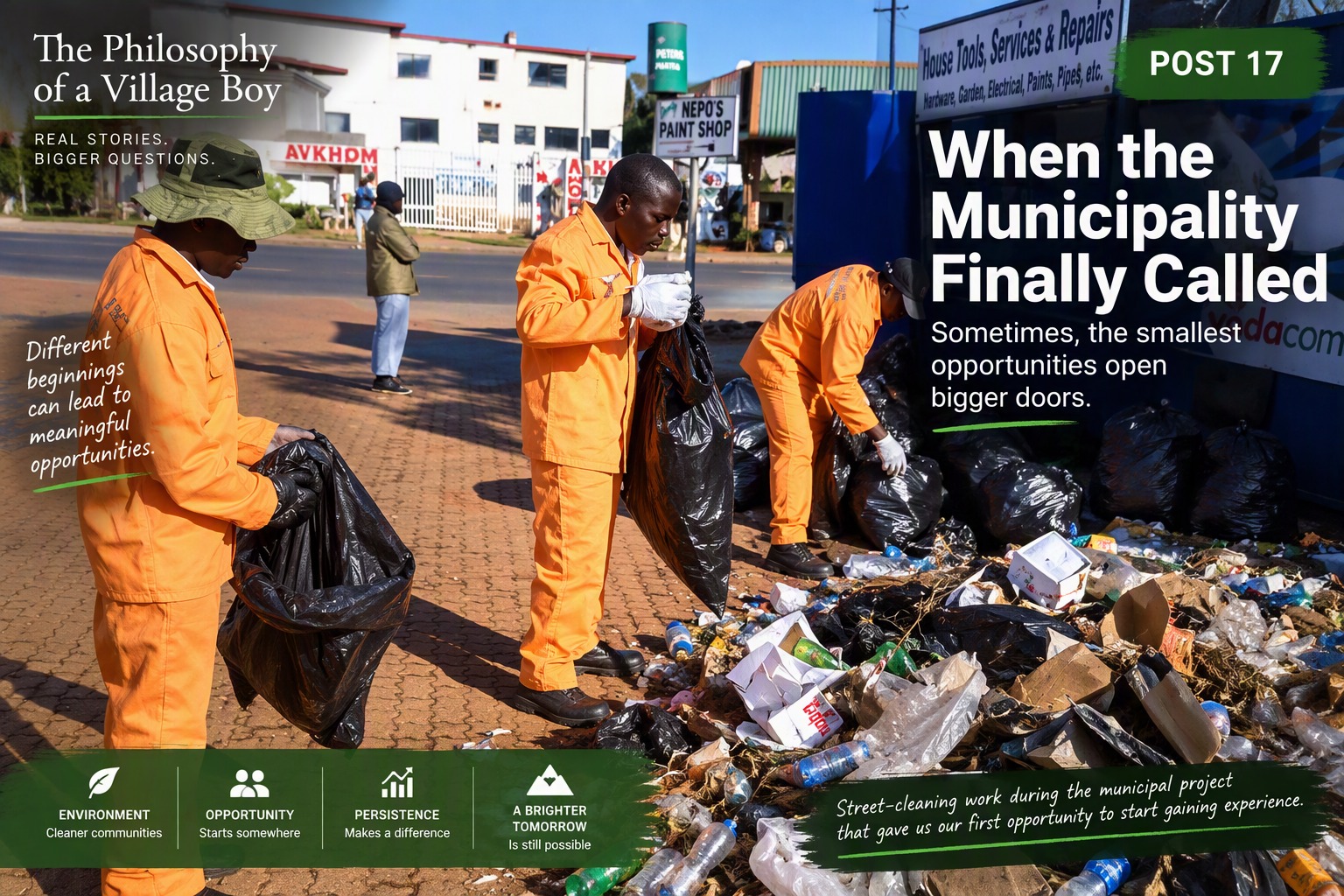
There was an opening in a street-cleaning and greening project. The municipality wanted environmental graduates who could assist with environmental education and awareness campaigns.
I was told to report the following morning to sign the contract.
After the call, I told the family friend I was working with.
He congratulated me and said he would find somebody else to help him finish the plastering job.
Then I called my friend from Tshikhudini.
He too had received the same call, he said.
We met at the municipal offices the following day and signed our contracts.
Only later did another part of the story become clear.
We were told that although we had originally been down the volunteer list, our repeated visits to the municipality to check on progress had demonstrated that we were serious. We had consequently been moved up the list.
That made me think.
When we walked into that office with handwritten CVs, being at the bottom of the list looked like something beyond our control.
We couldn’t control how many names were ahead of ours.
But perhaps we could control whether our names remained merely names on a piece of paper.
Every time we happened to be in town, we showed up.
We asked.
We followed up.
We made ourselves visible.
Perhaps persistence did not guarantee an opportunity.
But in this case, apparently, somebody noticed it.
The work itself was modest. It was volunteer work accompanied by a stipend that was just enough for some upkeep.
Initially, we even had to do litter picking in town.
We didn’t complain.
We had gone from handwritten CVs at the bottom of a volunteer list to having an opportunity to start building experience.
It wasn’t yet the breakthrough I needed.
But it was a lifeline.
And perhaps there is a subtle distinction there that I did not fully appreciate at the time:
Some things are beyond our control, but that does not necessarily mean that humans do not influence them.
Join the conversation
How many opportunities have people abandoned because they assumed that after submitting an application, everything else was beyond their control?

Leave a Reply