
When I previously wrote about the financial burden of taking on a new job, I only touched briefly on something I think deserves deeper reflection.
We often assume that going to university or college, obtaining a qualification and graduating will solve the problem. For many young people, particularly those from poor and rural families, perhaps that is not the end of the struggle. It may be only the beginning of another.
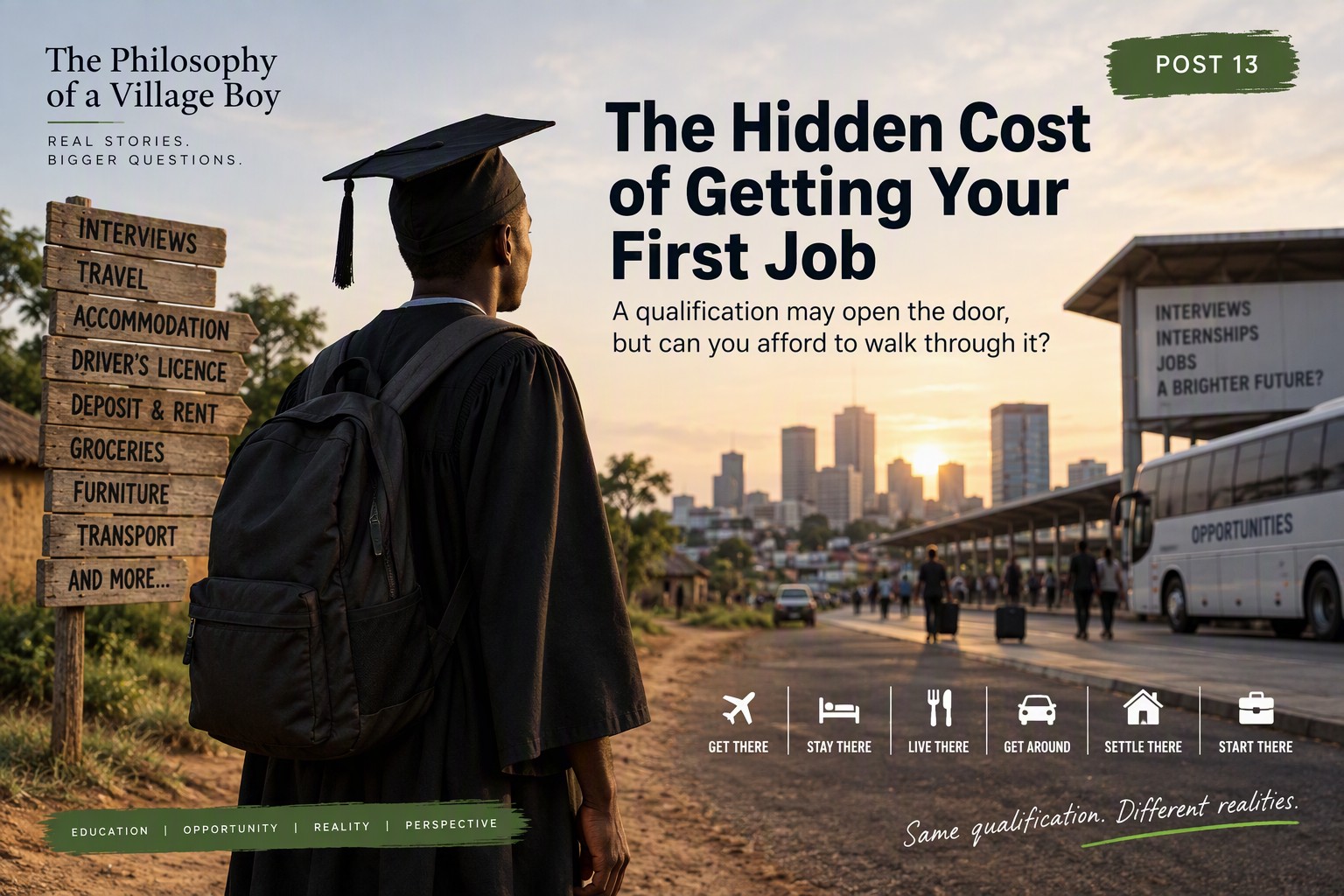
Entry-level positions require experience. Internships are supposed to help graduates acquire that experience. But even getting an internship requires resources.
You have to search and apply for opportunities. If you are invited for an interview in another town or province, you have to travel there. Depending on the distance, you may need accommodation. You need food and local transport. And increasingly, even some internships expect applicants to have a driver’s licence.
For someone whose family struggled just to get them through university, where is this additional money supposed to come from?
And suppose you overcome all of that and actually get the job.
You may still need money for your first month’s rent and a deposit. You need groceries. You may need furniture. You need transport to and from work. All of these expenses arrive before the first salary.
So what does it really mean to say that someone is “qualified” for a job?
On paper, the answer may be straightforward. They possess the required qualifications.
In reality, there seems to be another qualification that is rarely listed in the advertisement: you must be able to afford becoming employed.
I understood this problem too well.
After completing my undergraduate studies, I made what may sound like a strange decision. I was not going to apply for internships or entry-level positions.
It was not because I did not want to work.
I simply knew that my family could not afford everything that might follow from an application being successful.
But deciding not to apply did not solve anything. I still needed a strategy.
I had none.
I could not suddenly produce the money required to enter the job market. That part was beyond my control.
So I returned to a question that had already become important in my life:
What is within my control?
One answer seemed obvious.
I could continue studying.
Perhaps doing Honours would give me another year to improve my qualifications while allowing other things to resolve themselves as they sometimes did.
There was only one problem.
My family could not afford postgraduate studies either.
So I had solved one problem by creating another.
Join the conversation
How many unemployed graduates are actually unable to enter the job market, not because they lack qualifications or ambition, but because they cannot afford the cost of becoming employed?
Leave a Reply