
Continuation from Post 10.
There was another piece of the story that eventually forced me to reconsider how I understood those difficult years.
My second uncle, my grandmother’s middle child, worked as a security guard.
At some point, he confided in a family friend about his inability to assist me as much as he would have wanted.
His explanation, as it was later related to me, was simple:
“It is not like I don’t want to assist my nephew. I just can’t afford to.”
What apparently made the situation even more painful for him was the way I responded to my circumstances.
I was not demanding.
I did not constantly ask people for help.
I simply kept going and tried to do whatever I could with whatever was available to me.
Seeing that, while knowing that he could not do more, apparently troubled him deeply.
When I eventually learnt about this conversation, something shifted in my understanding.
When you are the person experiencing hardship, you naturally see the situation from where you are standing.
You know that your school fees have not been paid.
You know that you do not have a scientific calculator.
You know that you do not have the study materials you need.
You know what it feels like to watch others have things that would make your own journey easier.
Those experiences are real.
But there is something you may not know.
You may not know what is happening on the other side.
For years, I could have looked back at that period and concluded that the adults around me simply did not care enough.
It would have been an understandable conclusion.
But would it have been the correct one?
My second uncle’s words complicated that interpretation.
Then there was my eldest uncle, who quietly wrote “Well done and keep it up” on my school report years earlier and second uncle who later paid my first university registration fee.
There was my grandmother, stretching her pension to help with registration and the money I needed to travel from the village to university every day.
And there was my mother, taking whatever work she could find and eventually refusing money from me while seriously ill because she feared that giving it to her could interfere with my studies.
Perhaps what I had experienced as abandonment was, at least in part, helplessness on the other side.
That does not change what happened.
The school fees were still unpaid.
The resources were still absent.
The difficulties were real.
Understanding something differently does not require pretending that it never happened.
Perhaps maturity sometimes means being able to hold two truths at the same time:
I needed more than they were able to give.
And:
They may have wanted to give more than they had.
Today, I cannot honestly say that I would have achieved what I did without my family’s assistance.
My mother, my grandmother and my uncles helped me in different ways and at different stages of the journey.
Looking back now, I wonder whether some of them were judging themselves just as easily as I could have judged them.
Maybe they believed they should have done more.
Maybe they wanted to do more.
Perhaps their circumstances simply did not allow them to.
And this has left me with one of the most important lessons I have learnt about the human condition:
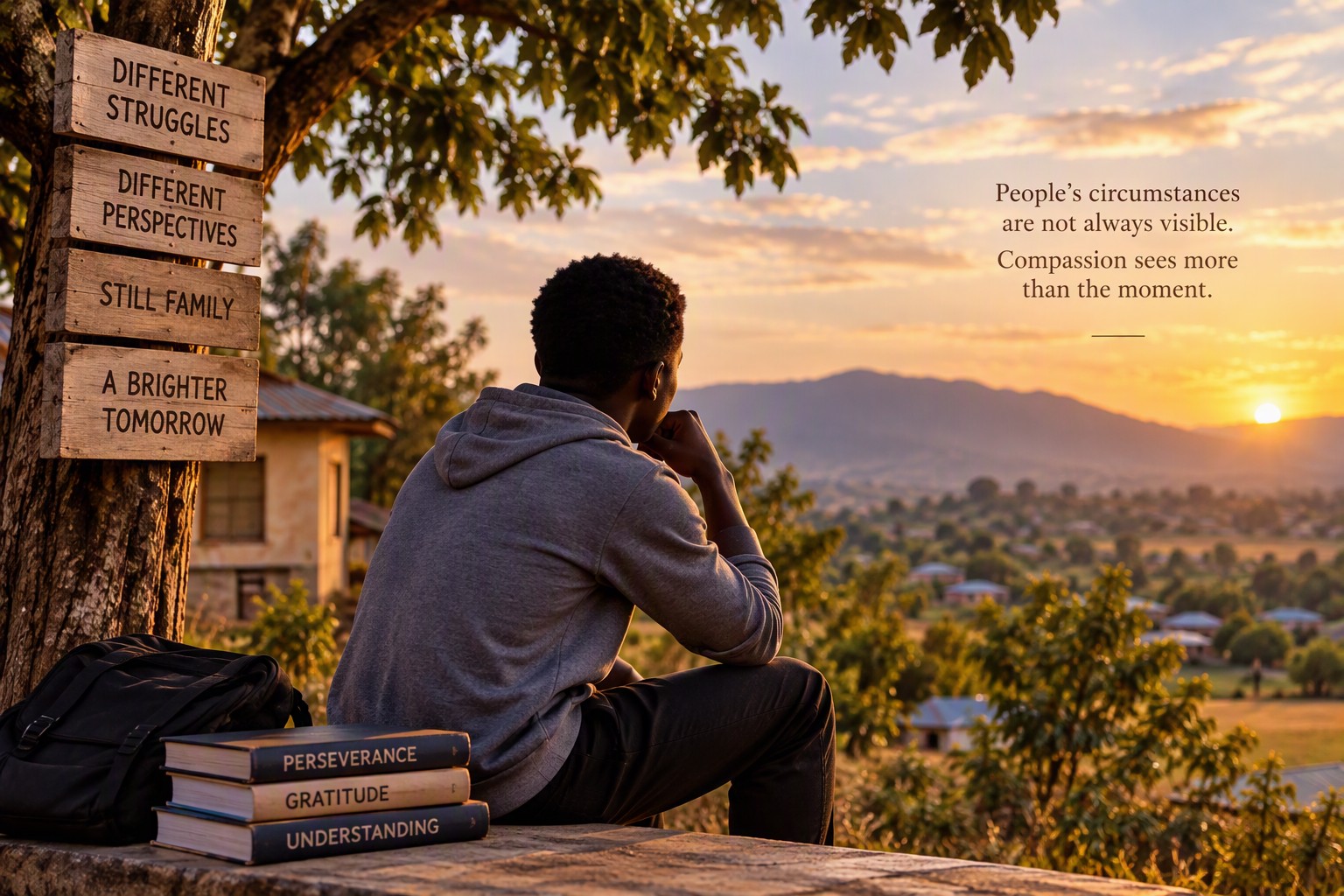
What looks like indifference from one side may sometimes be helplessness on the other.
We rarely know the full story while we are living through it.
Join the conversation
Have you ever reached a point in life where you had to reconsider something you had long believed about the people who raised you?
Leave a Reply