
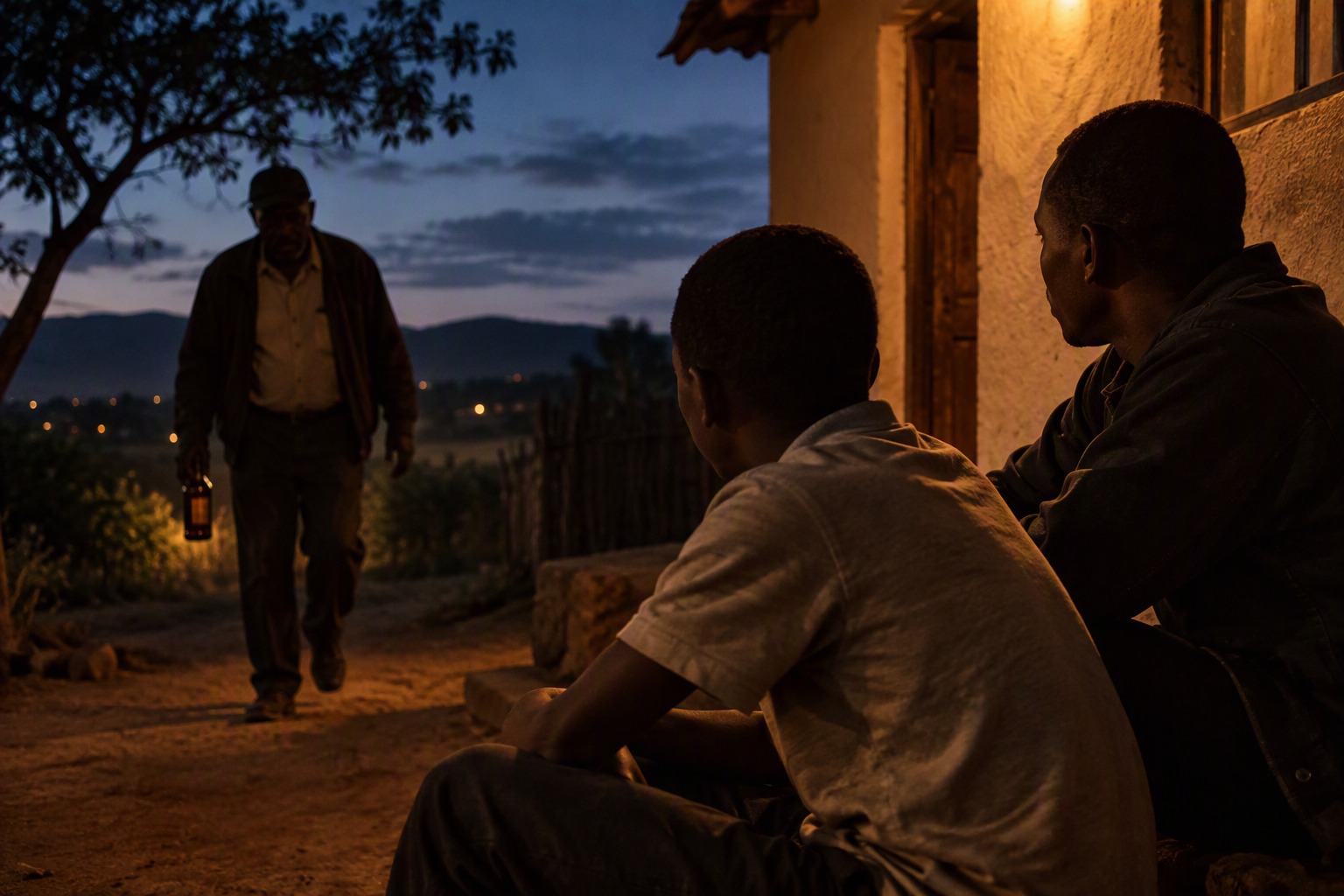
Just to emphasise how hopeless my situation had become, as a continuation from Post 3, I remember one early evening when I was sitting with my eldest cousin.
A figure appeared from the darkness and started walking in our direction. It was my uncle.
He was the middle child of my grandmother. My eldest cousin’s father was my grandparents’ first-born child, while my uncle was the middle child. He worked at the university as a security guard.
As he emerged from the darkness, my uncle greeted me with an unfamiliar voice and an unusual walk. He was holding something in one of his hands. The closer he came, the clearer it became that he was intoxicated and that what he was holding was a beer bottle.
I still remember that early evening very well.
It was just a year before I matriculated. I was doing Grade 11 at the time.
After exchanging pleasantries, my uncle went straight to the point. His attention was directed almost entirely towards me, as though he could not see his older brother’s son sitting beside me.
“My nephew,” he said, “I am here to apologise to you. I am sorry.”
He explained that he had been thinking about my prospects of furthering my education. He had made arrangements for the tertiary education of his own children, some of whom were around my age, but had not included me in that educational scheme.
Perhaps, he reflected, he should have done something earlier.
But he had never imagined that the situation would reach this stage.
He told me that he had a friend whom he had been counting on to find a way for me to further my education, even if what they were planning was not entirely ethical. Unfortunately, his friend had passed away.
That option was gone.
He then told me plainly that he could not afford to take me to a tertiary institution with his salary as a security guard while he also had his own family to support.
There were no other options that he could see.
Then he concluded with words that would remain with me for years:
“The situation is now in your hands.”
He turned his back on us and disappeared into the evening darkness.
I barely said a word.
Even today, I sometimes become completely silent when confronted with information that requires serious processing. My mind first needs time to understand what has happened and what it means.
I was still processing my uncle’s words when my cousin suddenly burst into laughter.
He was eight years older than me and was more like an elder brother than a cousin. After all, we lived together.
I asked him politely, “What are you laughing at?”
“No, I am not laughing at you,” he replied. “I am laughing at your uncle. He had to get himself drunk to summon the courage to come and tell you that. That is what I find funny.”
That was when the seriousness of the situation truly settled in.
The situation was now in my hands.
But I was only a Grade 11 learner.
What exactly was I supposed to do?
When There Is Nothing You Can Do
I spent some time trying to process everything and understand what it meant for the situation to be entirely in my hands.
Eventually, I came to a difficult but simple conclusion:
There was nothing I could do about it.
I had no money. I had no employment. I could not force anyone to finance my education. I could not bring back my uncle’s deceased friend. I could not suddenly create opportunities that did not exist.
The situation really was hopeless, at least from where I stood at that moment.
But perhaps this was when I began learning something that would stay with me for the rest of my life:
Some situations are completely beyond our control.
Recognising that does not necessarily mean giving up.
I could not solve the question of how I would one day go to university.
But there was still something I could do.
I could complete my studies.
So that is what I decided to do.
Leave a Reply