
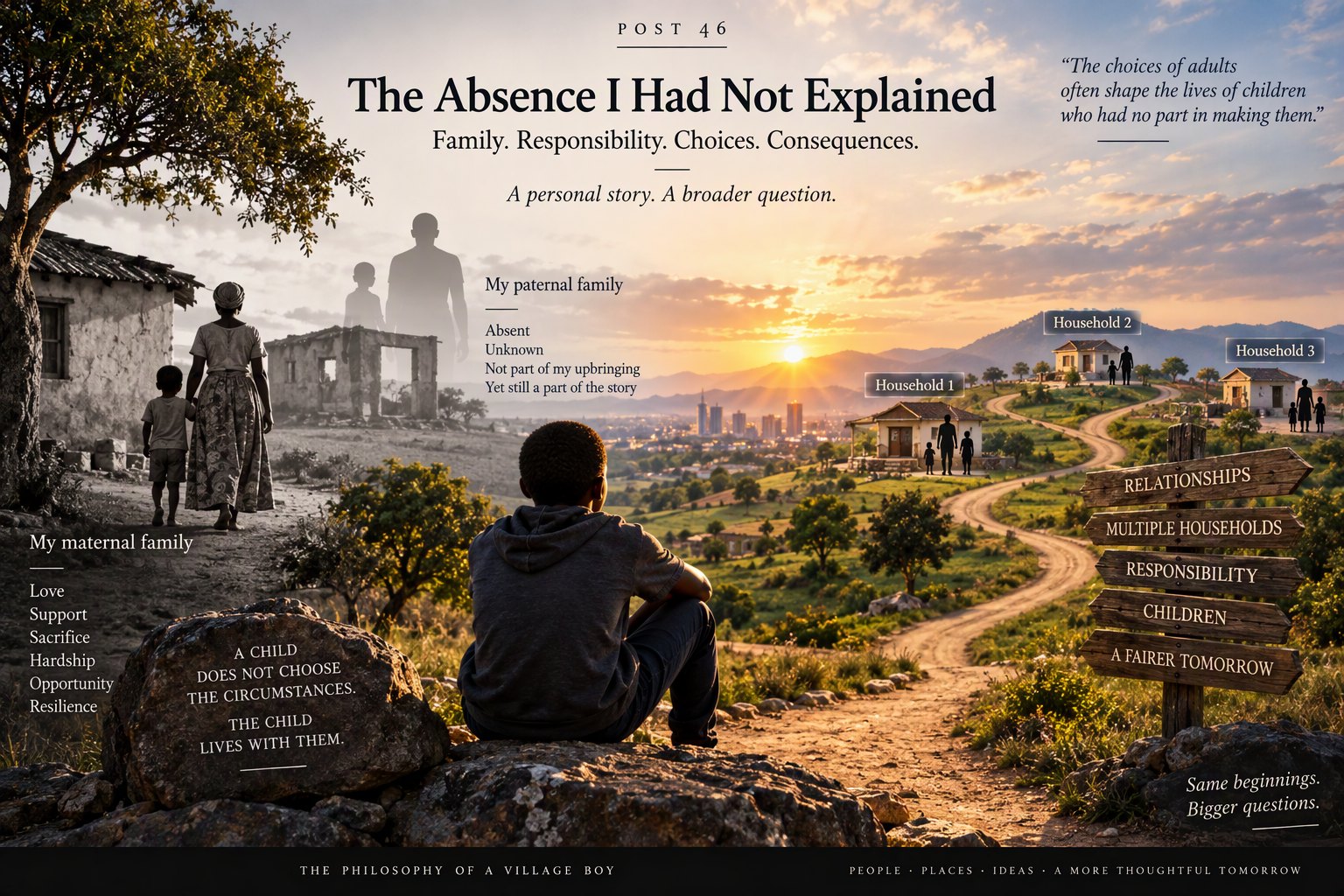
As I bring the autobiographical part of The Philosophy of a Village Boy to a close, I find myself thinking about something that has been present throughout this story precisely because it has been absent.
Perhaps some readers noticed it.
Perhaps others will only notice it now that I mention it.
Throughout this journey, whenever I wrote about family, hardship, support, and the people around me, almost all those stories involved my maternal family.
My paternal family hardly appeared at all.
There is a simple reason for that.
I was raised by my maternal family. I had no relationship with my paternal family.
That is not something I forgot to mention. It was something I chose not to explore.
But perhaps an autobiography is shaped not only by what is written.
Perhaps it is also shaped by what is missing.
When Responsibility Falls on One Side
Growing up without the involvement of both parents is not simply about the absence of one person. It can also mean growing up without the involvement of an entire side of the family.
The responsibilities associated with raising a child do not disappear because one parent, or one side of the family, is absent.
Someone else carries them.
A child still needs food, clothing, shelter, education, guidance, and support. When those responsibilities are not shared between both parents, they are often absorbed by the parent who remains and, in many cases, by that parent’s extended family.
In my case, that was my maternal family.
Perhaps this explains something that has remained almost invisible throughout this autobiography.
Much has been said about the difficulties experienced within my maternal family, but very little has been said about why so much of the responsibility rested there in the first place.
Where was the paternal family?
The answer is simple: they were not part of my upbringing.
But perhaps the more important question is not where they were.
It is what happens when responsibility that might ordinarily have been distributed between two parents, and potentially two extended families, becomes concentrated largely on one side.
A Much Bigger Question
My circumstances are personal, but the broader question is certainly not unique to me.
According to the State of South Africa’s Fathers 2024, only 35.6% of South African children lived in the same household as their biological fathers in 2023, while 40.3% lived with adult men who were not their biological fathers.
Those figures need to be interpreted carefully.
Not living with a biological parent does not automatically mean abandonment or lack of involvement. Economic circumstances, migration, and changing family structures can result in parents and children living apart even when relationships and responsibilities are maintained.
That distinction changes the question.
Perhaps we should not simply ask:
Where are the fathers?
Perhaps we should ask:
Where is the responsibility?
A parent can live somewhere else and remain deeply involved in raising a child.
A parent can provide financially, communicate, guide, visit, and participate in important decisions without sharing the same household.
Conversely, someone can be biologically connected to a child without meaningfully participating in raising that child.
Perhaps physical presence and parental responsibility should not always be treated as the same thing.
When There Are Several Families
The question becomes even more complicated when children are spread across different households.
A person may have children with more than one partner.
That fact alone does not establish irresponsibility.
Someone may have children in different households and accept responsibility for all of them.
The ethical problem is therefore not simply having children with different people.
The more difficult question arises when multiple responsibilities are created, but only some are honoured.
Someone may participate fully in raising children in one household while having other biological children elsewhere who experience little or no involvement.
That raises a difficult question.
Can someone be a responsible parent in one household while simultaneously neglecting parental responsibility in another?
And what does that experience look like from the perspective of the child on the other side?
What Have We Normalised?
Terms such as“baby mama” and“baby daddy” have become part of ordinary language.
Perhaps they are simply convenient descriptions of family arrangements that have existed for generations.
But language sometimes makes me wonder about what society has gradually learned to regard as ordinary.
Having children with different partners is not automatically the problem.
The problem arises when children are created across different relationships, and the responsibilities associated with those children are not equally taken seriously.
And that raises another uncomfortable question.
Should scrutiny fall only on fathers?
I don’t think it should.
Adult Choices and Responsibility
If adults knowingly enter relationships in which substantial family commitments already exist, should some responsibility attach to those choices too?
Perhaps.
But this requires careful distinction.
Someone may not know that the person they are involved with has another partner, another household or even other children. Deception changes the moral equation considerably.
But what if the circumstances are known?
What responsibility do adults have when entering relationships knowing that substantial responsibilities already exist elsewhere?
There is a danger here of turning the discussion into blaming women for the irresponsibility of men, and I do not think that would be fair.
Nor would the reverse be fair.
Perhaps the better principle is simply this:
Adults should be examined according to what they knew, what choices they made, and what responsibilities followed from those choices.
The question then stops being about men against women.
It becomes a question about adult responsibility.
Because when children eventually emerge from these relationships, there is one fact that cannot be escaped.
The adults made the decisions.
The child did not.
When Biological Parentage Is Uncertain
There are other complications too.
Sometimes there may be genuine uncertainty about biological parentage.
A mother may not know with certainty who the biological father is.
A man may genuinely doubt whether a child is biologically his.
There can also be dishonesty on either side.
And there can be cases where uncertainty becomes a convenient reason for avoiding responsibility.
These situations cannot all be treated in the same way.
Where genuine uncertainty exists, perhaps the responsible response is to establish the truth rather than allowing uncertainty to continue indefinitely.
That raises questions in both directions:
When does genuine uncertainty end and avoidance of responsibility begin?
And:
What responsibility does a mother have to establish biological parentage honestly when genuine uncertainty exists?
Again, however, there is someone easily forgotten when adults argue over responsibility.
The child.
Who Inherits the Consequences?
Perhaps this is where all these different situations eventually come together.
People enter relationships.
People leave relationships.
People have children in different households.
People make mistakes.
People deceive one another.
People struggle financially.
Some parents try under extremely difficult circumstances.
Others avoid responsibilities they are capable of carrying.
The situations are not morally equivalent, and pretending that they are would oversimplify human life.
But there is one person whose position is remarkably consistent.
The child.
The child did not choose the mother.
The child did not choose the father.
The child did not choose whether those people would remain together.
The child did not choose whether either parent already had another family.
The child did not decide how finances would be distributed.
The child did not create disagreements about parentage.
Yet the child can live with the consequences of all these decisions.
That leaves me with perhaps the most difficult question raised by this entire discussion:
Why are the consequences of adult decisions so often inherited by the one person who had absolutely no part in making them: the child?
Perhaps that is the issue society should scrutinise more carefully.
Not whether every family resembles some ideal arrangement.
Families have always taken different forms.
A child raised by a mother, grandparents, or extended family is not automatically growing up in a deficient family.
Nor does biology automatically make someone a meaningful parent.
Perhaps the deeper issue is responsibility.
Who accepts it?
Who avoids it?
Who eventually carries what somebody else leaves behind?
The Parts I Did Not Tell
And eventually these questions bring me back to my own story.
Much of the difficulty associated with that childhood was intentionally omitted from this narrative.
I chose what to tell.
I also chose what not to tell.
There are experiences associated with growing up without the involvement of both sides of my family that I have not explored here.
Should I?
I genuinely do not know.
Perhaps telling more would add something important.
Perhaps someone growing up under similar circumstances would find something useful in those stories.
But perhaps there comes a point where telling more stops adding meaning and simply becomes telling more.
And if some of those stories are worth telling, another question follows:
Do they belong here?
Perhaps they do.
Perhaps they require another space, another form or another time.
Or perhaps what has already been told is enough.
One wonders.
Perhaps Enough Has Been Told
When I started The Philosophy of a Village Boy, I did not intend to write an autobiography.
I wanted to write about broader questions.
Society.
Knowledge.
Science and technology.
Education.
Work.
Success.
Rural life.
Spirituality.
Meaning.
And the assumptions people sometimes accept without examining them.
But I wondered whether those discussions would mean much coming from someone the reader knew nothing about.
So I went backwards before going forwards.
I told you about the village boy.
Not everything.
But perhaps enough.
Enough to understand something about where he came from.
Enough to understand some of the circumstances that shaped him.
And perhaps enough to understand why the questions that come next are not merely abstract questions.
They come from somewhere.
Sometimes from what happened.
Sometimes from what was observed.
And sometimes, as in this post, from what was absent.
Is This Where the Autobiography Ends?
For those who have followed The Philosophy of a Village Boy mainly because of its autobiographical journey, I have one final question.
Have I told enough?
Not whether everything has been told.
It has not.
But has enough been told for the purpose this autobiographical journey was meant to serve?
Should some of what was deliberately omitted eventually be revisited?
Would those stories add something meaningful?
Would they help somebody travelling a similar road?
Or has the autobiographical material already provided enough of a foundation for what comes next?
Perhaps the remaining stories belong somewhere else.
Perhaps some belong nowhere except in memory.
I don’t yet know.
For now, however, I think The Philosophy of a Village Boy has reached a turning point.
Until now, much of the question has been:
What happened to the village boy?
Perhaps the next chapter should ask:
What does the village boy make of the world in which these things happen?
The autobiography may be ending here.
The philosophy is not.
Join the conversation
Has enough of the autobiographical journey been told for us to move into the philosophy, or are there parts of the story that you think are still worth exploring? [ahri.org] [theconversation.com]


Leave a Reply