
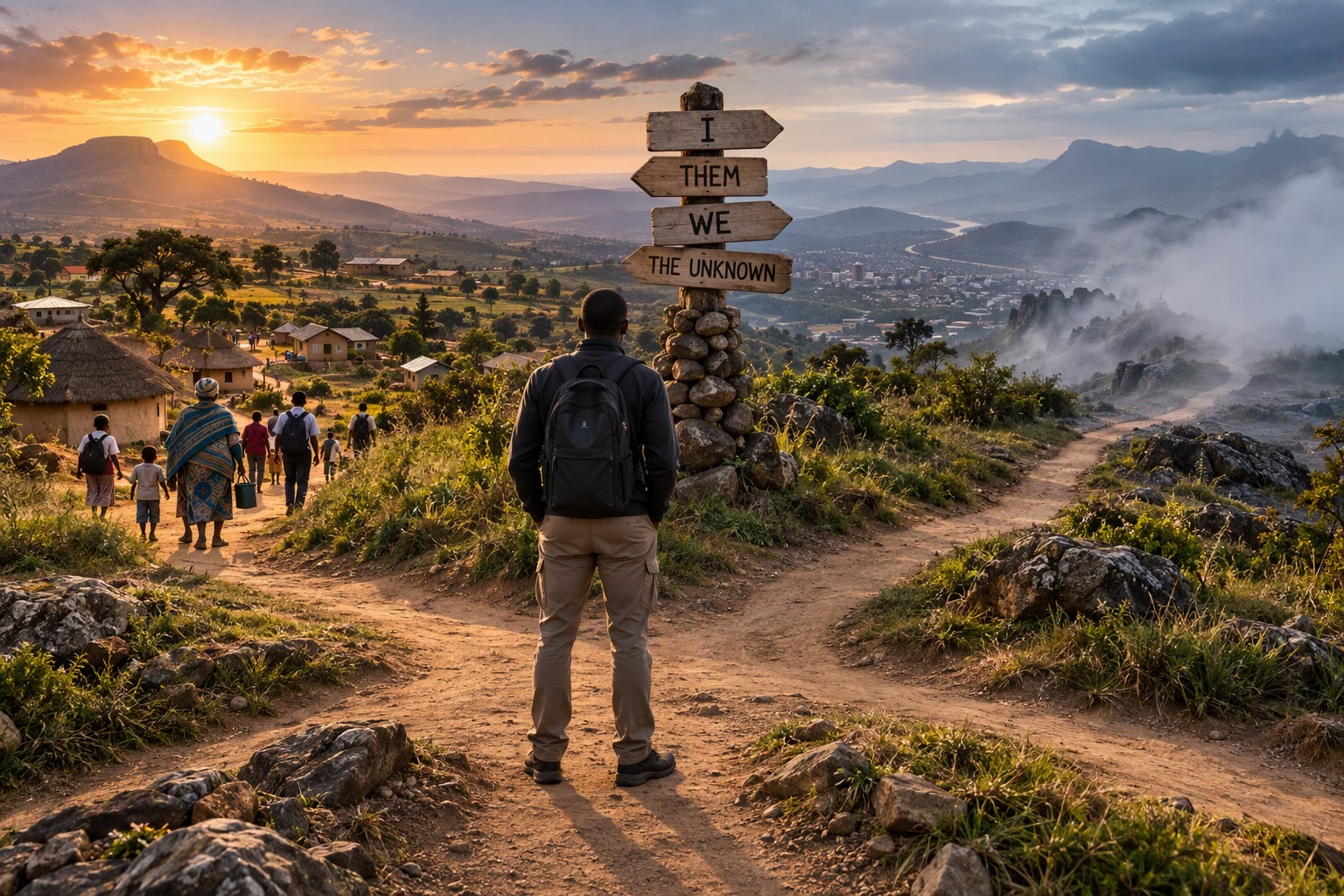
By this point in the journey, the question was no longer simply about what had happened to me.
The earlier posts had already told those stories.
The more difficult question was what I could reasonably conclude from them.
Some things seemed clear.
Others remained open to interpretation.
Perhaps one of the most important lessons from this journey has been learning not to confuse the two.
What I Know About the “I” and the “We”
The “I” mattered.
I made decisions. I studied. I worked. I applied. I followed up. I persisted. I accepted opportunities when they appeared.
At different stages, I continued even when there was no certainty about what would happen next.
But the “I” did not act alone.
There was always a “we” around it.
People provided money, accommodation, knowledge, encouragement, mentorship and opportunities. Some helped without expecting anything in return.
That makes it difficult for me to describe myself as completely self-made.
My qualifications may carry my name, but not everything that made those qualifications possible originated with me.
The “I” mattered.
So did the “we”.
Beyond that, my certainty becomes weaker.
My grandmother appeared willing to extend the “we” beyond the living, towards ancestors, blessings and perhaps spiritual intervention.
Then there were the dreams.
I know that I experienced them.
I know what I remember.
I know how other people interpreted them.
What I do not know is what ultimately caused them or what they meant.
There is a difference between saying:
I cannot prove this.
and saying:
Therefore, this is impossible.
Perhaps some things happened through ordinary human relationships and circumstances.
Perhaps there were forms of intervention I do not understand.
I cannot honestly claim either explanation merely because I prefer it.
Sometimes the most accurate answer available to me remains:
I don’t know.
But What Can I Do With What I Know?
Perhaps that uncertainty does not prevent the journey from teaching something useful.
Somebody reading this may currently be standing where I once stood.
Perhaps you know what you want, but you cannot see how you are going to get there.
Perhaps there is not enough money.
Perhaps you are studying under difficult circumstances.
Perhaps you have graduated but cannot find work.
Perhaps applications keep failing.
Perhaps somebody you expected to help you has not helped.
I cannot promise you that everything will work out.
My journey gives me no authority to make that promise.
But it does allow me to say something else.
Have a clear goal and be persistent towards it.
Persistence Is More Than Waiting
There were handwritten CVs.
There were applications.
There were follow-ups.
There were times when I kept checking our movement down a list rather than submitting something once and assuming that the rest was beyond my control.
That taught me something about the principle that has followed me throughout this journey:
Do what is within your control and let the unknown unfold.
Doing what is within your control does not mean trying once and waiting.
Sometimes it means following up.
Asking again.
Submitting another application.
Trying another route.
Knocking on another door.
Persistence does not guarantee success.
It simply means that uncertainty about the outcome should not become an excuse for abandoning what you can still do.
Question the Closed Door
My journey towards professional registration taught me another lesson.
Institutions have authority, but that does not mean every institutional decision must be accepted without question.
Ask.
Understand the requirements.
Ask for reasons.
Provide evidence.
Challenge respectfully where there are reasonable grounds.
Accept constructive criticism where it is justified, because criticism can identify what you still need to improve.
But do not confuse respecting an institution with believing that an institution can never be wrong.
A closed door may remain closed.
It may eventually open.
Or being forced away from one door may expose another route you had not previously considered.
I learned something similar when I left an internship.
At the time, leaving one opportunity could easily have looked like moving backwards.
But the journey did not end there.
Sometimes we know what happened after a closed door.
What we may never know is whether the new direction was chance, divine intervention, the consequences of ordinary events or something else.
I no longer think I need to pretend to know.
What matters practically is being prepared to respond when circumstances change.
Prepare for the Opportunity Before It Arrives
There is also a practical lesson I would give to students and graduates.
Do not prepare only for the qualification.
Prepare for what happens after it.
Your first entry-level job may be hundreds of kilometres from home.
Before receiving your first salary, you may need money for transport, accommodation, a deposit, food and other basic expenses.
Depending on the work you want to pursue, a driver’s licence may also expand the opportunities available to you.
So when you receive some money, do not think only about what it can buy today.
Sometimes ask:
What will the future I am working towards require from me before that future starts paying me?
Save when you can.
Work towards practical requirements such as a driver’s licence where they matter.
Think about how you would finance the first month of your first job.
An opportunity can finally arrive and still be difficult to take if you have made no preparation for it.
Do Not Be Too Proud
Do not become so proud of your qualifications that honest work becomes beneath you.
If you need to do odd jobs while pursuing something bigger, do them.
An honest job does not become undignified because your ambition extends beyond it.
And do not be too proud to ask for help.
Someone may say no.
Someone may genuinely be unable to help.
But pride should not make the decision before they do.
Ask when you genuinely need assistance.
At the same time, do what you can for yourself.
The “we” can assist the “I”, but the “I” still has responsibilities.
Give People Something Worth Investing In
People helped me.
That does not mean the lesson is simply to find people who can help you.
Work on yourself.
Learn.
Develop your skills.
Take your responsibilities seriously.
Remain humble and grounded.
Stay true to yourself while remaining willing to improve.
Listen to constructive criticism.
Let people see value in you.
Someone can tell you about an opportunity, but cannot prepare for the interview for you.
Someone can provide a scholarship, but cannot complete the qualification for you.
Someone can mentor you, but cannot become professionally competent on your behalf.
Someone can open a door.
The “I” still has to walk through it.
Remember Who Helped You
Progress should not make us forget the people who contributed when we needed them.
Thank them.
Some people contribute money.
Others contribute time, knowledge, accommodation, mentorship, encouragement or opportunities.
Sometimes their contribution may look small to them while changing something significant for you.
Remember it.
And when your circumstances improve, do not learn only how to receive.
Learn how to give.
Help others when you reasonably can.
Even when resources belong to you, there may be moments when it is worth comparing your own needs with the needs of others.
That does not mean neglecting yourself.
It means being willing to ask:
What do I genuinely need?
What does the other person need?
Where would these resources make the greatest difference?
And assistance does not always have to be repaid to the person who helped you.
Sometimes the better response is:
Carry it forward.
What If a Kind Heart Really Does Attract Fortune?
Perhaps a kind heart attracts divine favour.
Perhaps ancestors recognise what humans do.
Perhaps kindness creates relationships through which people become willing to help one another.
Perhaps the explanation is something else entirely.
I do not know.
But suppose the spiritual interpretation is correct.
Would it make sense to wait for blessings while neglecting the work already within your control?
What good is a scholarship if you have not prepared academically?
What good is an opportunity if you have not developed the necessary skills?
What good is an open door if you are not prepared to walk through it?
Whatever may or may not exist beyond the boundary of my control does not remove my responsibility for what lies within it.
What I Would Carry Forward
If I had to speak to the young Village Boy again, perhaps I would keep the message simple.
Have a clear goal.
Work hard and be persistent towards it.
Do what is within your control.
Follow up.
Capitalise on opportunities.
Question institutions respectfully when necessary.
Prepare financially for the future you say you want.
Save when you can.
Do not be too proud to ask for help.
Do not be too proud to do honest work.
Remain humble and grounded.
Stay true to yourself, but remain willing to learn and improve.
Accept constructive criticism where it has merit.
Thank the people who help you.
Help others when you can.
And when your opportunity comes, carry the help forward.
I still do not know everything that contributed to making me who I am.
Perhaps I never will.
But I do not need the unknown to be resolved before taking responsibility for the known.
I can decide what I work towards.
I can decide whether I prepare.
I can decide whether I remain persistent.
I can decide how I respond to criticism and setbacks.
I can decide how I treat people.
And when I eventually have something that can help another person, I can decide whether the help ends with me.
Perhaps that is enough.
Do what is within your control and let the unknown unfold.
Ndaa!
Join the conversation
Looking back at your own journey, what is one lesson you would carry forward to someone who is now standing where you once stood?
Leave a Reply