
The second dream bothered me enough that I started asking other people about it.
I particularly wanted to speak to Christians.
My reason was actually quite simple.
I wanted to know whether it was normal for people to experience dreams like this.
One of the Christians I approached was a woman from my own village, Tshivhulani. She was also a fellow GISc friend.
I knew her as someone who had been a devoted Christian from childhood, coming from a family with a similarly strong Christian background.
That was relevant to why I was interested in her perspective.
I was not approaching Christians because I had already concluded that the dream was Christian.
I was investigating my own experience.
Was this something people commonly dreamed?
Did people with a long religious background recognise the experience?
Had they experienced similar dreams themselves?
The people I spoke to did not tell me that they had experienced anything comparable.
The dream was regarded as unusual.
One interpretation I received was that I had been taken to heaven.
I could understand why somebody might arrive at that conclusion.
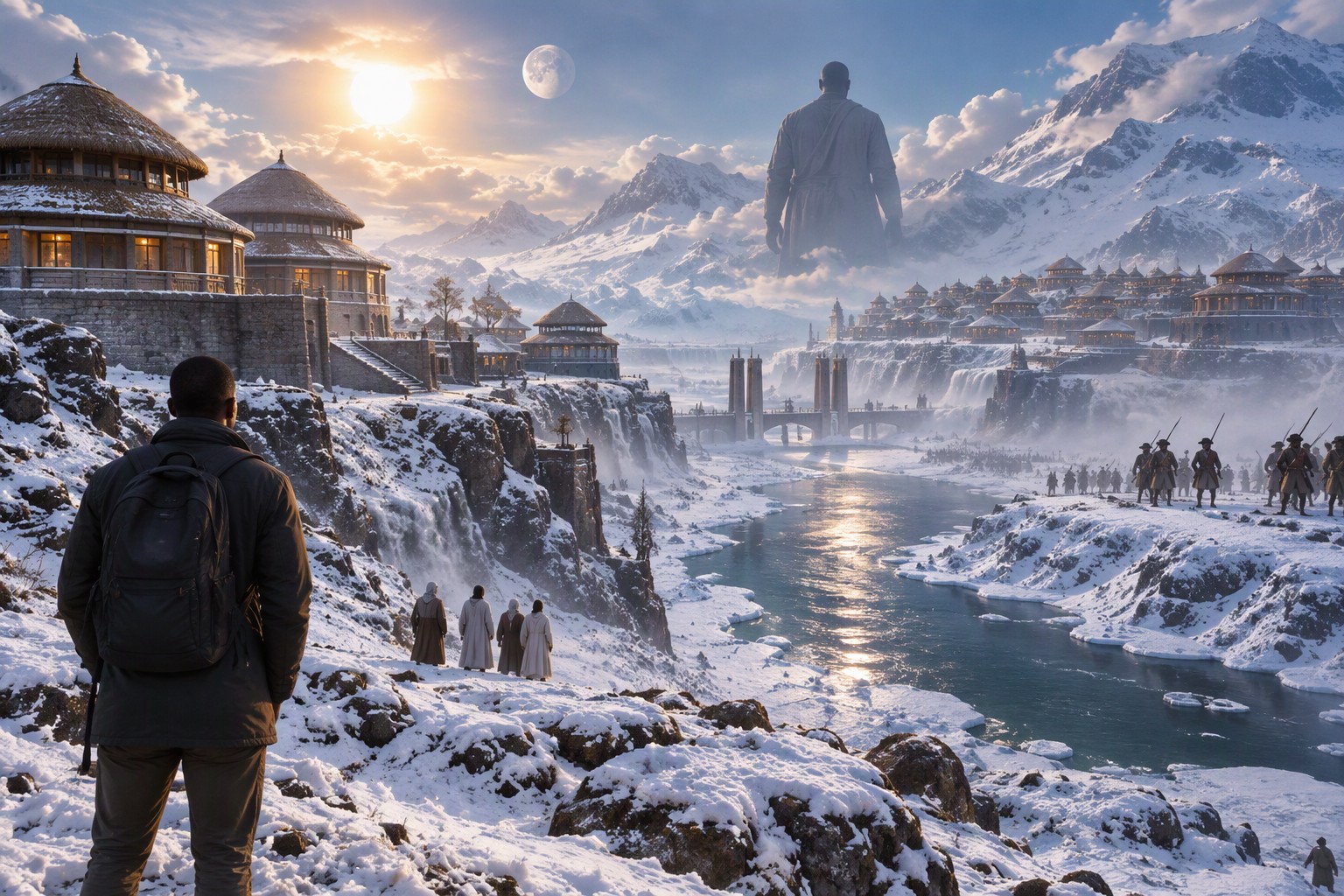
The dream contained an extraordinary realm.
There were places with apparent restrictions.
There seemed to be levels of authority.
Things responded to a force I experienced as wind.
There was light.
There was transformation.
There was a gigantic figure whose presence appeared to produce order.
But interpreting something as heaven does not establish that it was heaven.
In fact, the details make any simple interpretation difficult.
If the gigantic Black man was God, who was the man who showed me around?
If the gigantic man was not God, who was he?
Who were the four people?
Where had the three emerged from?
Why were other people apparently not allowed there?
Why was the man guiding me challenged for taking me somewhere I apparently should not have gone?
What was beyond the second restricted path?
Why were even the four people apparently unable to go there?
What were the colonies?
Why enormous double-storey houses with grass roofs?
Why a landscape covered in ice and snow but a river that remained unfrozen?
Why did the person who seemed to possess less authority apparently have responsibility for closing the doors and windows?
Why baboons and monkeys?
Why did the gigantic man’s hand return with the wind?
Why could I see the sun and moon together?
Why did people become gold?
Why did white light enter the sun?
And then the soldiers.
Who were these historical-looking men engaged in what appeared to be an endless battle with swords and rifles fitted with bayonets?
Why was I shown them?
And perhaps more importantly:
Why was I not sent to join them?
Of everything I witnessed, the instruction directed specifically at me was remarkably different.
“Go and get your people.”
And:
“Build a colony for them.”
I cannot establish what that meant.
A Christian may understand the dream through Christianity.
Someone approaching it through African spirituality may understand it differently.
Someone trained in psychology may interpret it through memory, subconscious processing, symbolism and identity.
A sceptic may regard it as an unusually elaborate dream and nothing more.
There is an interesting problem here.
Interpretation sometimes reveals as much about the interpreter as it does about the experience being interpreted.
The Christian recognises Christianity.
The African spiritualist recognises ancestors or a spiritual world.
The psychologist recognises the mind.
The sceptic recognises normal brain activity.
I have no reliable method for simply choosing whichever explanation I prefer.
And by then, the second dream was not standing alone.
The earlier posts had already recorded the first dream in detail: the description of my great-grandfather, my grandmother’s recognition of him and the message that everything would be alright.
I now had two unusual experiences, not one, and neither came with a reliable method for determining its cause.
I cannot establish a supernatural explanation for either dream.
But after the first dream, the second dream, my grandmother’s beliefs and the strange ways in which various events in my life had unfolded, simply saying “it was all meaningless” began to feel just as intellectually premature as saying “it was definitely supernatural.”
Perhaps I needed to become comfortable with something much more difficult.
I did not know.
Join the conversation
When several frameworks can explain an unusual experience differently, how do we distinguish between explanation, interpretation, and belief?
Leave a Reply