A few years before my grandmother passed away, I sat with her and reflected on my life.
By then, many things had happened.
There had been times when people assisted me.
There had also been times when the assistance I needed did not come.
There had been treatment that seemed unfair.
There had been opportunities I did not expect.
There had been education, financial struggles, internships, postgraduate studies, the PhD journey, and eventually permanent employment.
I was looking backwards at all of it.
I asked my grandmother about some of the difficult treatment I had experienced.
Her response was to ask me to look at what I had become.
Today, I am careful about what conclusion I draw from that.
I do not believe that something unjust becomes good simply because a positive consequence eventually emerges from it.
Nor can I assume that people who treated me badly were unknowingly participating in some plan for my character development.
Intentions matter.
Mistreatment remains mistreatment.
But consequences can also be complicated.
Experiences that were unfair can still influence who we eventually become.
Then I raised another question.
When I was young, my grandfather repeatedly used to tell me:
“Fhumulu uri hwii, iwe, u ḓo vho na, iwe.”
Loosely translated:
“Stop crying. You will see.”
I asked my grandmother what he had meant.
What had I seen?
Her answer stopped me.
She said:
“Ni tshi to vhona ini? Ni vhona nga ezwi zwithu zwoṱhe zwine na khou zwi ita, ni khou tou koniswa nga noṱhe naa?”
Loosely translated:
“When you look at everything you have been able to achieve and accomplish, do you think all of this is your own doing?”
I paused.
I gathered my thoughts.
Then I nodded and thanked her.
She had made me consider something that I could neither immediately accept nor reject.
At one level, her question had a straightforward answer.
I had clearly not done everything alone.
My mother had sacrificed.
My grandparents had assisted me.
Different relatives had intervened.
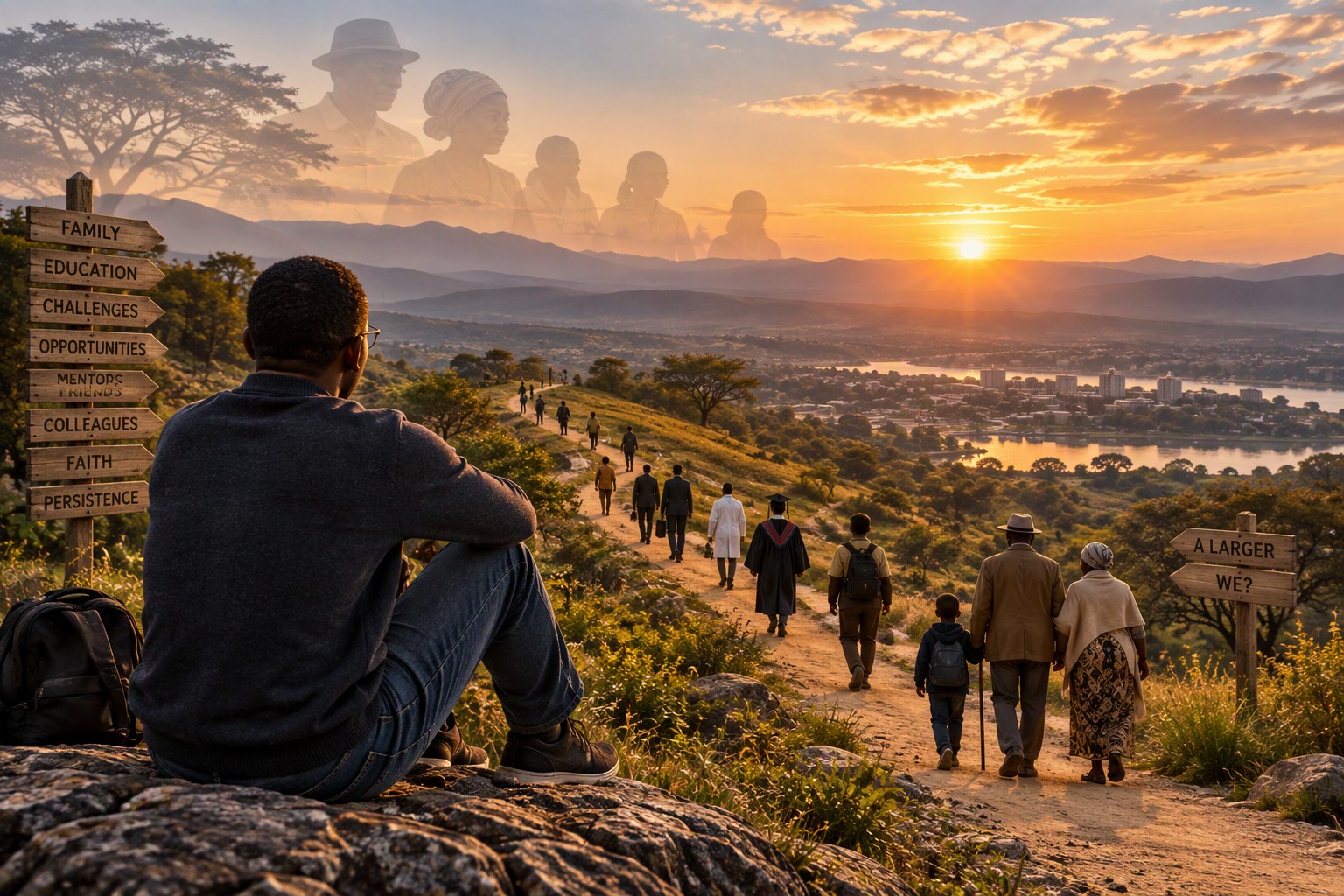
Teachers, friends and colleagues contributed.
People opened opportunities.
Some provided money.
Others provided accommodation, knowledge or encouragement.
My grandmother’s younger brother had paid a substantial debt that had caused my university results to be withheld.
There was therefore no serious basis on which I could describe myself as completely self-made.
But that was not all I understood my grandmother to be saying.
She appeared to regard my grandfather’s repeated words as blessings.
I understood her to believe that my accomplishments had the backing of my ancestors, including my grandfather.
That was different.
I could not prove it.
But neither could I prove that such a possibility was impossible.
I thanked her because she had opened my mind to precisely that difficulty.
There might be possibilities beyond my comprehension that I could neither reasonably accept as established fact nor reject simply because I did not understand them.
The earlier dream involving her father had already made her interpretation difficult for me to dismiss casually.
That dream has already been told and examined in the earlier posts.
There is no need to tell it again here.
What matters at this point is the question my grandmother had placed before me:
How far did the “we” behind my life extend?
The visible part was clear.
My mother had sacrificed.
My grandparents and relatives had assisted me.
Teachers, friends, colleagues, and institutions had contributed.
I had also made decisions, worked, and persisted.
But my grandmother appeared to believe that the visible story was not the entire story.
I could not prove that she was right.
I could not prove that she was wrong.
What I could say with certainty was much narrower:
I had not done all of it alone.
Join the conversation
When you look back at your accomplishments, who or what belongs inside the we that helped make them possible?
Leave a Reply